
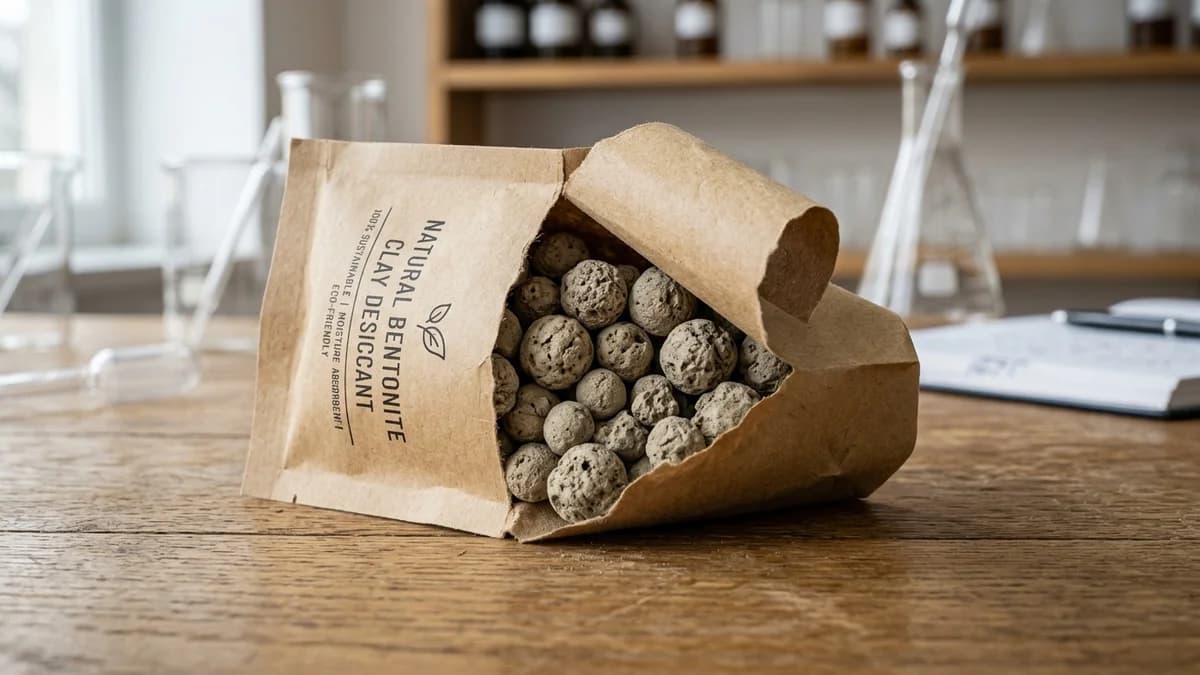
Clay desiccant is activated montmorillonite mineral, not synthetic silica
Clay desiccant (commonly known as bentonite desiccant or activated montmorillonite) is a 100% naturally occurring, non-hazardous aluminosilicate mineral (CAS 1302-78-9) mined from volcanic ash deposits. Unlike synthetic silica gel, which is manufactured through an energy-intensive reaction of sodium silicate and sulfuric acid, clay desiccant is naturally formed, washed, extruded into uniform pellets, and thermally activated. It serves as the primary eco-friendly, cost-effective moisture barrier for industrial export packaging, electronics, automotive components, machinery, and retail consumer products worldwide.
- Mineral composition: Layered hydrous aluminum silicate (montmorillonite clay, CAS 1302-78-9).
- Production footprint: Low-energy mining, natural drying, and thermal activation with zero chemical synthesizers.
- Sustainability profile: 100% naturally biodegradable, non-toxic, DMF-free, and plastic-free when wrapped in Kraft paper.
- Primary formats: Sized sachets (0.5g to 1000g) and standardized Desiccant Units (1/6 Unit to 16 Units per DIN 55473 / MIL-D-3464E).
How clay desiccant works: physical adsorption mechanism
Clay desiccant controls humidity entirely through physical adsorption - not absorption. Inside every bentonite clay granule lies an extensive micro-capillary network formed by microscopic phyllosilicate crystalline sheets. When surrounding humidity rises, water vapor molecules are drawn into the sub-microscopic interlayer spaces and held tightly by electrostatic dipole forces (Van der Waals interactions). Because the moisture is captured physically within the mineral lattice, the clay granules remain completely dry, firm, and free-flowing without turning into mud, leaking, or degrading the outer sachet.
- Layered crystalline platelets create millions of microscopic capillary channels per gram of activated clay.
- Moisture is trapped physically within the interlayer lattice without chemical liquefaction or swelling outside the sachet.
- High adsorption rate at standard industrial storage humidity (20% to 40% Relative Humidity).
- Completely non-corrosive and chemically inert; safe for direct proximity to steel, aluminum, copper, and optical glass.
Clay desiccant vs Silica Gel: adsorption performance curves and temperature limits
Understanding the performance differences between clay desiccant and silica gel is critical for packaging engineers. At low-to-moderate humidity levels (20% to 40% RH) - which represent the target environment for export shipping cartons and sealed storage - activated clay matches the moisture adsorption capacity of silica gel virtually gram-for-gram, but at 30% to 40% lower material cost. However, two distinct boundaries apply: at high humidity (above 70% RH), silica gel adsorbs significantly more water (up to 35-40% of its weight vs 25% for clay). Furthermore, clay begins releasing adsorbed moisture if ambient temperatures exceed 50°C (122°F), whereas silica gel retains its moisture up to 100°C–120°C.
- At 20% RH (25°C): Clay adsorbs ≥ 9.0% by weight (comparable to silica gel's 10-11%).
- At 40% RH (25°C): Clay adsorbs ≥ 16.5%–19.0% by weight (matching standard industrial requirements).
- At 80% RH (25°C): Silica gel adsorbs up to ~35%; clay levels off at ~25%–28%.
- Temperature ceiling: Clay is optimized for cargo below 50°C; silica gel is preferred for engine bays or high-heat storage above 55°C.
- Cost advantage: Clay desiccant offers approximately 30% to 40% procurement savings across high-volume container and carton programs.
Understanding Desiccant Units: DIN 55473 and MIL-D-3464E standard sizing
Unlike silica gel which is frequently purchased simply by gram weight (1g, 5g, 10g), industrial clay desiccant is globally governed by the 'Desiccant Unit' (DU) standard defined under German DIN 55473 and US Military Specification MIL-D-3464E. One 'Unit' of desiccant is defined as the quantity of adsorbent that will adsorb at least 6.0 grams of water vapor at 40% Relative Humidity (at 23°C ± 2°C). For high-grade activated bentonite clay, approximately 33 grams of clay equals 1 Unit. This standard allows procurement teams to calculate precise dosage based on barrier bag surface area rather than guessing bag weights.
- 1 Unit (1 U) = Adsorbs at least 6.0 grams of moisture vapor at 40% RH (DIN 55473 / MIL-D-3464E).
- Clay Unit weights: 1/6 Unit (~5.5g), 1/3 Unit (~11g), 1/2 Unit (~17g), 1 Unit (~33g), 2 Units (~66g), 4 Units (~132g), 8 Units (~265g), 16 Units (~530g).
- Standard carton rule: For sealed barrier bags, 1 Unit protects approximately 0.1 to 0.2 square meters of packaging film area under moderate transit conditions.
- DIN certification types: Type A (standard low-dust) and Type B (dust-proof for sensitive electronics and optical instruments).
Why global export brands choose FSC-certified Kraft paper clay packaging
Global regulatory pressure, particularly the European Union's Packaging and Packaging Waste Regulation (PPWR) and corporate ESG mandates, has driven major fashion, footwear, consumer electronics, and automotive brands to replace plastic Tyvek or synthetic silica gel with natural bentonite clay in FSC-certified Kraft paper sachets. When combined with FSC (Forest Stewardship Council) Chain of Custody (CoC) certified breathable paper and recycled corrugated cartons, the resulting desiccant package is 100% plastic-free, recyclable with paper waste streams, and naturally compostable.
- FSC Chain of Custody (FSC-STD-40-004): Guarantees that the Kraft paper sachet substrate originates from responsibly managed forests.
- Zero plastic footprint: Eliminates spunbond polyethylene (Tyvek) and synthetic film waste from export carton recycling.
- DMF-free guaranteed: Natural bentonite clay contains zero Dimethyl Fumarate (EU Decision 2009/251/EC compliant).
- Micro-porous dust barrier: Specially calendered Kraft paper permits rapid vapor transmission (18–32 s Gurley) while completely blocking clay particulate egress.
Application matrix: when to choose clay desiccant vs alternatives
Selecting between clay desiccant, silica gel, and calcium chloride comes down to your cargo category, destination route, temperature exposure, and sustainability criteria. Clay desiccant is the uncontested industry standard for machinery parts, automotive export crates, footwear, textiles, dry industrial hardware, and export cartons where cargo temperatures stay below 50°C. For sealed electronics and pharmaceutical bottles, silica gel or molecular sieve remains preferred. For high-volume ocean container sweat prevention, calcium chloride hanging poles or multi-chamber strips are required.
- Choose Clay Desiccant for: Export apparel, footwear, leather goods, automotive castings, machinery crates, furniture, and cost-sensitive bulk carton packing.
- Choose Silica Gel for: Pharmaceutical bottles, precision PCB packaging, high-temperature storage (>50°C), and applications needing visual indicator color change.
- Choose Calcium Chloride for: 20ft and 40ft ocean container walls to prevent 'container rain' during 30-to-60 day tropical maritime transit.
- Choose Molecular Sieve for: Extremely dry packaging (<10% RH), cryogenic gas lines, and specialized diagnostic kit vials.
Procurement specifications: what B2B buyers must specify in an RFQ
When requesting pricing for clay desiccant from an export manufacturer like DryGelWorld, specifying only 'clay desiccant' results in vague quotes. A professional procurement RFQ should explicitly define unit size (grams or DIN Desiccant Units), sachet wrapping substrate (breathable FSC Kraft paper vs non-woven), packaging atmosphere, barrier specifications, and document requirements (SDS, COA, ISO 9001:2015, and FSC Chain of Custody certificate).
- Specify fill size: Either gram weight (e.g. 2g, 5g, 10g, 25g, 50g, 100g) or DIN 55473 Units (e.g. 1/3 U, 1 U, 4 U, 16 U).
- Specify sachet material: Porous unbleached FSC-certified Kraft paper (recommended for ESG compliance) or non-woven fiber.
- Specify barrier packing: Factory hermetic master polybags inside heavy-duty corrugated export cartons to prevent pre-saturation during transit.
- Required compliance documents: Material Safety Data Sheet (SDS), Certificate of Analysis (COA), ISO 9001:2015, and FSC Chain of Custody declaration.
References
- DIN 55473 — Desiccant bags for packaging: testing and delivery specifications , Deutsches Institut für Normung (DIN)
- MIL-D-3464E — Desiccants, Activated, Bagged, Packaging Use , US Department of Defense (Defense Logistics Agency)
- FSC-STD-40-004 V3-1 — Chain of Custody Certification , Forest Stewardship Council (FSC)
- PubChem Hazardous Substances Data Bank — Bentonite (CAS 1302-78-9) , National Library of Medicine (NIH)