
Copying last shipment's quantity onto a different route
A dose sized for Karachi-Jebel Ali in winter under-protects the same cargo to Rotterdam in monsoon season. Re-estimate whenever route, season, or duration changes.
There is no universal desiccant quantity - the right dose depends on container volume, cargo, wood moisture, route, duration, packaging, and the desiccant's own capacity. This guide walks through each factor, the format choices, placement, and exactly what an export quotation needs, so the number you order is the number your cargo actually requires.
A loaded container seals in warm, humid air - at 30°C and 80% relative humidity, a 40ft box holds close to 1.5 kg of water as vapor. At sea the steel shell cools faster than the air inside it each night; when the roof drops below the dew point, that vapor condenses on the ceiling and drips back onto the cargo like rain. The cycle repeats daily, and door gaskets leak in a little more humid air every day of the voyage. The water comes from three places: the air sealed in at loading, the daily leakage, and the cargo itself - including its pallets. Wet cartons, mold, mildew, rust, and label damage discovered at destination are the usual result. The container rain prevention guide covers the mechanism in depth.
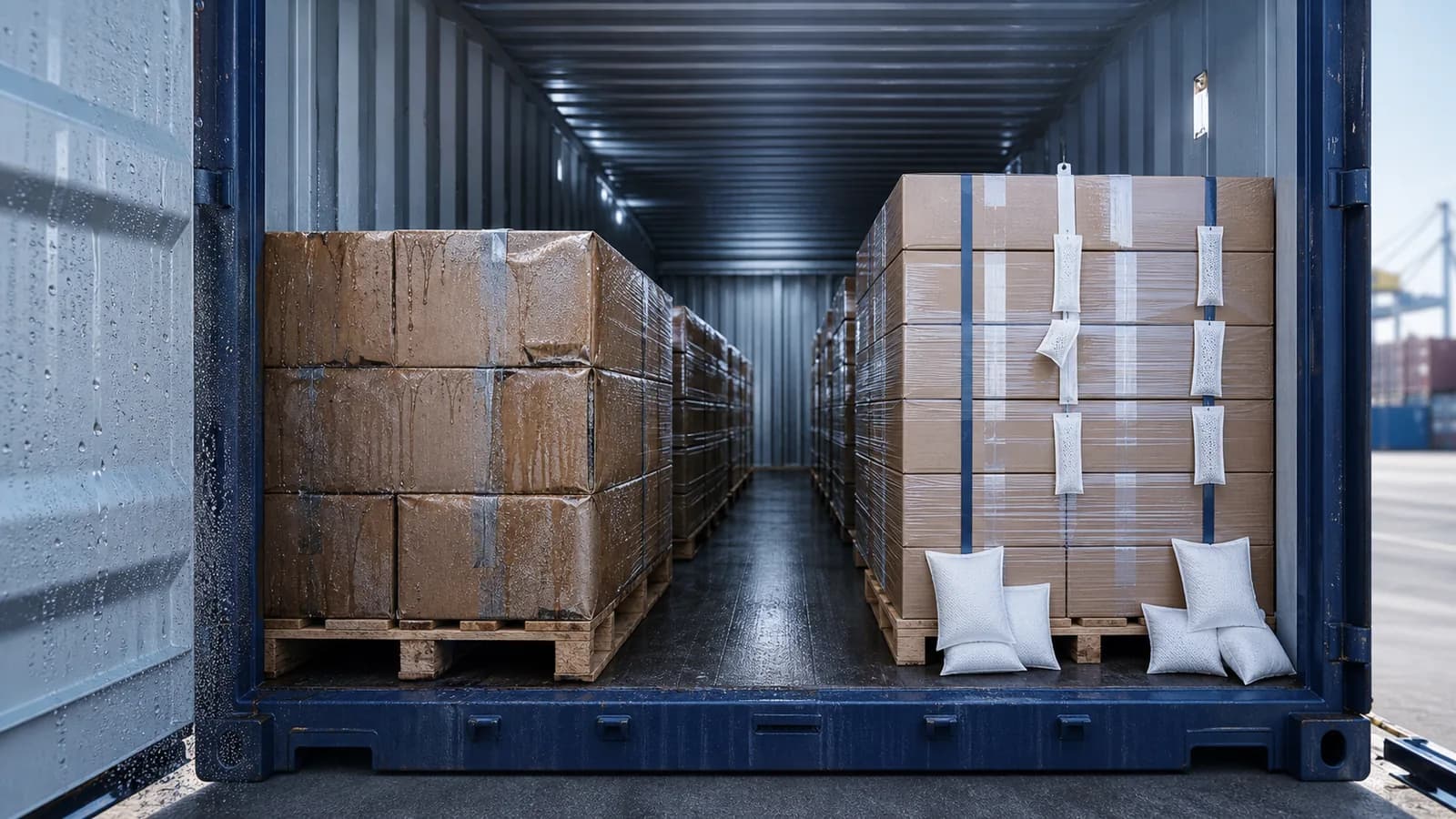
Every serious dosage estimate weighs the same inputs. If a supplier quotes you a quantity without asking about most of these, treat the number with suspicion.
| Factor | Why it changes the dose |
|---|---|
| Container volume | A 40ft high-cube holds ~76 m³ of air against ~33 m³ in a 20ft box - more than double the water vapor sealed in at loading. |
| Cargo type | Hygroscopic cargo (textiles, leather, paper, wood, food) carries and releases its own moisture as temperature cycles; metal, plastic, and glass do not. |
| Wood and pallets | Undried pallets and dunnage are the classic hidden moisture source - wood can hold well above 20% moisture content and release it into a sealed box. |
| Route climate | Tropical and cross-equator lanes load more water into the air and cycle through more condensation events than dry or temperate lanes. |
| Voyage duration | Humid air leaks through door gaskets every day at sea (~0.6% of container volume per day), so a 45-day voyage carries roughly twice the ingress of a 21-day one. |
| Packaging condition | Shrink-wrapped pallets expose less free air than loose stow; cartons sit in between. Packaging sets how much of the container's air the desiccant must dry. |
| Desiccant working capacity | Container-grade silica gel adsorbs up to one-third of its weight in water vapor; sizing at a 300 g/kg working value keeps a safety margin. |
The estimation logic is: work out the grams of water the container must control (trapped air + daily leakage + cargo and wood moisture), then divide by the desiccant's working capacity (~300 g of water per kg for container-grade silica gel) and round up. As planning bands, that lands at roughly 1.5-3 kg for a 20ft container and 3-6 kg for a 40ft - low end for short dry routes with inert cargo, high end for long tropical routes with hygroscopic cargo, and above the band when undried wood or a near-50-day voyage stacks the load. The container desiccant calculator runs this exact math from your own inputs and shows every step. For carton-level sachets, use the silica gel calculator and the packets-per-box guide. If your buyer's specification is written in DIN 55473 units, convert at ~33 g of silica gel per unit - the DIN 55473 units guide shows how.
Planning bands, not guaranteesThree formats, three different jobs - most protected shipments combine two of them.
| Format | What it is | When to use it |
|---|---|---|
| Hanging strips (1-2 kg) | High-capacity desiccant in a hangable sleeve, hooked into the container's upper lashing points. | The default for container-level protection - condensation forms at the ceiling, so the desiccant belongs above the cargo. Sized in kg per container. |
| Desiccant bags | Bulk desiccant in breathable bags placed on the floor or between pallets. | Doses above ~10 kg, part-loaded containers, or stows where nothing can hang. Often combined with strips on high-dose loads. |
| Carton-level sachets | Small silica gel packets (0.5 g - 500 g) inside individual boxes or poly bags. | An addition, not a substitute: they protect the goods inside each carton while strips handle the container air. Standard for leather, electronics, and pharma cargo. |
Strip formats and export supply are covered on the shipping container desiccant supplier page; sachet sizes and packet options are on the silica gel packets page.
A calculator estimate is the right starting point for general cargo. Ask the supplier to validate the dosage against product specifications and your actual shipment conditions when any of these apply:
Send these eight points with your enquiry and the quotation can state a confirmed dosage instead of a guess. Copy the list into your RFQ email.
A dose sized for Karachi-Jebel Ali in winter under-protects the same cargo to Rotterdam in monsoon season. Re-estimate whenever route, season, or duration changes.
The cargo was dry, the container still rained - because the air-dried pallets carried litres of water in with them. Specify verified kiln-dried wood (an ISPM 15 HT stamp alone certifies pest treatment, not dryness) or dose for the wood you actually use.
One heavy cluster by the door leaves the far end unprotected. Distribute strips evenly along the ceiling line and upper corrugations.
Sachets inside boxes cannot dry the container's free air - they saturate first and the ceiling still drips. Container air needs container-grade strips or bags.
Under-dosing fails completely once the desiccant saturates mid-voyage. Round up, and on voyages beyond ~50 days pair desiccant with sealed liners.
Every calculator - ours included - is a planning model. Final quantity must be validated against product specifications, actual cargo moisture, and shipment conditions.
No. The correct quantity depends on container volume, cargo type, wood and pallet moisture, route climate, voyage duration, packaging condition, and the desiccant's working capacity. Two 40ft containers on the same vessel can need different doses. Use a per-shipment estimate, then have the supplier confirm it at quote stage.
As a planning band - not a guarantee - DryGelWorld's published guidance runs roughly 1.5-3 kg for a 20ft container and 3-6 kg for a 40ft, with the low end for short, dry routes and inert cargo and the high end for long tropical routes and hygroscopic cargo. Undried pallet wood or voyages near the 50-day mark can push the estimate past the top of the band; when the calculator says more, order more.
Hanging strips protect the container itself from the ceiling down, where condensation forms. Bags do the same job from the floor for high doses or part loads. Carton-level sachets protect the goods inside each box and are an addition to container-level protection, not a replacement for it.
Carton-level sizing works from the carton's volume and the packet count per box rather than container air. Use the silica gel calculator for sachet sizing, and the how-many-packets-per-box guide for the arithmetic.
Whenever the cargo is high-value or moisture-critical (pharma, electronics, leather), when a buyer's specification names DIN 55473 units or a specific desiccant standard, when the voyage exceeds ~50 days, or when a previous shipment arrived with moisture damage. In those cases send the full shipment profile and have the dosage confirmed against the actual product specification before ordering.
Container type and monthly volume, cargo description, packaging and pallet detail, route and season, transit duration, any buyer specification, and the documentation you need (SDS, COA, DMF-free statement). With those eight points a quote can state a confirmed dosage rather than a guess.
Turn the estimate into a confirmed export quotation.
Run the estimate for your own container, cargo, route, and duration.
SupplyStrip formats, bag options, and export supply from Karachi.
SachetsCarton-level sachet sizes for the goods inside each box.
RFQSend the checklist above for a confirmed dosage and price - samples are free.