
What container rain actually is
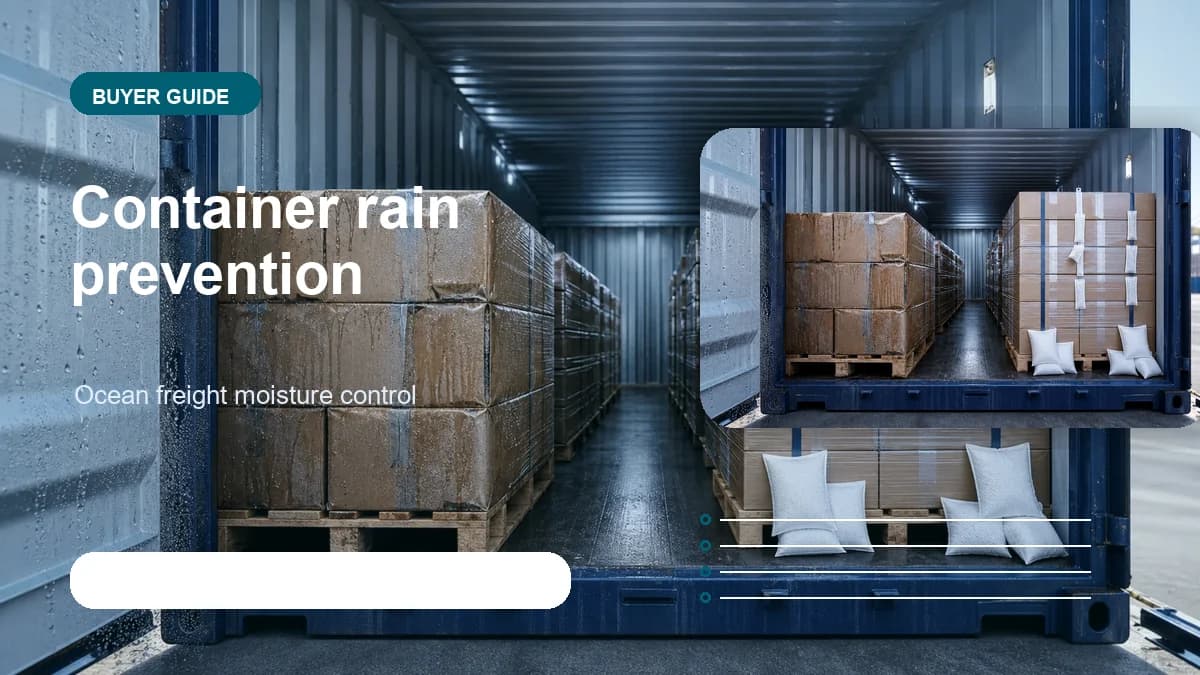
"Container rain" is the visible droplet condensation that forms on the inside of a sealed shipping container during ocean transit. It is not exotic; it is basic psychrometrics. A loaded 40-foot dry-box container holds roughly 67 cubic meters of air. At 30°C and 80% relative humidity, that air can carry close to 1.5 kg of water vapor before it has to release any of it as liquid water. The moment the container's steel ceiling drops below the dew point of the trapped air - which happens almost daily during multi-week ocean voyages - that vapor condenses on the ceiling, drips back down onto cartons, soaks through corrugated, and starts staining or rotting cargo. The temperature swing between a daytime equator transit and a night Atlantic crossing is more than enough to cycle condensation 20-30 times before the box is unloaded.
- Cargo type matters: kiln-dried timber pallets, wet cardboard, fresh paint, salt residue and even moist textile fibers all add vapor to the trapped air on top of ambient humidity.
- Container condition matters: older boxes with damaged door seals or roof pinholes leak humid sea-air in faster than fresh-trip boxes.
- Route matters most: Karachi → Hamburg (~25 days), Karachi → New York (~30 days), Karachi → Sydney (~22 days) and Karachi → Vancouver (~30 days) all cross enough climate zones to drive multiple condensation cycles per voyage.
- The damage is rarely a single 'flood event' - it is gradual saturation of corrugated, slow oxidation of unpainted metal parts, and biological growth on leather, paper, and natural fibers.
Why long-haul ocean routes are the worst case
Air freight rarely sees container rain because the journey is short and the temperature is stable in pressurized cargo holds. Truck and rail freight on land routes sees moderate exposure but the cargo is unloaded within days. Long-haul ocean is the worst case for three compounding reasons: voyage duration is measured in weeks, the steel container behaves like a thermal mass that lags the outside temperature by hours, and ocean air is salt-laden - meaning that even small condensation events bring corrosive chlorides into contact with metal cargo. By the time a 40-foot container has crossed from Karachi to a North European port, its interior has typically gone through 25-40 thermal cycles, each of which is a fresh chance for water to drop out of the air.
- Tropical-to-temperate routes (e.g. Karachi → Hamburg, Mumbai → Rotterdam) have the worst delta because the container is loaded warm-and-humid and unloaded cool-and-dry.
- Cross-equator routes (Karachi → Sydney, Karachi → Buenos Aires) cycle the dew point twice per voyage as the box crosses the ITCZ.
- Trans-Pacific routes (Karachi → Vancouver, Karachi → Long Beach) often add a Pacific-storm leg where the box swings between high humidity and cold sea air for days at a time.
- Buyer-managed FOB routing tends to be more exposed than seller-managed CIF programs because the FOB shipper has less control over the carrier's stowage choice.
The desiccant math: how much do you actually need
DryGelWorld silica gel adsorbs up to one-third of its own weight in water vapor and runs roughly 35 percent more efficient than typical clay desiccant in the same operating range. That gives an exporter a real number to design around. As a working starting point, a 40-foot container shipping moisture-sensitive cargo through a tropical-to-temperate route should plan around 4-6 kilograms of container-grade desiccant placed at the ceiling line; a 20-foot container in the same conditions starts around 2-3 kilograms. Cost-tier industrial cargo (durable goods, parts, machinery) where the moisture risk is mainly oxidation rather than mold can run at the lower end of those bands and is often a good fit for activated dry clay desiccant. Precision cargo, packaged pharma-style goods, electronics, and leather should run at the higher end with silica gel and add carton-level sachets on top of strip-level coverage.
- 20 ft container, low-risk industrial cargo, 20-day route: ~1.5-2 kg dry clay or silica gel strips.
- 20 ft container, high-risk leather/electronics, 20-day route: ~3 kg silica gel strips + carton-level sachets.
- 40 ft container, low-risk industrial cargo, 25-30 day route: ~3-4 kg dry clay or silica gel strips.
- 40 ft container, high-risk cargo, 30+ day route (Karachi → New York, Karachi → Vancouver): ~5-6 kg silica gel strips + carton-level sachets, optional VCI emitters where corrosion is the primary risk.
- Reefer and ventilated containers need their own protocol - desiccant alone does not solve refrigeration loop condensation.
Format-by-format protection plan
A modern moisture control program runs on three layers. The product layer uses small sachets - 0.5 g, 1 g, 3 g, 5 g - placed inside individual cartons or product packs to keep the immediate microenvironment dry. The carton layer uses larger sachets and bead bags - 25 g, 50 g, 100 g, 250 g, 500 g - placed inside master cartons or shipping cases to manage the carton-level air pocket. The container layer uses 1 kg to 5 kg multi-chamber strips hung along the inner ceiling and walls of the container itself, where the largest condensation events happen. Buyers running cost-tier durable goods often substitute activated dry clay at the carton and container layers; buyers running precision or regulated cargo keep silica gel across all three layers and request DMF-free product confirmation.
- Product layer: 0.5 g-5 g breathable paper sachets inside each pack or unit carton.
- Carton layer: 25 g-500 g sachets or bead bags inside master cartons; 25 kg loose bulk for re-packers.
- Container layer: 1 kg, 2 kg, 3 kg, 5 kg multi-chamber strips hung at the container ceiling and along the walls.
- Pair with surface protection - VCI paper or emitter for ferrous cargo, food-safe liners for sensitive packaging.
- Avoid loading desiccant in direct contact with damp cargo - let the air around the cargo do the work.
Pre-dispatch loading workflow that prevents claims
Most container rain claims that go to insurance arbitration fail not because the desiccant was wrong, but because the loading workflow was undocumented. A claim-defensible workflow looks the same every time and produces the same paper trail: pre-load humidity check on cargo, pallet inspection (kiln-dried, free of bark and moisture), liner placement, sachet placement at the carton level (recorded by carton count and sachet weight), strip placement at the container level (recorded by hanging position and strip weight), seal, and a dated photo log. The cost of building this workflow once is small; the cost of losing a single high-value container claim because no one can prove what went into the box is substantial. Buyers running recurring programs should standardize the workflow once and require the supplier to follow it on every shipment.
- Step 1: humidity-check cargo before loading. Reject anything above the agreed threshold (commonly 12-14% moisture content for woven goods).
- Step 2: inspect pallets. Use kiln-dried wood or plastic pallets; reject anything visibly damp, mossy, or split.
- Step 3: place liner if required by buyer (food-safe, VCI, or food-contact film).
- Step 4: place carton-level sachets and record by carton count.
- Step 5: place container-level strips at ceiling line and record hanging positions plus total kg.
- Step 6: seal container and take a dated photo log: cargo, sachets, strips, seal number.
- Step 7: dispatch with a packing list that includes desiccant format, total quantity, and placement.
Documentation that defends an insurance claim
When container rain damage triggers an insurance claim, the carrier and the underwriter both look for evidence that moisture mitigation was attempted and that the damage was outside the shipper's control. A solid evidence pack includes: an SDS for the desiccant used (so the underwriter can confirm it was the appropriate product), a COA that ties the desiccant batch to the shipment, an ISO 9001:2015 quality reference for the manufacturer, photos of the loading workflow, and a packing list that names the desiccant format and quantity. DryGelWorld supports this documentation set on request. What the documentation cannot do is rescue a shipment where the desiccant was visibly absent or under-spec - that is why the loading workflow above matters before the dispatch, not after.
- SDS (Safety Data Sheet) - proves the desiccant is non-toxic, non-flammable, and DMF-free.
- COA (Certificate of Analysis) - ties batch quality to the shipment.
- ISO 9001:2015 quality reference - anchors the manufacturer's process credibility.
- Loading photo log - captures placement, quantity, seal, and date.
- Packing list with desiccant detail - quantifies what went into the box.
- Voyage temperature/humidity data from the carrier (where available) - shows the conditions the cargo was exposed to.
When desiccant alone is not enough
Desiccant is the right tool for moisture in still air. It is not the right tool for refrigeration loop condensation, hull leaks, salt-spray contamination, packaging that is wet at loading, or shipments where the cargo itself is the moisture source (kiln-fresh timber, undried agricultural product). For those cases the program needs ventilation control, source elimination, or a sealed liner - and desiccant becomes a supplementary layer rather than the primary defense. Equally, very long voyages (Karachi → South America, Karachi → some Pacific island routes) can outrun the working capacity of any practical kg of desiccant; on those routes the pragmatic move is to combine desiccant with route insurance and explicit cargo-handover documentation.
- Reefer or ventilated containers - refrigeration loop condensation needs different mitigation.
- Hull damage or seal failure - desiccant cannot keep up with active water ingress; address the seal.
- Wet cargo at loading - fix the source; do not rely on desiccant to dry damp goods in a sealed box.
- Voyages beyond ~50 days - combine desiccant with insurance and sealed liners; reassess kg-per-container.
- Ferrous corrosion risk - pair silica gel with VCI paper or emitter for surface protection.
References
- IMO/ILO/UNECE Code of Practice for Packing of Cargo Transport Units (CTU Code) , International Maritime Organization
- Cargo Ventilation and Precautions to Minimise Sweat , West of England P&I Club
- Don't work up a sweat! (cargo sweat and ship's sweat) , Gard
- Cargo Incident Notification System (CINS) , CINS
- Dew Point vs Humidity , NOAA National Weather Service
- Container Desiccant Calculator | kg per 20ft & 40ft , DryGelWorld