
What a 'desiccant unit' actually is
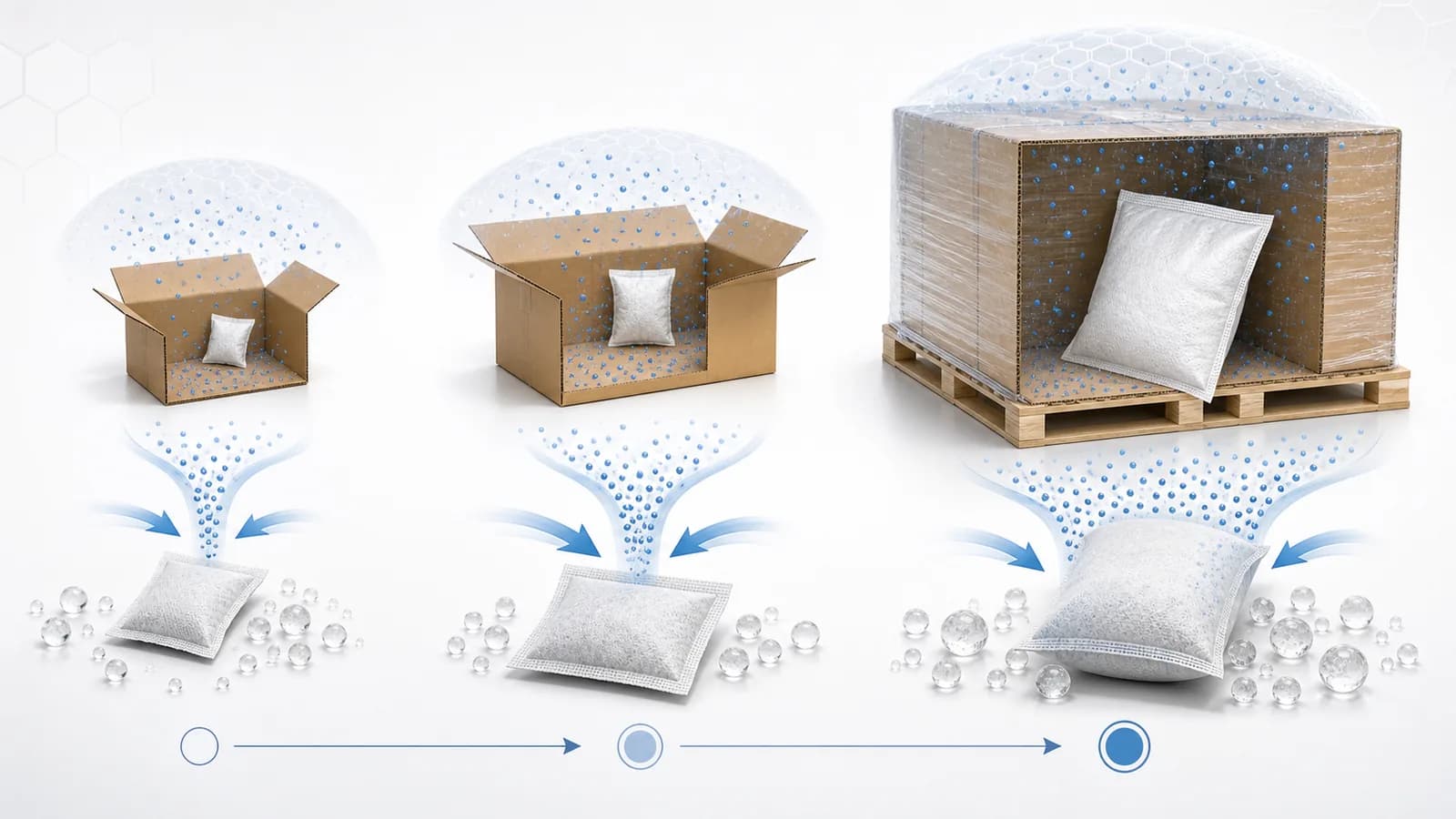
Buyers often see desiccant specified in 'units' rather than grams, especially in European and military-derived specifications. The desiccant unit is defined by the German standard DIN 55473 (and echoed in older MIL-D-3464 practice): one unit of desiccant is the quantity that, under defined test conditions, adsorbs a specified amount of water vapor - roughly 6 grams of water at 20% RH and about 6.6 grams at higher reference conditions. In practical silica gel terms, one DIN unit corresponds to approximately 33-34 grams of silica gel, because silica gel holds about 20% of its weight at the lower reference RH. Units exist so that desiccants of different materials can be compared on capacity rather than raw weight.
- Unit sizing comes from DIN 55473 (and legacy MIL-D-3464).
- 1 unit = quantity adsorbing a defined water amount (~6 g at 20% RH reference).
- 1 DIN unit ≈ 33-34 g of silica gel in practice.
- Units compare desiccants by capacity, not by raw weight.
Why specs use units instead of grams
Units decouple the specification from the material. A purchasing spec that says '20 units per container' will be satisfied by the right quantity of silica gel, clay, or another adsorbent - each material needs a different gram weight to deliver one unit, but the protection is equivalent. This matters for buyers who second-source or mix materials: the unit is the protection currency. It also makes military and aerospace specs portable across suppliers. The catch is that a cheap supplier can quote 'units' loosely; a unit is only meaningful if it is the DIN/MIL-defined unit measured under the standard's conditions, so ask whether quoted units are DIN 55473 units or a marketing approximation.
- A unit is material-independent - the 'currency' of moisture protection.
- Different materials need different gram weights to equal one unit.
- Lets buyers second-source or mix materials on equal protection.
- Confirm quoted units are true DIN 55473 units, not a loose approximation.
Converting units to silica gel grams and sachets
For silica gel, the working conversion is: 1 unit ≈ 33 g. So a spec calling for 1/6 unit ≈ 5.5 g, 1/3 unit ≈ 11 g, 1/2 unit ≈ 16.5 g, 1 unit ≈ 33 g, 2 units ≈ 66 g, 10 units ≈ 330 g. DryGelWorld's sachet ladder (0.5 g up to 500 g) maps onto this cleanly: a 5 g sachet ≈ 1/6 unit, a 25-33 g sachet ≈ ~1 unit, a 250 g bag ≈ ~7.5 units. When a buyer hands over a unit-based spec, convert to grams using the ~33 g/unit factor, then pick the nearest standard sachet size at or above the requirement. Always round up - under-rounding a unit spec means under-protecting the cargo.
- Working factor: 1 unit ≈ 33 g of silica gel.
- 1/6 unit ≈ 5.5 g · 1/3 ≈ 11 g · 1/2 ≈ 16.5 g · 1 unit ≈ 33 g.
- 5 g sachet ≈ 1/6 unit; 25-33 g ≈ ~1 unit; 250 g bag ≈ ~7.5 units.
- Convert the spec to grams, then pick the nearest sachet at or above it.
- Always round up - rounding down under-protects.
Unit sizing for containers and large packaging
Container and large-case specs are frequently written in units. A common reference point: a typical 20ft container loading might be specified at 16-24 units and a 40ft at 24-40 units for general cargo on a moderate route, scaling up for long tropical voyages - but the authoritative number always comes from the cargo's moisture load and route, not a rule of thumb. Translate the unit requirement into silica gel or clay strips: at ~33 g/unit, 24 units ≈ 0.8 kg of active desiccant, usually delivered as multiple 1 kg strips for distribution and hanging. The DryGelWorld container dosage calculator works in grams/strips; if your buyer specs units, convert first, then size the strip count.
- Container/case specs are often written in units.
- Reference only: ~16-24 units (20ft), ~24-40 units (40ft) general cargo, moderate route.
- Authoritative number comes from cargo moisture load + route, not a rule of thumb.
- Convert units → grams (~33 g/unit) → strip count for hanging distribution.
- Use the container dosage calculator after converting units to grams.
Common unit-sizing mistakes
Three mistakes recur. First, treating a 'unit' as if it were a gram - a 20-unit spec is ~660 g of silica gel, not 20 g; misreading this under-doses by 30×. Second, assuming all materials give the same grams per unit - clay needs more grams per unit than silica gel because its capacity is lower, so a unit spec filled with clay weighs more. Third, accepting 'units' from a supplier without confirming they are DIN 55473 units; an undefined unit is a marketing number. When in doubt, ask for the spec in both units and grams and confirm the test standard, so the protection you pay for is the protection you get.
- Mistake: reading units as grams (a 20-unit spec is ~660 g, not 20 g).
- Mistake: assuming clay and silica gel give the same grams per unit (clay needs more).
- Mistake: accepting undefined 'units' - confirm they are DIN 55473 units.
- Ask for the spec in both units and grams plus the test standard.
References
- DIN 55473:2021-07, Auxiliary means of packaging: desiccant in bag , DIN Media (German Institute for Standardization)
- MIL-D-3464 desiccant specification (ASSIST Quick Search) , U.S. Defense Logistics Agency