
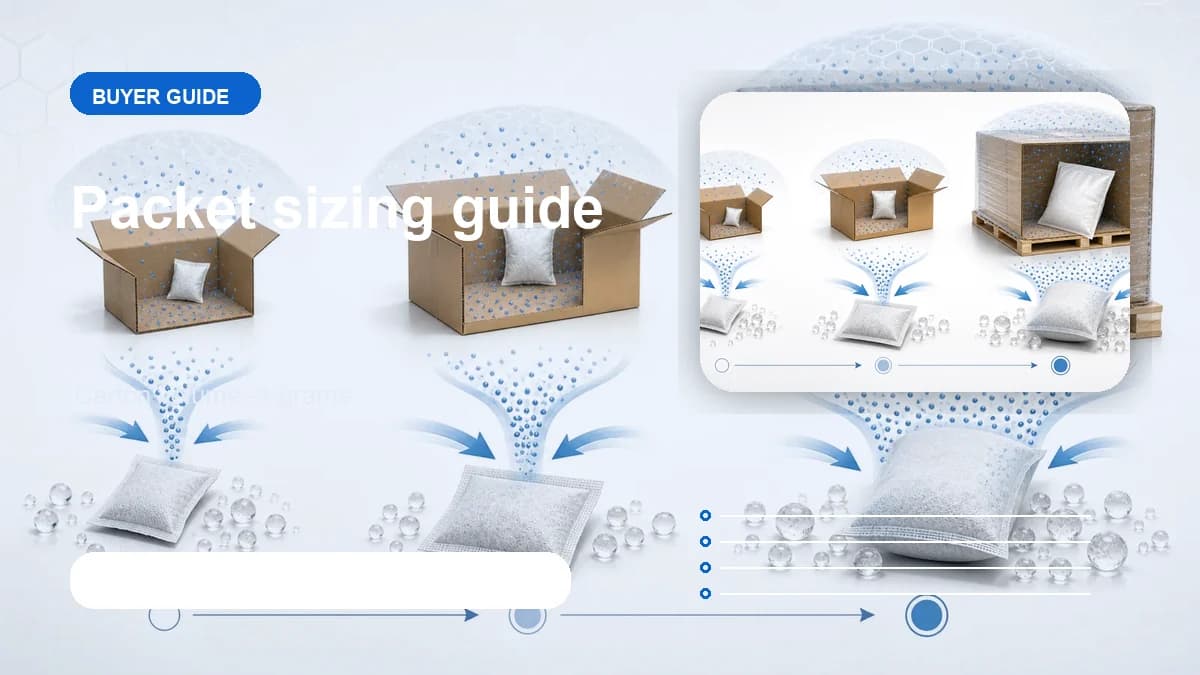
Packet sizing is math, not habit
Pick the packet size from the sealed air volume and the moisture in it, not from what looks right on the product. The maths is short: DryGelWorld silica gel adsorbs up to one-third (33%) of its own weight in water vapour, so the packet has to carry at least three times the water you expect it to hold. A sealed carton of internal volume V (in cubic meters) at average export humidity holds approximately V × 20 grams of water vapor. To control that, you need silica gel weighing at least 3× the vapor mass (i.e., V × 60 grams). Adjust upward for high-humidity destinations, long voyages, and weak packaging barriers; adjust downward for short routes and tight packaging. Once you have the calculation, sizing becomes mechanical.
- Silica gel adsorbs ~33% of its weight in water vapor.
- Sealed carton vapor load: ~V × 20g where V is carton volume in cubic meters.
- Minimum silica gel: 3× vapor load → V × 60g.
- Adjust for route, voyage length, and packaging quality.
Sachet size cheat sheet by carton volume
For practical B2B sizing, here's the working table by carton volume. Small unit pack (0.001-0.01 m³, e.g. consumer electronics box): 0.5g-1g sachet. Standard product carton (0.01-0.05 m³, e.g. small retail box): 2g-5g sachet. Medium product carton (0.05-0.1 m³, e.g. typical export carton): 5g-10g sachet. Master carton (0.1-0.5 m³): 25g-50g sachet. Large export carton (0.5-1 m³): 50g-100g sachet. Pallet-level supplementary protection: 250g-500g bag at pallet base. Container ceiling: 1kg-5kg multi-chamber cargo strips, 4-6 strips per 40ft container on long-haul routes.
- Small unit pack (0.001-0.01 m³): 0.5g-1g sachet.
- Standard product carton (0.01-0.05 m³): 2g-5g sachet.
- Medium product carton (0.05-0.1 m³): 5g-10g sachet.
- Master carton (0.1-0.5 m³): 25g-50g sachet.
- Large export carton (0.5-1 m³): 50g-100g sachet.
- Pallet level: 250g-500g supplementary bag.
- Container ceiling: 1kg-5kg strips, 4-6 per 40ft container.
Route adjustments - when to size up
The base sizing math assumes standard conditions. Real-world routes deviate. Tropical-to-temperate long-haul (Karachi → Hamburg, ~25 days): increase sizing 50-100% over base. Trans-Pacific (Karachi → Vancouver, ~30 days with storm cycling): increase 75-100%. Cross-equator (Karachi → Sydney, ITCZ crossings): increase 50%. Intra-region short routes (Karachi → Jebel Ali, ~7 days): use base sizing or even reduce 20-30%. Multi-month warehouse storage at destination before final use: increase 30-50%. Buyers running long-haul export programs to Europe or the US almost always need larger sachets than the base table suggests.
- Tropical-to-temperate long-haul (~25 days): +50-100% over base.
- Trans-Pacific (~30 days with storm cycling): +75-100%.
- Cross-equator with ITCZ: +50%.
- Intra-region short routes (~7 days): base sizing or -20-30%.
- Multi-month destination storage: +30-50%.
Product sensitivity - what cargo actually needs
Different cargo types have different moisture tolerance, which changes sizing. Precision electronics (PCBs, MSL 2-3 components): high sensitivity - size at upper end of base table, plus container-level strips. Leather and footwear (mold-sensitive): high sensitivity, especially on long-haul routes. Pharma packaging (regulated): size against the product's documented stability range, not just the carton volume. Cost-tier industrial durable goods (machinery parts): mild oxidation risk - base sizing or slightly below. Food packaging (food-grade context): base sizing; food-grade compliance is a separate documentation question. Match the sizing aggression to cargo damage cost - high-value cargo deserves over-sizing, low-value durable goods don't.
- Precision electronics: upper-end base sizing + container strips.
- Leather/footwear (mold-sensitive): upper-end on long-haul routes.
- Pharma packaging: size against stability spec, not just carton volume.
- Cost-tier industrial: base sizing or slightly below.
- Match sizing aggression to cargo damage cost.
Format matters as much as weight
Picking the right sachet weight is half the decision; picking the right format is the other half. Breathable paper sachets (DryGelWorld default) work for most B2B applications - clean low-dust packaging, good print surface, B2B-appropriate cost. Woven or non-woven bead bags for larger formats (25g+). Multi-chamber cargo strips for container-ceiling placement (1kg-5kg). Tyvek format for cleanroom-grade pharma (on the expansion roadmap; not yet in DryGelWorld catalog). For pharma bottle inserts specifically, look at the pharmacopoeia-compliant insert pattern for your destination market - the format and material requirements vary.
- Breathable paper sachets: B2B default, 0.5g-10g range.
- Woven / non-woven bead bags: 25g+ formats.
- Multi-chamber cargo strips: 1kg-5kg container ceiling.
- Tyvek: cleanroom-grade pharma; expansion roadmap, not yet in catalog.
- Pharma bottle inserts: per-market pharmacopoeia compliance separately.
Common sizing mistakes
Three sizing mistakes recur in B2B procurement. First: using small unit-pack sachets in master cartons because they're cheaper per unit - the math doesn't work, you'd need 10+ small sachets to equal one properly-sized 25g. Second: using container strips alone without carton-level sachets - strips manage container-air humidity but don't protect cargo inside each carton from micro-environment moisture. Third: ignoring route adjustments because 'the supplier said 5g works' - supplier defaults are conservative for standard short routes, not for tropical-to-temperate long-haul. Avoid all three by doing the sizing math explicitly per shipment, not by inheriting it from the previous shipment.
- Mistake: small sachets in master cartons (10× more cost-effective to use 1 properly-sized).
- Mistake: container strips without carton-level sachets (strips don't protect cargo INSIDE boxes).
- Mistake: ignoring route adjustments ('supplier said 5g works').
- Avoid by doing sizing math per shipment.
Pre-shipment validation - sample test before bulk commit
For serious procurement programs, validate sizing before locking MOQ. Order samples in the calculated size range, run a 14-30 day humidity test against representative packaging, and measure either the indicating-silica-gel color change or the carton humidity directly. If the sample sachet saturates before voyage simulation completes, size up; if it stays fresh-orange/blue at end of test, you might be over-sized and can reduce by 20-30% on the next order. This validation step adds 2-4 weeks to procurement timeline but pays back massively on long-haul export programs.
- Order samples in the calculated sizing range.
- Run 14-30 day humidity test against representative packaging.
- Measure indicating color change OR carton humidity directly.
- Saturation before test ends → size up.
- Fresh at end of test → potentially over-sized; reduce 20-30% next order.
- 2-4 weeks added timeline; massive payback on long-haul programs.
References
- DIN 55474:2015-03 — Auxiliary means of packaging - Desiccants in bag - Application, calculation of the required number of desiccant units , DIN Media (German Institute for Standardization)
- Silica Gel Calculator | How Much Desiccant Do You Need? , DryGelWorld
- Dew Point vs Humidity , NOAA National Weather Service
- Test Procedures , International Safe Transit Association (ISTA)
- Silica (silicon dioxide, SiO2) — compound summary, CID 24261 , National Institutes of Health (PubChem)