
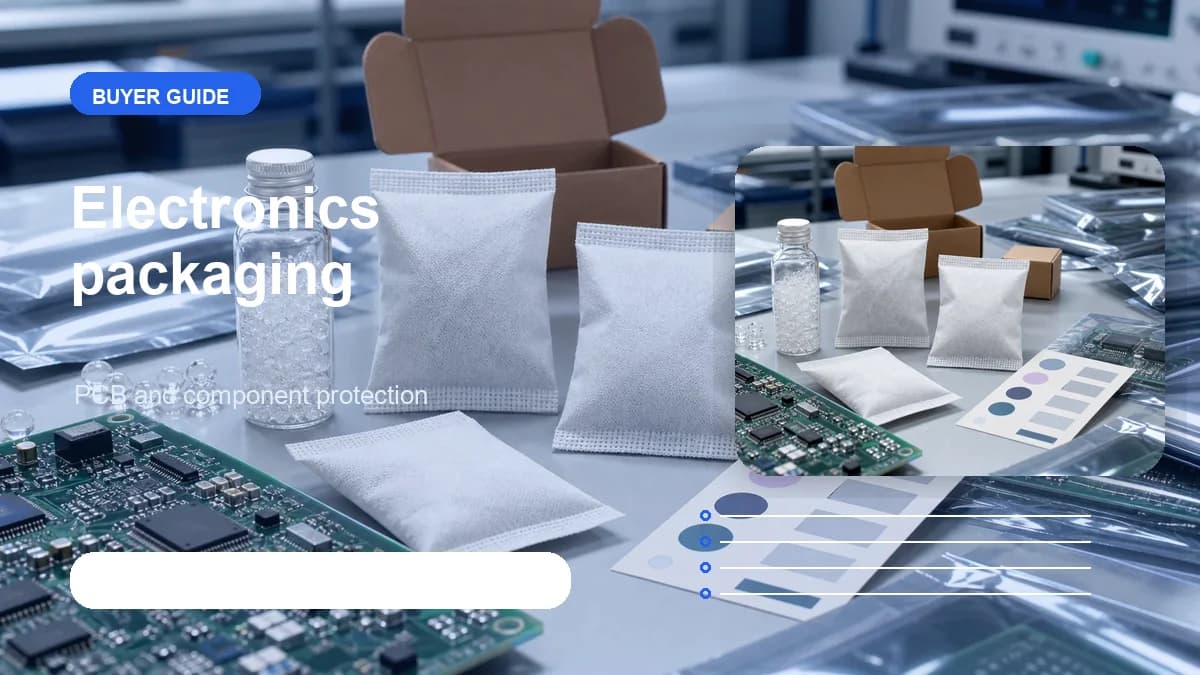
Why electronics need stricter moisture control than most cargo
Electronics packaging is the use case where small moisture amounts produce expensive damage. A 1% humidity excess inside a PCB carton can drive solder-joint oxidation, capacitor degradation, contact resistance creep, and dendrite growth - all of which fail far above the threshold the buyer paid the supplier to deliver. For high-volume export programs (consumer electronics, IoT modules, accessories, batteries) the desiccant cost is fractional compared to the unit value, yet it's the line item most often under-specced. Treat electronics-grade desiccant as fixed insurance overhead, not as variable cost to negotiate down.
- PCBs and assembled modules absorb ambient moisture during storage and reflow it during transit thermal cycles - visible damage shows up at destination, not at packing.
- Capacitor and connector materials are particularly humidity-sensitive - corrosion can be invisible to QC at packing.
- Battery packaging adds an additional safety angle: moisture exposure of lithium-ion cells can drive thermal events on long-haul cargo.
- Damage doesn't always show at unboxing - it shows as elevated field-failure rates 6-18 months later, by which point the supplier relationship is harder to defend.
The MSL framework: moisture sensitivity levels
Industrial electronics buyers often reference Moisture Sensitivity Level (MSL) classifications under IPC/JEDEC J-STD-033. The standard defines 8 levels (MSL 1 through 6) based on how long a component can stay exposed to ambient conditions before it needs reflow bake-out. Buyers building reflow-soldering production lines need desiccant programs that keep packaging humidity inside MSL-appropriate windows. DryGelWorld supplies the silica gel that goes inside the moisture barrier bag - but JEDEC J-STD-033 compliance is a customer-driven framework, not a held credential. Buyers requiring JEDEC-stamped packaging programs should align documentation and audit expectations against their compliance team before commercial terms.
- MSL 1: unlimited floor life at <30°C and <85% RH (most permissive).
- MSL 2 - MSL 2a: ~1 year to 4 weeks floor life depending on humidity.
- MSL 3: ~168 hours floor life - common for SMT components.
- MSL 4: ~72 hours.
- MSL 5 / 5a / 6: progressively stricter - used for sensitive packages and large BGAs.
- JEDEC J-STD-033 compliance must be confirmed by the buyer's team. DryGelWorld supplies silica gel, SDS, COA, and ISO 9001:2015 reference; formal JEDEC alignment must be confirmed against the buyer's compliance program.
Sachet sizing math for electronics packs
Electronics packs are typically smaller and denser than general cargo, which changes the desiccant math. A small antistatic bag holding a single PCB has internal air volume around 50-150 ml - a single 0.5g or 1g sachet is sufficient. A larger assembled-module box (1-5 liter internal volume) typically uses 2g-5g sachets. Master cartons holding multiple boxed units justify 10g-25g sachets at the carton air-volume level. The DryGelWorld silica gel adsorbs ~33% of its own weight, so a 1g sachet has working capacity for ~0.33g of water - sized correctly for a single small PCB pack on a 30-day voyage.
- PCB antistatic bag (50-150 ml): 0.5g-1g sachet.
- Assembled module box (1-5 liter): 2g-5g sachet.
- Multi-pack carton (5-30 liter): 10g-25g sachet.
- Master carton (30+ liter): 25g-50g sachet or larger bag.
- Pallet-level supplementary: 100g-250g bag at pallet base for high-value programs.
- Increase by ~50% for tropical-to-temperate routes and high-volume reflow lines requiring strict MSL bake-out windows.
ESD bag integration: where the sachet goes
The placement question matters more for electronics than for any other cargo type. The sachet should sit inside the moisture barrier bag (MBB) or antistatic shielding bag - between the product and the bag wall, never sealed in plastic that blocks vapor exchange. For static-sensitive components, the sachet itself should be packaged in non-shedding paper that won't contaminate the cleanroom-grade assembly. For combined product-plus-component packs, a small unit-level sachet plus a master carton sachet gives the layered protection JEDEC-style programs expect. Avoid placing sachets directly against any component that generates heat during shipping - the warm-zone moisture exchange isn't where the desiccant should be working.
- Inside the moisture barrier bag (MBB): the standard placement for MSL 2-6 components.
- Antistatic / shielding bag: 0.5g-2g sachet for single-component packs.
- Outer carton: 10g-25g sachet inside the master carton, away from the moisture barrier bag.
- Pallet level: 100g-250g bag for high-value programs.
- Materials note: use low-dust breathable paper sachets - Tyvek is preferred for cleanroom-grade programs; DryGelWorld currently supplies breathable paper sachets, with Tyvek format on the expansion roadmap.
Long-haul electronics shipping considerations
For Karachi-to-export electronics shipments, route timing and humidity profile drive the desiccant program. Karachi-to-Hamburg (~25 days) means 25-40 thermal cycles inside the container; Karachi-to-Vancouver (~30 days) crosses Pacific storm cycles; Karachi-to-Sydney crosses the ITCZ. For high-value electronics on tropical-to-temperate routes, the right program combines: unit-level sachets in each pack, carton-level sachets in each master carton, and 1kg-5kg container strips at the container ceiling for condensation control. Buyers should also consider VCI (volatile corrosion inhibitor) paper for cargo with exposed metal contacts - VCI complements desiccant rather than replacing it.
- Tropical-to-temperate routes (Karachi → Hamburg / NYC): full tiered program - unit + carton + container.
- Trans-Pacific (Karachi → Vancouver / LA): same tier; consider supplementary VCI for connector-heavy cargo.
- Intra-region (Karachi → UAE / Saudi): short routes need carton-level desiccant; container strips optional based on cargo value.
- Battery shipments: confirm IATA / IMDG class requirements; desiccant program does not change battery hazard classification.
Documentation electronics buyers actually require
Industrial electronics procurement teams typically require more documentation than other cargo categories. A standard ask includes ISO 9001:2015 quality reference, SDS for the desiccant, COA tied to the shipment batch, DMF-free product statement, and, for large customers, batch traceability records. DryGelWorld supplies all five on request. DryGelWorld does not currently supply formal JEDEC J-STD-033 compliance certification, MIL-D-3464 stamped product, or RoHS-specific audit. Those frameworks must be aligned against the customer's compliance program before commercial terms. Buyers should send their full compliance requirement list at RFQ stage so the document set can be confirmed before sample dispatch.
- ISO 9001:2015 quality reference - anchor manufacturer credibility.
- SDS - non-toxic, non-flammable, DMF-free product confirmation.
- COA - batch quality tied to shipment date.
- Batch traceability - available for high-volume programs on request.
- JEDEC J-STD-033, MIL-D-3464, RoHS audit - not credentials currently held by DryGelWorld.
Cost reality: electronics is where the desiccant ROI is highest
Electronics is the use case where the desiccant-to-cargo-value ratio is most favorable. A USD 50 PCB with a USD 0.02 sachet costs 0.04% of cargo value in desiccant. A claim for moisture-damaged PCBs typically runs 100-500% of cargo value once you count warranty, replacement logistics, and customer-relationship damage. The prevention-to-damage ratio for electronics is roughly 1:2500 in extreme cases. Under-spending on desiccant for electronics cargo is the single most common procurement mistake in this category.
- Typical desiccant cost: 0.01-0.1% of electronics cargo value.
- Typical moisture damage claim: 100-500% of original cargo value (counting warranty + replacement + reputational damage).
- Prevention-to-damage ratio: 1:1000 to 1:2500 for high-value electronics.
- Cheapest desiccant program is almost never the most cost-effective for electronics shipments.
References
- IPC/JEDEC J-STD-033D — Handling, Packing, Shipping and Use of Moisture, Reflow, and Process Sensitive Devices (table of contents) , IPC (Global Electronics Association) / JEDEC
- IPC/JEDEC J-STD-020F — Moisture/Reflow Sensitivity Classification for Non-Hermetic Surface Mount Devices (table of contents) , IPC (Global Electronics Association) / JEDEC
- Directive 2011/65/EU (RoHS 2) — restriction of hazardous substances in electrical and electronic equipment , EUR-Lex, Publications Office of the European Union
- MIL-D-3464 — Desiccants, activated, bagged, packaging use (ASSIST Quick Search) , U.S. Defense Logistics Agency
- Silica (silicon dioxide, SiO2) — compound summary, CID 24261 , National Institutes of Health (PubChem)
- DIN 55473:2021-07 — Auxiliary means of packaging - Desiccant in bag - Technical delivery conditions , DIN Media (German Institute for Standardization)