
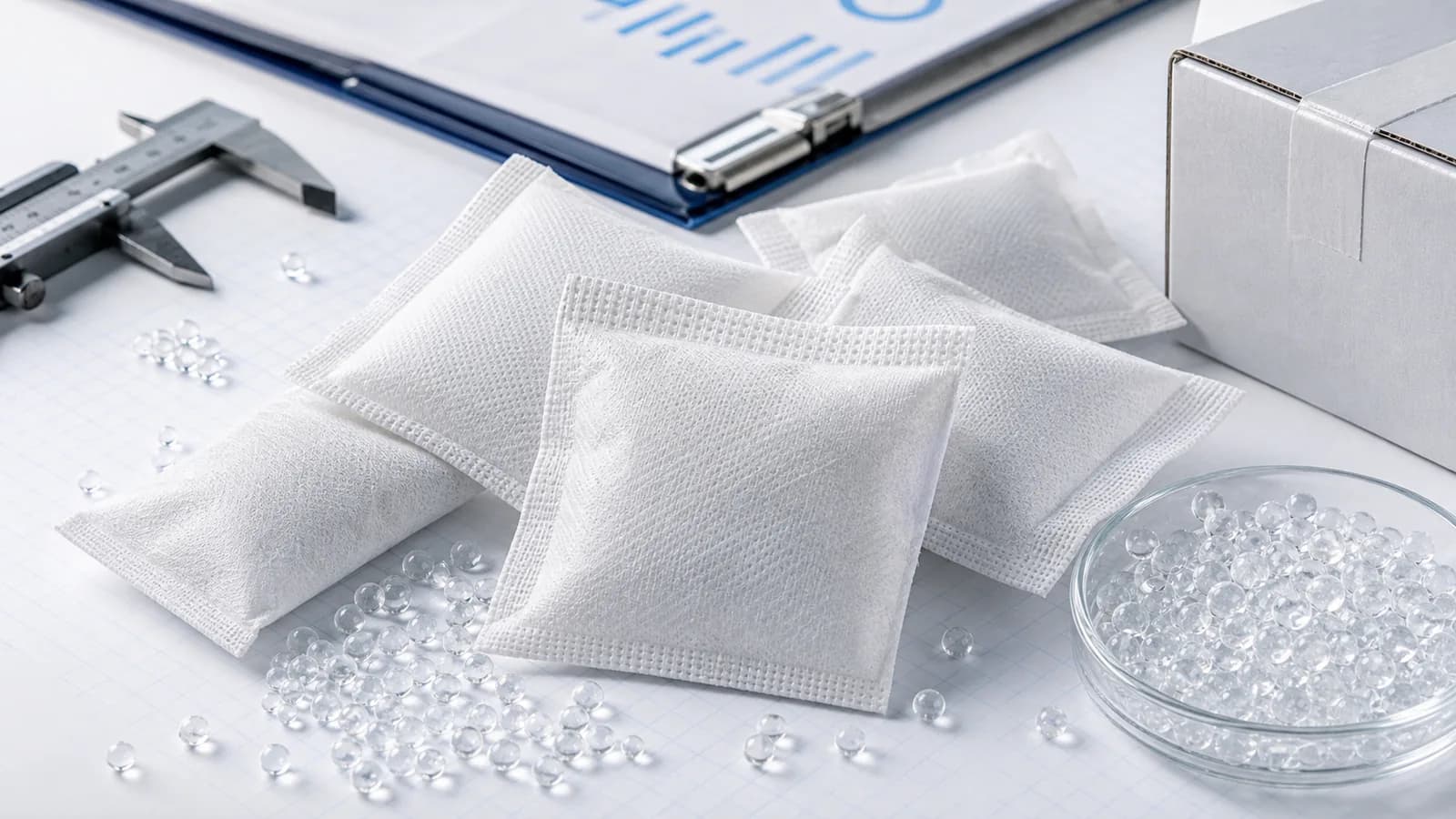
The sachet outer is a real engineering choice
Buyers focus on what's inside the sachet (silica gel, clay, grams) and overlook the outer material - but the outer determines dust, strength, print quality, breathability, and whether the sachet is acceptable in a given end-market. A desiccant sachet has to be permeable enough to let water vapor in quickly while strong enough to survive packing lines and shipping without splitting or shedding dust onto the product. Different outer materials trade these properties off differently, and the right choice depends on the cargo and the cleanliness requirement of the destination. The three common families are breathable paper, Tyvek (spunbonded polyethylene), and laminated/perforated film.
- The sachet outer sets dust, strength, print, breathability, and market acceptance.
- It must be permeable (fast vapor uptake) yet strong (no splitting/dust on the line).
- Right choice depends on cargo and destination cleanliness requirements.
- Three families: breathable paper, Tyvek, laminated/perforated film.
Breathable paper sachets
Breathable paper is the B2B default and DryGelWorld's standard sachet outer. It offers good vapor permeability for fast moisture uptake, a clean printable surface for 'DO NOT EAT' and branding, low cost, and adequate strength for most packaging lines. Its limits: it is more prone to dusting and tearing than Tyvek if abused, and it is not a cleanroom-grade material. For the vast majority of export applications - packaged goods, leather, textiles, general industrial cargo, container-level protection - breathable paper is the correct, cost-effective choice. It is where most buyers should start unless a specific requirement (cleanroom, very low dust, high abrasion) pushes them elsewhere.
- B2B default and DryGelWorld's standard outer.
- Good permeability, clean print surface, low cost, adequate strength.
- Limits: more dusting/tearing than Tyvek if abused; not cleanroom-grade.
- Correct choice for most export, leather, textile, and general industrial cargo.
Tyvek sachets
Tyvek (spunbonded high-density polyethylene) is the premium outer for low-dust and cleanroom-adjacent applications. It is very strong (resists tearing and puncture), essentially lint- and dust-free, and still highly breathable. That makes it the format of choice for electronics and pharmaceutical packaging where particulate contamination matters, and where a sachet must survive automated insertion without shedding. The trade-offs are cost (notably higher than paper) and that it is a specialized format. Note: Tyvek-format sachets are on DryGelWorld's expansion roadmap but are not currently in the catalog - buyers needing cleanroom-grade Tyvek today should source from a cleanroom-format-specific manufacturer.
- Spunbonded HDPE: very strong, lint-/dust-free, highly breathable.
- Preferred for electronics and pharma where particulates matter.
- Survives automated insertion without shedding.
- Higher cost than paper; specialized format.
- Not yet in the DryGelWorld catalog (roadmap) - source cleanroom Tyvek elsewhere for now.
Laminated and perforated film sachets
Film-based sachets use a laminated or perforated plastic outer. Perforated film gives a moisture-permeable, low-dust, often glossy and highly printable sachet used in some retail and consumer-facing packs. Fully laminated (non-perforated) film is essentially a moisture barrier and is used for outer over-pouches that keep fresh sachets sealed until use, not for the working desiccant sachet itself. The buyer pitfall here is confusing the two: a non-perforated film sachet won't adsorb because vapor can't reach the gel. If you see 'film sachet', confirm it is perforated/breathable for in-pack use, or understand it is a barrier over-pouch for storage.
- Perforated film: permeable, low-dust, glossy/printable - some retail packs.
- Laminated (non-perforated) film: a moisture barrier, used for storage over-pouches.
- Pitfall: a non-perforated film sachet won't adsorb - vapor can't reach the gel.
- Confirm 'film sachet' is perforated for in-pack use vs a barrier over-pouch.
Choosing the right outer
Match the outer to the requirement. General industrial/export cargo, leather, textiles, container protection: breathable paper (default, cost-effective). Electronics and pharma where low dust/particulates and automated insertion matter: Tyvek (source accordingly while DryGelWorld's Tyvek line is on roadmap). Retail/consumer-facing packs wanting a glossy printed look: perforated film. Long-term storage of unused sachets: keep them in their laminated barrier over-pouch and only open near point of use. When requesting a quote, state the cargo, the destination's cleanliness expectations, whether insertion is manual or automated, and any print/branding needs - the outer recommendation follows directly from those.
- General/export/leather/textile/container: breathable paper.
- Electronics/pharma, low-dust, automated insertion: Tyvek.
- Retail/consumer glossy print: perforated film.
- Unused-sachet storage: keep in the laminated barrier over-pouch until use.
- Quote inputs: cargo, cleanliness need, manual/automated insertion, print needs.