
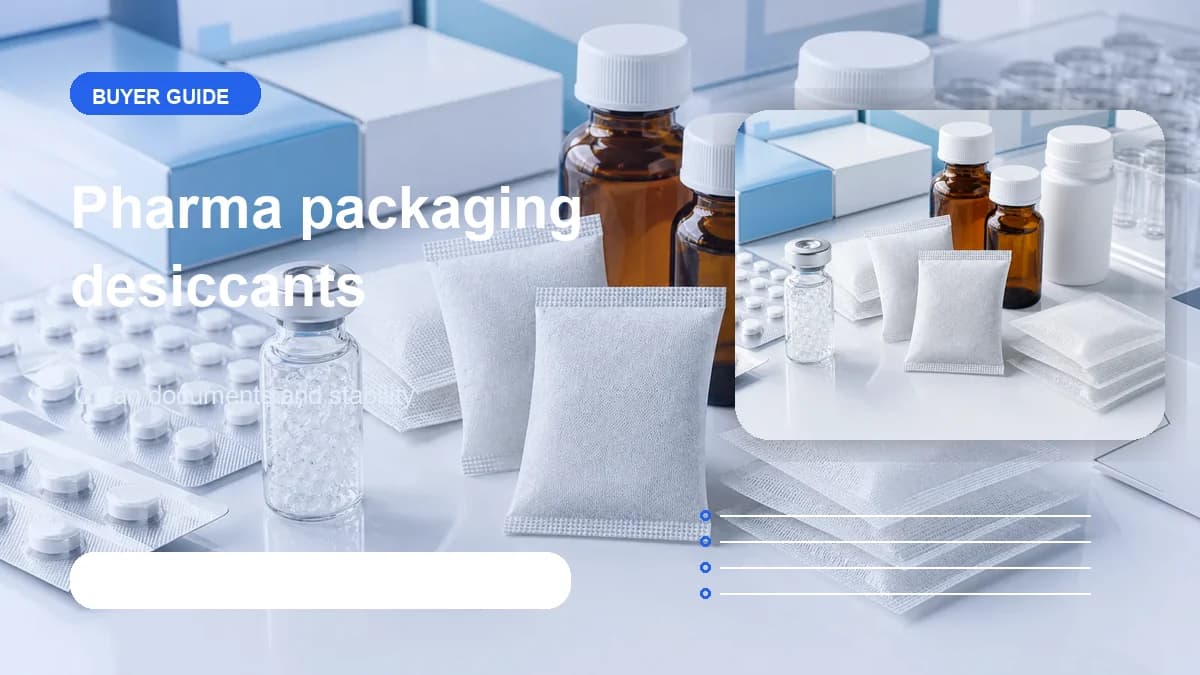
Pharma desiccant procurement is not the same as industrial desiccant procurement
When a procurement team buys silica gel for pharmaceutical packaging, the evaluation criteria shift sharply. Adsorption capacity is the same chemistry - the regulatory layer on top is what makes the buying decision different. Pharma packaging desiccant needs to demonstrate consistent material identity, contamination control, manufacturer accountability, and traceability per shipment. The cost premium versus industrial-grade silica gel is real, but so is the audit risk if a procurement team treats them as interchangeable. Get the buying criteria right at the supplier-shortlist stage; the documentation cost of switching mid-program is much higher than the front-end cost of choosing correctly.
- Pharma desiccant ≠ industrial desiccant from a regulatory perspective.
- Capacity (~33% by weight) is identical; documentation and material identity are not.
- Cost premium reflects audit-readiness, not chemistry.
- Switching mid-program is more expensive than choosing right initially.
What pharma packaging buyers should require from any supplier
A practical minimum requirement set for evaluating pharma desiccant suppliers: ISO 9001:2015 manufacturer certification with a current and verifiable certificate number; per-shipment Certificate of Analysis (COA) showing moisture content, adsorption capacity, and lot identifier; Safety Data Sheet (SDS) in the destination market's required format and language; DMF-free statement on letterhead; documented manufacturing process control (especially particle-size distribution if bead format) and contamination prevention. Region-specific certifications (FDA Drug Master File, REACH, JP/EP/USP pharmacopoeia compliance) are separate from the baseline and need to be verified individually against the buyer's regulatory submission requirement.
- ISO 9001:2015 manufacturer cert with current certificate number.
- Per-shipment COA: moisture content, adsorption capacity, lot ID.
- SDS in the destination market's required format and language.
- DMF-free statement on letterhead.
- Documented contamination prevention and particle-size control.
- Region-specific certs (FDA DMF, REACH, USP/EP/JP) are SEPARATE and must be verified individually.
Sachet format matters more than people think
Pharma packaging silica gel typically ships in one of three sachet formats: breathable paper, non-woven polypropylene, or Tyvek. Breathable paper is the most common B2B default and is appropriate for most non-direct-contact pharma packaging applications. Non-woven polypropylene works for slightly larger formats and direct insertion into bottle headspace. Tyvek is the cleanroom-grade option used for direct contact with regulated pharmaceutical products - its low particulation profile is the differentiator. DryGelWorld currently supplies breathable paper and non-woven formats; Tyvek is on the expansion roadmap but not yet in the current catalog. Buyers with direct-contact pharma applications requiring Tyvek should confirm format at quote stage.
- Breathable paper: B2B default for non-direct-contact pharma applications.
- Non-woven polypropylene: medium-format, direct bottle headspace insertion.
- Tyvek: cleanroom-grade for direct contact with regulated products.
- DryGelWorld currently supplies paper + non-woven; Tyvek on roadmap.
- Buyers needing Tyvek for direct pharma contact: confirm at quote stage.
Regional pharma documentation - what differs market to market
Pharma desiccant documentation requirements vary materially by destination market. United States: FDA Drug Master File reference is the gold standard for direct-contact desiccant; non-DMF desiccant is acceptable for non-direct-contact secondary packaging applications where the desiccant doesn't touch the dosage form. European Union: REACH registration of the manufacturer, plus relevant pharmacopoeia compliance (typically EP, the European Pharmacopoeia) where the desiccant is part of the registered packaging. UK post-Brexit: largely follows EU pattern but check MHRA-specific requirements. India: IP (Indian Pharmacopoeia) reference where required, plus CDSCO documentation if importing into India for re-export of finished product. Middle East: registration varies by country but typically follows USP or EP pattern. Always verify with the destination market's regulator, not with general internet guidance, before placing a pharma order.
- USA: FDA DMF for direct-contact; non-DMF acceptable for secondary packaging.
- EU: REACH + EP (European Pharmacopoeia) where desiccant is registered packaging.
- UK post-Brexit: largely EU pattern; check MHRA-specific.
- India: IP reference + CDSCO documentation for finished-product re-export.
- Middle East: USP or EP pattern; varies by country.
- ALWAYS verify with the destination regulator - not general internet guidance.
Contamination control - the procurement question most buyers forget to ask
Cross-contamination from manufacturing facilities that also produce non-pharma desiccants is the single most common audit finding in pharma packaging desiccant. Procurement teams should ask: does the supplier produce desiccants for non-pharma uses in the same facility? If yes, what physical separation (dedicated lines, dedicated cleaning protocols, dedicated personnel) is in place? Are there documented changeover procedures between batches? Are batches segregated by intended end-use? For DryGelWorld and similar manufacturers, the honest answer is that the same production facility produces both industrial and packaging-grade silica gel. This is fine for non-direct-contact secondary packaging where regulatory requirements permit it; it's not acceptable for direct-contact pharma applications, which is why Tyvek-format DMF-grade silica gel is a separate procurement category supplied by specialized manufacturers.
- Cross-contamination is the #1 pharma desiccant audit finding.
- Always ask: shared facility with non-pharma desiccants?
- If yes: physical separation, cleaning, personnel, batch segregation?
- Shared facility is OK for secondary packaging (non-direct contact).
- Direct-contact pharma needs specialized DMF-grade suppliers - be honest about which buying category you're in.
Working with DryGelWorld on pharma packaging programs
DryGelWorld serves pharma packaging buyers in the secondary-packaging and non-direct-contact category. The current supply matrix: breathable paper and non-woven sachets from 0.5g to 100g, plus bulk silica gel beads (Type A and Type B) for buyers who package their own desiccant into pharmacy-side dispensing. ISO 9001:2015 manufacturer certification, per-shipment COA, SDS in English (translations on request), and DMF-free statement are standard. Tyvek-format direct-contact desiccant and FDA Drug Master File registration are not currently held - buyers in those categories should source from specialized US/EU manufacturers and treat DryGelWorld as a parallel option for their non-DMF packaging requirement. Honest scope conversations upfront save quarterly auditing pain later.
- DryGelWorld serves: secondary packaging, non-direct-contact pharma.
- Catalog: paper + non-woven sachets 0.5g-100g, bulk Type A and Type B beads.
- Standard docs: ISO 9001:2015, COA per shipment, SDS, DMF-free statement.
- Not currently held: Tyvek format, FDA DMF, region-specific pharmacopoeia compliance.
- Direct-contact pharma buyers: use specialized DMF-grade suppliers in parallel.
References
- Q1A(R2) — Stability Testing of New Drug Substances and Products , International Council for Harmonisation (ICH)
- ICH Q1A (R2) Stability testing of new drug substances and drug products — Scientific guideline , European Medicines Agency
- 〈671〉 Containers—Performance Testing , United States Pharmacopeia (USP-NF)
- Regulation (EC) No 1907/2006 (REACH) , EUR-Lex, Publications Office of the European Union
- Silica (silicon dioxide, SiO2) — compound summary, CID 24261 , National Institutes of Health (PubChem)