
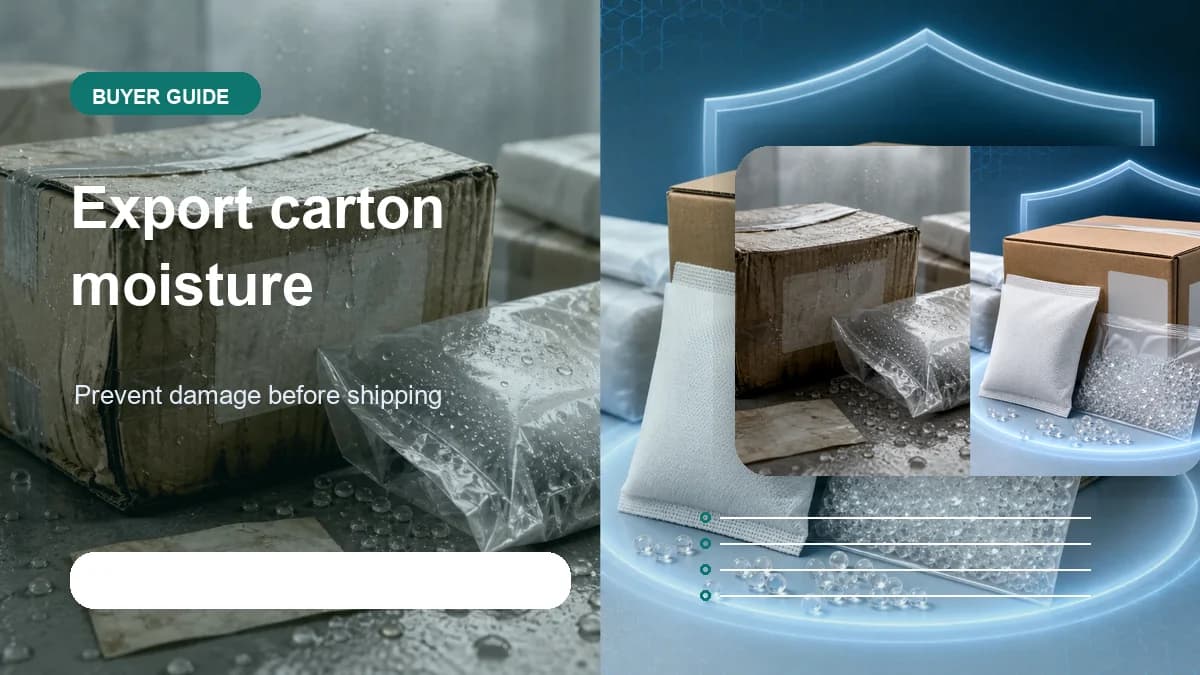
Carton moisture starts inside the factory, not on the ocean
Most exporters who get hit with carton-level moisture damage assume it happened during sea freight. The truth is uncomfortable: the majority of unsalvageable carton damage starts in the packing area, hours before the container is sealed. Humid factory air, damp corrugated cardboard, wet wooden pallets, moisture-saturated cargo coming straight off a wash or curing line, and slow staging in an un-conditioned warehouse all add water vapor to the carton's internal air before it ever leaves Karachi. Silica gel inside the carton is the right tool - but only after the upstream sources of moisture are controlled. Treat desiccant as the last line of defense, not the only line.
- Cardboard and corrugated stock should be stored in a dry indoor area for at least 48 hours before packing - humid stock acts like a vapor reservoir inside the sealed carton.
- Wooden pallets should be kiln-dried or plastic; raw or damp wood is a major moisture source on tropical-origin shipments.
- Cargo should be at ambient packing-room temperature and humidity before sealing - packing freshly washed leather, just-printed paper, or recently steamed textiles guarantees high carton humidity at dispatch.
- Desiccant should be placed at the moment of carton sealing, not added after staging or transit - early-placed packets saturate before reaching the container.
The route math: where carton moisture damage actually peaks
The same cargo, packed identically, will suffer different moisture outcomes depending on which ocean lane it travels. Tropical-to-temperate routes are the worst case: cargo loaded at 30°C and 75% RH in Karachi and unloaded at 8°C and 60% RH in Hamburg has crossed multiple climate zones and cycled the dew point 25-40 times. Trans-Pacific routes (Karachi → Vancouver, Karachi → Long Beach) typically run 28-32 days through Pacific storm cycles. Cross-equator routes (Karachi → Sydney) cross the ITCZ twice and add unpredictable humidity. Even fast intra-region lanes (Karachi → Jebel Ali, ~6-8 days) accumulate condensation cycles, just fewer of them. Knowing your route's worst case lets you size desiccant correctly instead of guessing.
- Karachi → Hamburg / Rotterdam: ~25 days, tropical-to-temperate, 25-40 condensation cycles, highest carton risk.
- Karachi → New York / East Coast US: ~30 days, similar profile, often slightly worse due to Atlantic storms.
- Karachi → Vancouver / Long Beach: ~30 days trans-Pacific, frequent storm cycling.
- Karachi → Sydney: ~22 days, crosses ITCZ twice, unpredictable humidity at the equator.
- Karachi → Jebel Ali / Saudi Arabia: ~6-8 days, lower cycle count but still meaningful risk for moisture-sensitive cargo.
Sachet sizing math: how much silica gel per carton
There's no universal rule, but there's a working starting point. DryGelWorld silica gel adsorbs up to one-third (~33%) of its own weight in water vapor. A sealed export carton with internal volume around 0.05 cubic meters (a typical small consumer export carton) holds about 50-60 grams of air at average export humidity, of which roughly 1-2 grams is vapor that needs to be controlled. A 5g silica gel sachet has working capacity for ~1.6g of water - enough to control that volume comfortably. Scale up: a 0.5 cubic meter master carton needs roughly 25-50 grams of silica gel; a full pallet of cartons may justify a 100g-500g bag in addition to per-carton sachets. These are starting points; cargo sensitivity, route humidity, and packaging barrier quality push the dosage up or down.
- Small unit pack (0.001-0.01 m³): 0.5g-1g sachet inside the pack.
- Standard product carton (0.01-0.05 m³): 2g-5g sachet.
- Master carton (0.05-0.2 m³): 10g-25g sachet.
- Large export carton (0.2-0.5 m³): 25g-100g bag.
- Pallet-level supplementary protection: 250g-500g bag at the pallet base.
- Increase by 50-100% for tropical-to-temperate long-haul routes; reduce by 30-50% for short intra-region lanes.
Placement strategy by cargo type
Where you put the sachet matters as much as how big it is. For electronics, the sachet should sit inside the antistatic bag, near the product but not pressed against any heat-generating component. For leather and footwear, place sachets inside each shoe or each leather good plus one in the master carton - leather absorbs ambient moisture and slowly releases it, so it benefits from in-pack desiccant. For pharma and bottled goods, follow the bottle insert standard plus a secondary carton-level sachet. For textiles, fold sachets into the woven goods at the master carton level rather than inside individual product packs (the textile fibers carry their own humidity that's better absorbed at carton level). For dry food cartons, regulatory caution applies - never let the sachet contact the food directly, and confirm food-grade compliance against the buyer's market before commercial terms.
- Electronics: 1g-5g sachet inside the antistatic bag; supplementary 25g-50g sachet in master carton.
- Leather and footwear: 1g sachet inside each shoe or product, plus 25g-50g in the master carton.
- Pharma bottles and healthcare: bottle insert silica gel + 10g-25g secondary sachet at carton level.
- Textiles and apparel: 25g-50g at master-carton level, folded between woven goods.
- Dry food cartons: indirect placement only (no food contact); discuss food-grade documentation per buyer market - DryGelWorld holds ISO 9001:2015 + DMF-free; FSSC 22000 / FDA / EU 1935/2004 are not credentials currently held by DryGelWorld.
- Heavy machinery parts: 100g-500g desiccant bag inside the crate; pair with VCI paper if corrosion is the primary risk.
The pre-loading workflow that prevents claims
A claim-defensible packing workflow looks the same every shipment and produces the same paper trail. Step one: humidity-check incoming cargo and reject anything above the agreed threshold (commonly 12-14% moisture content for woven goods, 8-10% for paper-based products). Step two: inspect cartons and pallets, rejecting damp or split material. Step three: place sachets at the unit and carton level by the documented dosage, recording sachet size and placement count per carton. Step four: seal the carton and label it with date and packer ID. Step five: load into the container with desiccant strips at the ceiling (1kg-5kg per 20-foot or 40-foot container based on route). Step six: photo-log the loading and seal the container. Step seven: dispatch with a packing list that names desiccant format and total quantity. The cost of building this workflow once is small; the cost of losing a single claim because no one can prove what went into the box is substantial.
- Step 1: Humidity-check cargo at receiving; reject above-threshold material.
- Step 2: Inspect and reject damp cartons, pallets, and packaging material.
- Step 3: Place sachets at unit and carton level by documented dosage; record per-carton.
- Step 4: Seal carton, label with date and packer ID.
- Step 5: Place container-level strips at the ceiling line for long-haul routes.
- Step 6: Photo-log loading; seal container; record seal number.
- Step 7: Dispatch with packing list naming desiccant format, quantity, and placement.
Documentation that actually defends a moisture claim
When a moisture-damage claim hits the carrier or the underwriter, both parties look for evidence that the shipper used appropriate moisture mitigation and that the damage was outside their control. A solid evidence pack includes: an SDS for the desiccant used (proves it was the appropriate non-toxic material), a COA tying the desiccant batch to the shipment, an ISO 9001:2015 reference for the manufacturer, dated photos of the loading workflow, and a packing list naming the desiccant format and quantity per carton. DryGelWorld supplies the SDS, COA, ISO 9001:2015 reference, and DMF-free statement on request. What documentation cannot do is rescue a shipment where the desiccant was visibly absent, under-spec, or placed too late - which is why the workflow above must be in place before dispatch, not assembled after a claim.
- SDS - non-toxic, non-flammable, DMF-free desiccant confirmation.
- COA - batch quality tied to shipment date.
- ISO 9001:2015 reference - manufacturer process credibility.
- Loading photo log - shows placement, quantity, seal, and date.
- Packing list with desiccant detail - quantifies what went into the box.
- Voyage temperature/humidity log from the carrier (where available) - shows conditions cargo was exposed to.
Real failure scenarios (and how to prevent them)
Most carton moisture failures fall into a small number of recurring patterns. The most common: desiccant placed too late, after cartons have already absorbed humidity from ambient packing-room air. The second-most-common: desiccant sealed inside a plastic bag with no airflow, where it cannot adsorb the carton-level vapor at all. The third: under-dosing relative to cargo sensitivity (a 1g sachet inside a 50-litre carton of leather goods on a 30-day tropical route is functionally cosmetic). The fourth: hidden moisture sources - kiln-fresh wooden pallets, paint-fresh metal parts, undried agricultural product, or steam-cured concrete - that overwhelm any reasonable desiccant program. The fix for all of these is the same: write the workflow down, train the packing team, and audit a sample of cartons each shipment.
- Failure: late desiccant placement → fix with workflow discipline, dosage at sealing.
- Failure: sachet sealed away from cargo air → fix with placement training, no plastic-wrap-over-sachet.
- Failure: under-dosing → fix with carton-volume sizing math (above).
- Failure: hidden moisture source → fix with cargo humidity check and pallet inspection at receiving.
- Failure: missing documentation → fix with packing list discipline and photo-logging.
Cost reality: desiccant is the cheapest insurance you can buy
For most B2B export programs, the per-shipment desiccant cost runs 0.1-1% of cargo value. A 40-foot container of leather goods worth USD 80,000 might use USD 200-400 in silica gel sachets and container strips. A single rejected shipment for moisture damage - say, USD 8,000 of damaged goods, plus carrier fees, plus lost buyer relationship - costs ~20-40x the prevention cost. The math is not subtle. Moisture protection is the single highest-ROI line item in most export programs, yet it's the line item most often skipped or under-specced because the upside (no damage) is invisible. Treat desiccant as fixed insurance overhead, not as a variable cost to negotiate down.
- Typical desiccant cost: 0.1-1% of cargo value.
- Typical moisture-damage claim cost: 5-20% of cargo value plus carrier fees and reputation damage.
- Prevention-to-damage ratio: roughly 1:20 to 1:40.
- Cheapest desiccant program is rarely the most cost-effective once you account for damage risk.
References
- IMO/ILO/UNECE Code of Practice for Packing of Cargo Transport Units (CTU Code) , International Maritime Organization
- Cargo Ventilation and Precautions to Minimise Sweat , West of England P&I Club
- TT Talk — Protecting cargo from wet damage , TT Club
- Dew Point vs Humidity , NOAA National Weather Service
- Test Procedures , International Safe Transit Association (ISTA)
- Silica Gel Calculator | How Much Desiccant Do You Need? , DryGelWorld