
Ceiling-hung strips
1kg-5kg multi-chamber strips hung at the container ceiling and along corrugations.
Container desiccant strips, pole desiccants, and bulk silica gel for 20ft and 40ft containers on transpacific, trans-Atlantic, and trans-equatorial routes.
Request Industry Quote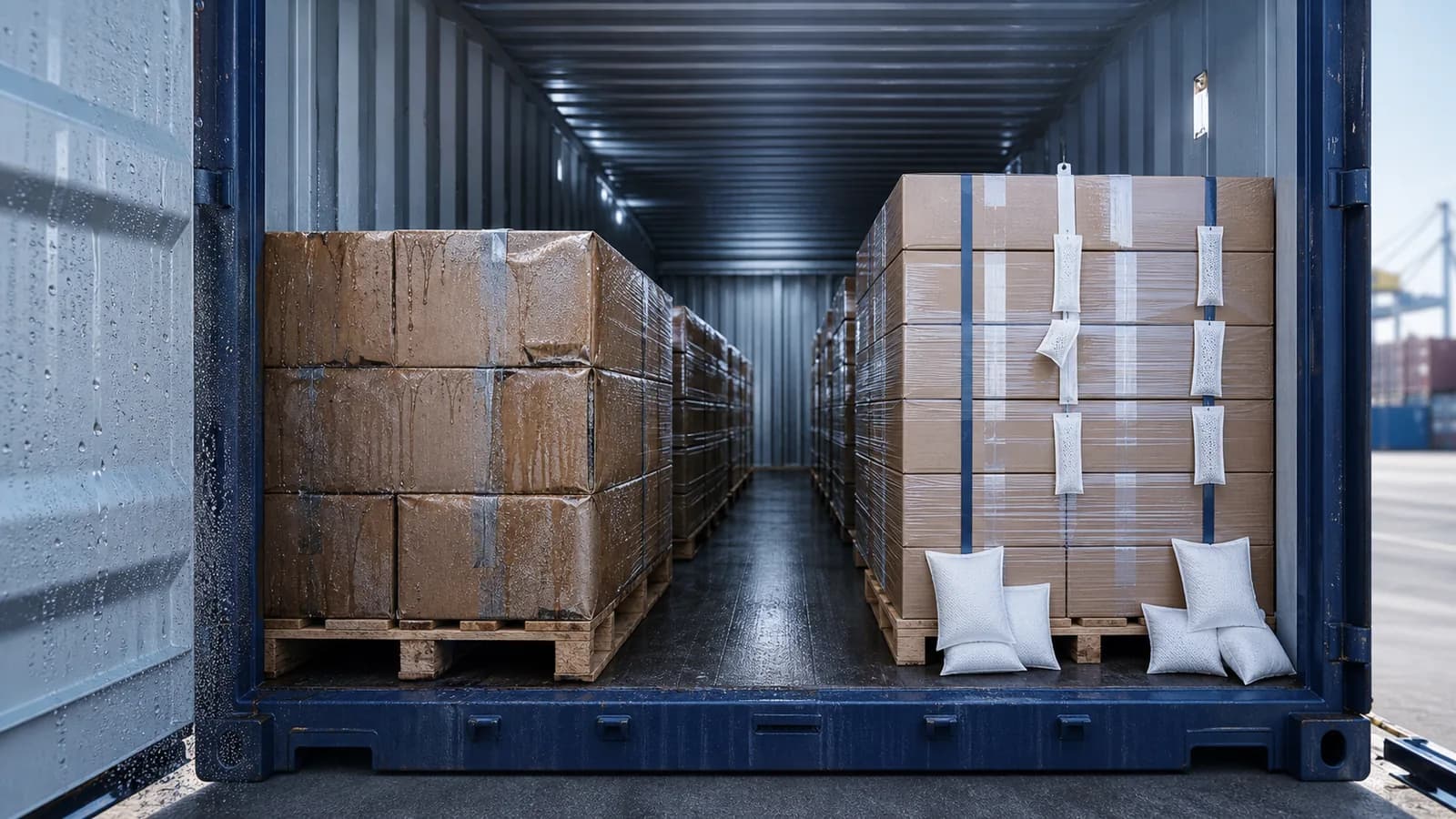
On long ocean voyages, day-night temperature swings make trapped moisture condense on the container ceiling and walls and drip onto cargo - 'container rain'. DryGelWorld supplies container desiccant strips, pole desiccants, and bulk silica gel for 20ft and 40ft containers on transpacific, trans-Atlantic, and trans-equatorial routes.
1kg-5kg multi-chamber strips hung at the container ceiling and along corrugations.
For even distribution across the cargo space on humid lanes.
Regenerable beads for reusable closed-loop container applications.
Standard loading is 6-10 strips per 20ft container and 10-16 per 40ft, with long-haul tropical routes using the upper end. Even distribution beats concentrated placement. Container desiccant is a single-voyage consumable; for reusable closed-loop systems, regenerable bulk silica gel beads are the right product.
Typically 10-16 strips of 1-2kg per 40ft container on long-haul tropical-to-temperate routes (25+ days), 8-12 for medium-haul, and 6-8 for short-haul. High-cube containers use the upper end. Send your route and cargo for an exact recommendation.
Container rain is condensation that forms on the ceiling and walls when warm moist air cools at night, then drips onto cargo. Container desiccant adsorbs that moisture so humidity stays below the dew point, preventing the condensation cycle.
Hang strips at the container ceiling and along the corrugations, distributed evenly across the cargo space rather than concentrated in one area. Even placement protects the whole load against localized condensation.
Container strips are single-voyage consumables. For reusable closed-loop applications, regenerable bulk silica gel beads can be reactivated by heating and reused. Tell us your use case and we recommend the right format.
Tell us your packaging specifications, required quantity, and destination - the factory export desk returns a documented quote with MOQ, lead time, and shipping options.