
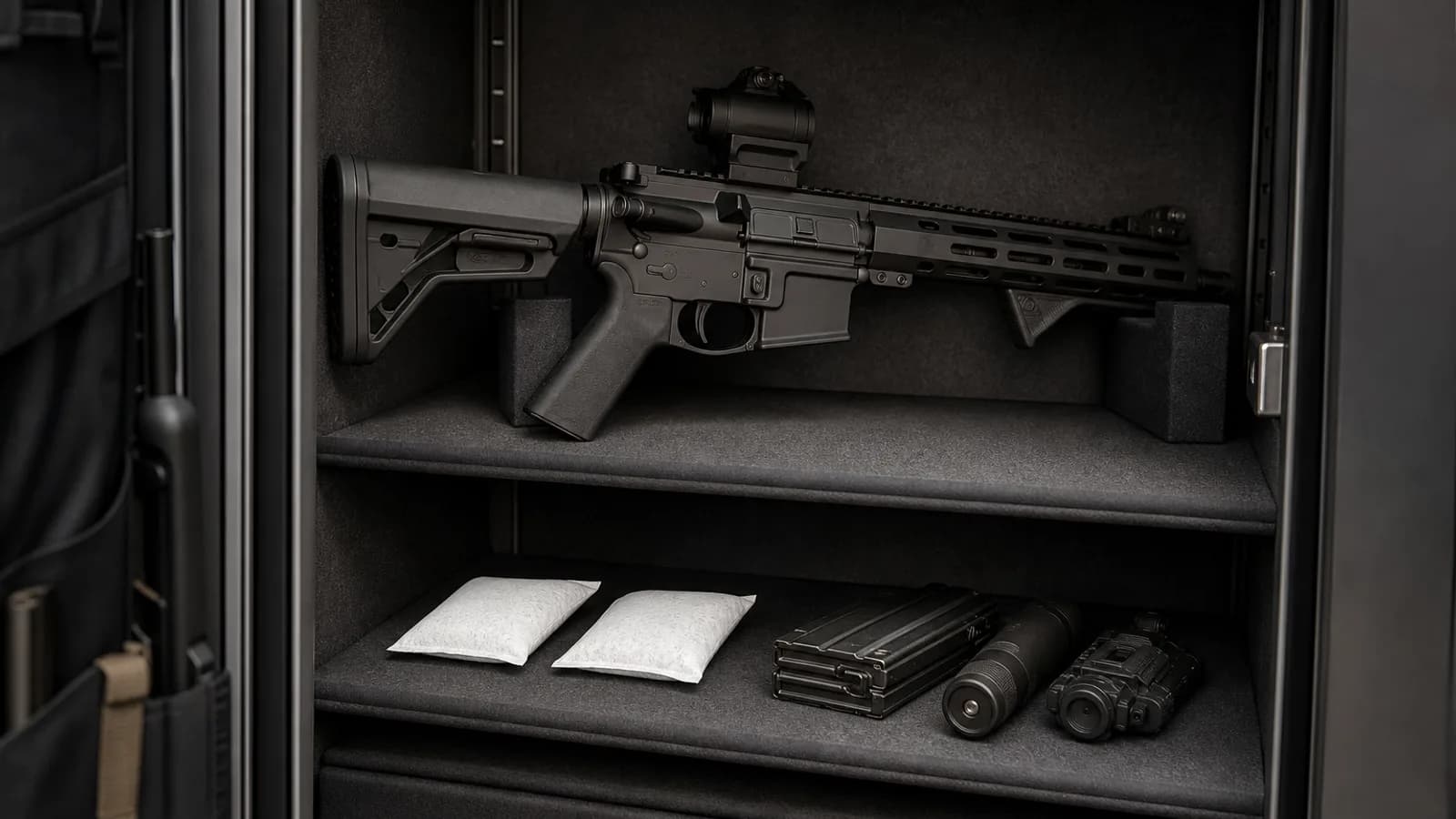
Why a safe makes the problem worse, not better
A gun safe is a sealed steel box, usually standing on or against an exterior wall or a concrete floor. Those surfaces are colder than the room, so the interior of the safe runs slightly cool, and moisture in the trapped air condenses on the coldest surfaces inside it - which are the steel parts you are trying to protect. There is no ventilation to carry it away and no light to dry it. Surface rust on bare metal, corrosion at bluing wear points, and mildew on leather cases and stock finishes all follow from the same trapped humidity. The safe is not the cause, but it removes every mechanism that would otherwise dry things out.
- Concrete floors and exterior walls wick moisture and hold temperature below room ambient.
- Sealed means no air exchange - whatever humidity is inside stays inside.
- Leather and wood in the safe act as reservoirs, releasing moisture slowly into the enclosed air.
Quantity by safe size
Desiccant is sized to enclosed volume, and safes are commonly described by capacity rather than cubic feet, so a rough conversion is needed. The figures below are practical starting points for a reasonably well-sealed cabinet in a normal domestic environment; a damp basement or a humid coastal climate needs more, and a safe opened daily needs refreshing more often. The aim is to hold the interior below about 50 percent relative humidity - dry enough to stop corrosion without stripping the oil from moving parts.
- Small cabinet, up to around 8 cubic feet: 200 to 300 g of silica gel.
- Medium safe, 8 to 20 cubic feet: 400 to 700 g.
- Large safe or a walk-in vault: 1 kg and upward, distributed rather than in one place.
- Distribute it. One container in a corner leaves the far end of a tall safe unprotected.
Rechargeable units suit safes particularly well
A gun safe is one of the few applications where a rechargeable desiccant canister is clearly the right format rather than a convenience. The safe is accessed rarely, the desiccant sits undisturbed for months, and the alternative - replacing disposable sachets on a schedule you will forget - fails in practice. A canister of indicating gel shows its state through a window, comes out once or twice a year for regeneration, and goes back. Silica gel is not consumed; it only becomes saturated, and heat resets it completely.
- Indicating gel shows saturation through the window without opening anything.
- Regenerate at 150 degrees Celsius, or 300 Fahrenheit, in a shallow layer.
- Cool it sealed before returning it, or it reloads with room humidity on the way back.
What desiccant does not fix
Desiccant manages the humidity of the air inside the cabinet. It does not compensate for a safe standing in standing water, a basement with an active damp problem, or firearms put away wet after use in rain. It also does not replace oiling. In a genuinely damp room, a low-wattage safe heater rod combined with desiccant works better than either alone - the rod keeps the interior slightly above ambient so condensation does not form, and the gel handles the residual humidity.
- Never store equipment wet and expect the desiccant to deal with it.
- Lift the safe off a concrete floor if you can - a pallet or feet break the thermal and moisture bridge.
- In a persistently damp room, treat the room as well as the cabinet.