
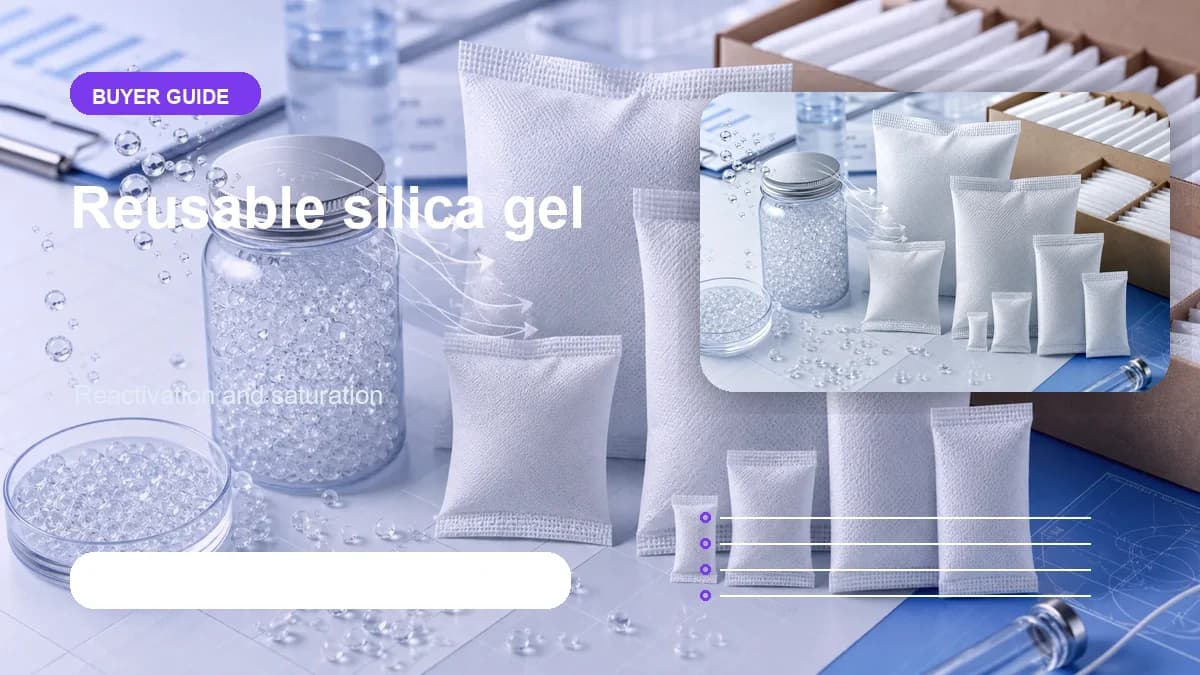
The honest answer: technically yes, operationally usually no
Silica gel is one of the few B2B packaging materials that's genuinely regenerable - heating saturated material at 150°C drives off the absorbed water and restores adsorption capacity. So 'can you reuse silica gel' is technically yes. But the right operational question is different: 'should you reuse silica gel in your specific use case?' For most B2B export operations, the answer is no - not because reuse is unsafe but because the labor, utility, and QC overhead of regeneration exceeds the savings vs fresh material. Reuse makes economic sense in specific contexts; outside those contexts, treating silica gel as consumable is the right operational choice.
- Silica gel regenerates at 150°C (max 250°C - higher damages the porous structure).
- Activated clay desiccant regenerates at 100-120°C.
- Technical regenerability is real; operational economics often don't favor it.
- Most B2B export operations default to single-use because reuse infrastructure doesn't pay back at typical throughput.
Three scenarios where reuse genuinely wins
Reuse makes economic and operational sense in three specific contexts. (1) Laboratory desiccator cabinets - small quantities, frequent cycling, in-house oven capacity already exists for other lab uses, no regulatory documentation overhead. (2) Industrial gas processing systems - compressed air dryers, refrigerant dryers, refinery gas dehydration. The bed is part of plant infrastructure; regenerable design is built in. (3) Very high-volume operations (>10,000kg/month desiccant throughput) where dedicated regeneration equipment and labor scale economically. Outside these three contexts, reuse adds complexity without saving money.
- Lab desiccator cabinets: small quantities, in-house infrastructure.
- Industrial gas dryers: regenerable beds part of plant design.
- Very high-volume manufacturing (>10,000kg/month): dedicated regeneration equipment.
- Outside these three: disposable usually wins.
Why fresh sachets dominate B2B export programs
For B2B export buyers, fresh sachets win for procurement and QC reasons that go beyond unit cost. Fresh sachets give batch consistency - every shipment uses material at the same documented spec. Fresh sachets pass customer QC and audit reviews more cleanly than regenerated material (regenerated material requires performance-equivalence documentation that adds operational cost). Fresh sachets simplify the packing SOP - workers grab from a single carton type, no risk of mixing fresh and regenerated material. And for the cost of cents per sachet at B2B scale, the labor and QC complexity of regeneration isn't justified.
- Batch consistency - every shipment uses documented-spec material.
- Customer QC review - fresh material has cleaner documentation trail.
- Packing SOP - workers grab from one carton type, no mixing risk.
- Cost: cents per sachet at B2B scale; regeneration overhead exceeds savings.
Cycle limits - how many times silica gel can actually be regenerated
If you do operate a regeneration program, plan for cycle limits. Standard B2B silica gel typically handles 3-10 regeneration cycles before adsorption capacity drops noticeably. Beyond that, the porous bead structure degrades from repeated thermal cycling - silica gel becomes 'tired' and absorbs less water per gram. Some industrial-grade silica gel formats are engineered for 50+ cycles, but those are specialty products outside DryGelWorld's standard catalog. Budget for replacement after 3-5 cycles in typical reuse contexts; track cycle count if you operate a serious regeneration program.
- Standard silica gel: 3-10 regeneration cycles before capacity drops.
- After cycle limit: porous structure degraded; replace.
- Industrial-grade regenerable beds: 50+ cycles (specialty products).
- Most B2B reuse contexts: budget for replacement after 3-5 cycles.
- Track cycle count if running a serious regeneration program.
Container strips - practically single-voyage regardless of theoretical regenerability
For container-grade cargo strips (1-5kg), the disposable-vs-reusable question rarely comes up in practice. Strips are sized to saturate by end of voyage; the handling cost of removing, regenerating, repackaging, and certifying a single 5kg strip for reuse exceeds the cost of a fresh strip. Treat container strips as single-voyage consumables in your shipping economics, regardless of theoretical regenerability. Same logic applies to bulk sachets used in long-haul export programs.
- Container strips: single-voyage consumables in practice.
- Theoretical regenerability ≠ practical reusability.
- Strip handling cost > fresh strip cost.
- Build single-voyage strip cost into your shipping economics.
Safe regeneration - if you do reuse, do it right
If your operation falls into one of the three reuse contexts above, regenerate safely. Use a calibrated oven at 150°C; do not microwave (uneven heating can damage sachet material). Spread loose beads in a thin layer, not piled high. For indicating silica gel (orange or blue), look for the color reverting to original (orange or blue, away from the saturated green or pink) as the visual confirmation. Do not regenerate sachets with metallic ink or coated paper (those can degrade under heat). After regeneration, cool to room temperature in a sealed container before redeploying to prevent re-absorption of ambient humidity.
- Oven at 150°C; not microwave (uneven, can damage material).
- Spread beads thinly; don't pile high.
- Indicating silica gel: watch for color reversion to confirm.
- Avoid sachets with metallic ink or coated paper.
- Cool in sealed container after regeneration to prevent ambient re-absorption.
Reuse vs disposable - the decision matrix
Pick disposable when: B2B export shipments, audited customer programs, food/pharma packaging, operations under 50-100 employees per shift, or any context where unit cost is cents per sachet. Pick reuse when: laboratory desiccator cabinets with existing oven capacity, industrial gas processing with regenerable bed design, very high-volume manufacturing (>10,000kg/month) with dedicated regeneration equipment. When in doubt, default to disposable - the operational simplicity is worth more than the per-unit savings.
- Disposable: B2B export, audited programs, food/pharma, under 10,000kg/month.
- Reuse: lab desiccators, industrial gas dryers, very high-volume manufacturing.
- Default: disposable for operational simplicity.
- When economics are unclear: model 6-month total cost both ways before deciding.
References
- Silica (silicon dioxide, SiO2) — compound summary, CID 24261 , National Institutes of Health (PubChem)
- Water vapor desorption from silica gel in a combined drying and double-condenser compression refrigeration system (Heliyon, 2022) , PubMed Central, U.S. National Library of Medicine
- Drying and Preserving Plant Materials for Decorative Uses (CIR495/EP004) , UF/IFAS Extension, University of Florida
- Cobalt chloride (CoCl2) — compound summary, CID 3032536 , National Institutes of Health (PubChem)
- DIN 55473:2021-07 — Auxiliary means of packaging - Desiccant in bag - Technical delivery conditions , DIN Media (German Institute for Standardization)