
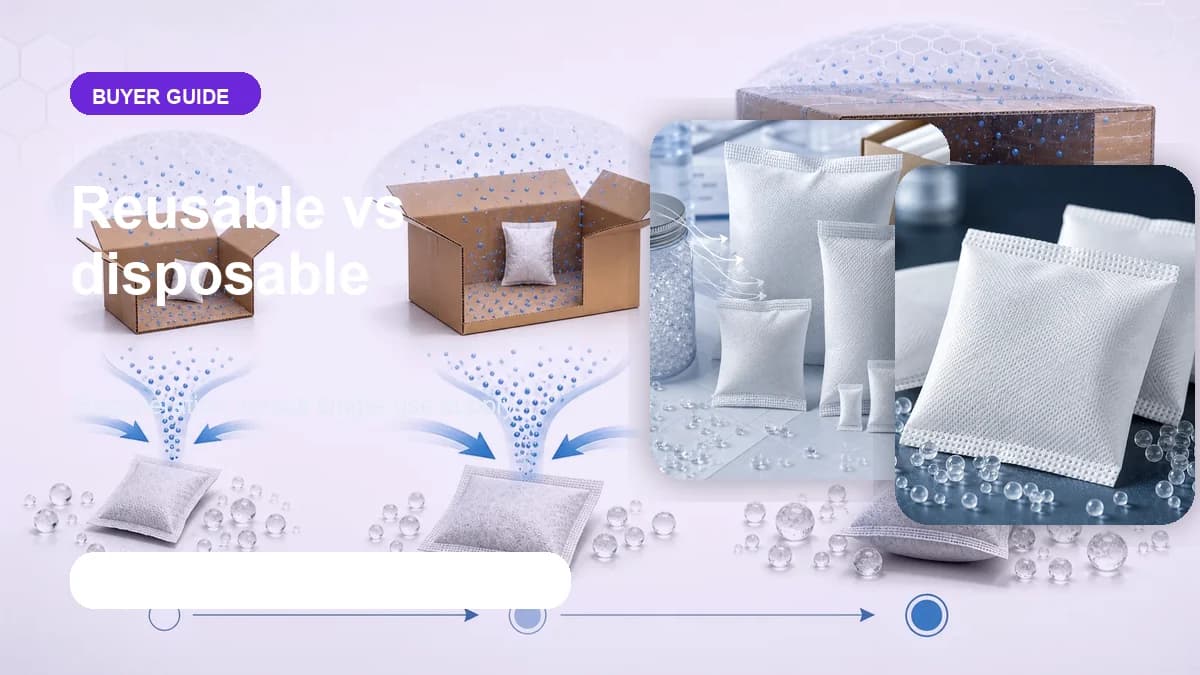
Both options exist - the choice is about your operation, not the product
Most silica gel and clay desiccants are technically regenerable - heating saturated material at 150°C (silica gel) or 100-120°C (clay) drives off the absorbed water and restores adsorption capacity. So 'reusable' is a property of the material, not a special product category. The real decision is whether your operation has the infrastructure, labor budget, and quality control to make regeneration economic. For most B2B export buyers, the answer is no - and that's a perfectly defensible operational choice.
- Most desiccants (silica gel, clay) are technically regenerable.
- Reusable vs disposable is an operational choice, not a product difference.
- Regeneration needs: oven capacity, labor, QC for moisture content, replacement program for damaged sachets.
- Most B2B export programs treat desiccants as consumables - defensible economics.
Disposable economics - why most B2B programs default here
Disposable desiccant is the dominant B2B model for clear economic reasons. The per-unit cost of fresh silica gel is low (a 5g sachet at scale costs cents). The labor cost of regenerating, inspecting, repackaging, and re-certifying used desiccant typically exceeds the per-unit savings. Plus the QC overhead: regenerated material needs moisture-content testing, which means a quality lab on-site or a third-party arrangement. For most B2B export operations, disposable is the right answer - not because reusable is bad, but because the supporting infrastructure isn't there.
- Per-unit cost of fresh desiccant: cents at B2B scale.
- Labor + utility cost of regeneration: often exceeds per-unit savings.
- QC overhead: moisture-content testing, lab capacity, third-party validation.
- Disposable wins for: most export operations, especially below 1000kg/month desiccant throughput.
When reusable wins - three operational contexts
Reusable desiccant programs make economic sense in specific contexts. (1) Laboratory and research operations using desiccator cabinets - small quantities, frequent reuse, in-house oven capacity already exists. (2) Industrial gas processing systems where desiccant beds are part of the plant infrastructure (compressed air dryers, refrigerant dryers, refinery gas processing). (3) Very high-volume manufacturing operations (>10,000kg/month desiccant throughput) where regeneration scales economically with dedicated equipment. Outside these contexts, reusable adds complexity without saving money.
- Lab desiccator cabinets - small quantities, in-house oven capacity.
- Industrial gas dryers - regenerable beds are part of the system design.
- Very high-volume manufacturing (>10,000kg/month) - dedicated regeneration equipment economic.
- Outside these contexts: disposable usually wins.
The hidden cost of regeneration most buyers miss
Beyond labor and utility cost, regenerated desiccant has a hidden QC overhead that most buyers don't price in. Regenerated material's adsorption capacity isn't always identical to fresh - repeated thermal cycles can reduce porosity, dust can accumulate from handling, and sachets may degrade after multiple uses. For audited export programs (pharma, food, electronics MSL-classified packaging), regenerated desiccant requires documentation that proves performance equivalence - and that documentation costs money to maintain. Fresh single-use desiccant has none of these problems.
- Adsorption capacity may decline with repeated thermal cycles.
- Dust accumulation from handling can affect cleanroom-grade applications.
- Sachet degradation after multiple uses.
- Audited programs need performance equivalence documentation - costs money.
Container strips - single-voyage regardless of regenerability
For container-grade cargo strips (1-5kg), the disposable-vs-reusable question rarely comes up in practice. Strips are sized to saturate by end of voyage; regeneration after a full saturation cycle is technically possible but not economic. The handling cost of removing, regenerating, re-packaging, and certifying a single 5kg strip for reuse exceeds the cost of a fresh strip. Treat container strips as single-voyage consumables regardless of theoretical regenerability.
- Container strips: single-voyage consumables in practice.
- Theoretical regenerability does not equal practical reusability.
- Handling cost of strip reuse > fresh strip cost.
- Build single-voyage strip cost into your shipment economics.