
What regeneration actually does
Regenerate silica gel at 120-150 °C for about two to three hours, in a shallow single layer, until the beads stop losing weight. Indicating gel is done when the colour returns. That works because adsorption is physical and reversible: heat drives the water back out of the pores and restores most of the original capacity. This is regeneration (or reactivation). It is one of silica gel's structural advantages over single-use deliquescent desiccants - the same beads can cycle many times in a closed-loop industrial system. The key is using enough heat to drive off the water without so much heat that you damage the pore structure or scorch any indicator dye. Done correctly, regenerated silica gel returns to near its original adsorption capacity; done with excess heat, capacity is permanently reduced.
- Adsorption is reversible - heat drives the water back out of the pores.
- Restores most of the original capacity; beads can cycle many times.
- A structural advantage over single-use deliquescent desiccants.
- Too little heat: incomplete; too much heat: permanent capacity loss.
Correct oven temperature and time
For standard silica gel beads, regenerate at 120-150°C (250-300°F) for 2-4 hours, depending on bead size and how saturated the gel is. Larger beads and heavily saturated gel need the longer end. Spread the gel in a thin, single layer on a tray so heat and escaping vapor reach all of it; a deep pile regenerates unevenly. Allow the oven to vent the released moisture (crack the door or use a fan oven) so the driven-off water doesn't just re-adsorb on cooling. After heating, cool the gel in a sealed, dry container - hot gel left in open air will re-adsorb ambient humidity within minutes and waste the whole cycle.
- Standard beads: 120-150°C (250-300°F) for 2-4 hours.
- Larger / heavily saturated beads: use the longer time.
- Thin single layer on a tray - deep piles regenerate unevenly.
- Vent the oven so released vapor escapes rather than re-adsorbing.
- Cool in a sealed dry container - open-air cooling re-saturates in minutes.
Indicating gel and special cases
Indicating silica gel can be regenerated, but watch the dye and the temperature. Orange (non-cobalt) and legacy blue indicating gels both reactivate in the same 120-150°C window and visibly return to their dry color, which is a convenient end-point signal - when the color is fully back, regeneration is essentially complete. Do not exceed ~150°C for indicating gel, as excessive heat can degrade the dye. Microwave regeneration is sometimes suggested for small amounts but is risky (uneven heating, hot spots, dye damage, and container hazards) and is not recommended for anything beyond tiny hobby quantities. For industrial reactivation, a vented convection oven or a purpose-built desiccant reactivation unit is the reliable method.
- Indicating gel reactivates in the same 120-150°C window.
- Color returning to 'dry' is a convenient completion signal.
- Don't exceed ~150°C for indicating gel - excess heat degrades the dye.
- Microwave regeneration: risky and uneven - avoid beyond tiny quantities.
- Industrial: vented convection oven or dedicated reactivation unit.
When regeneration makes sense - and when it doesn't
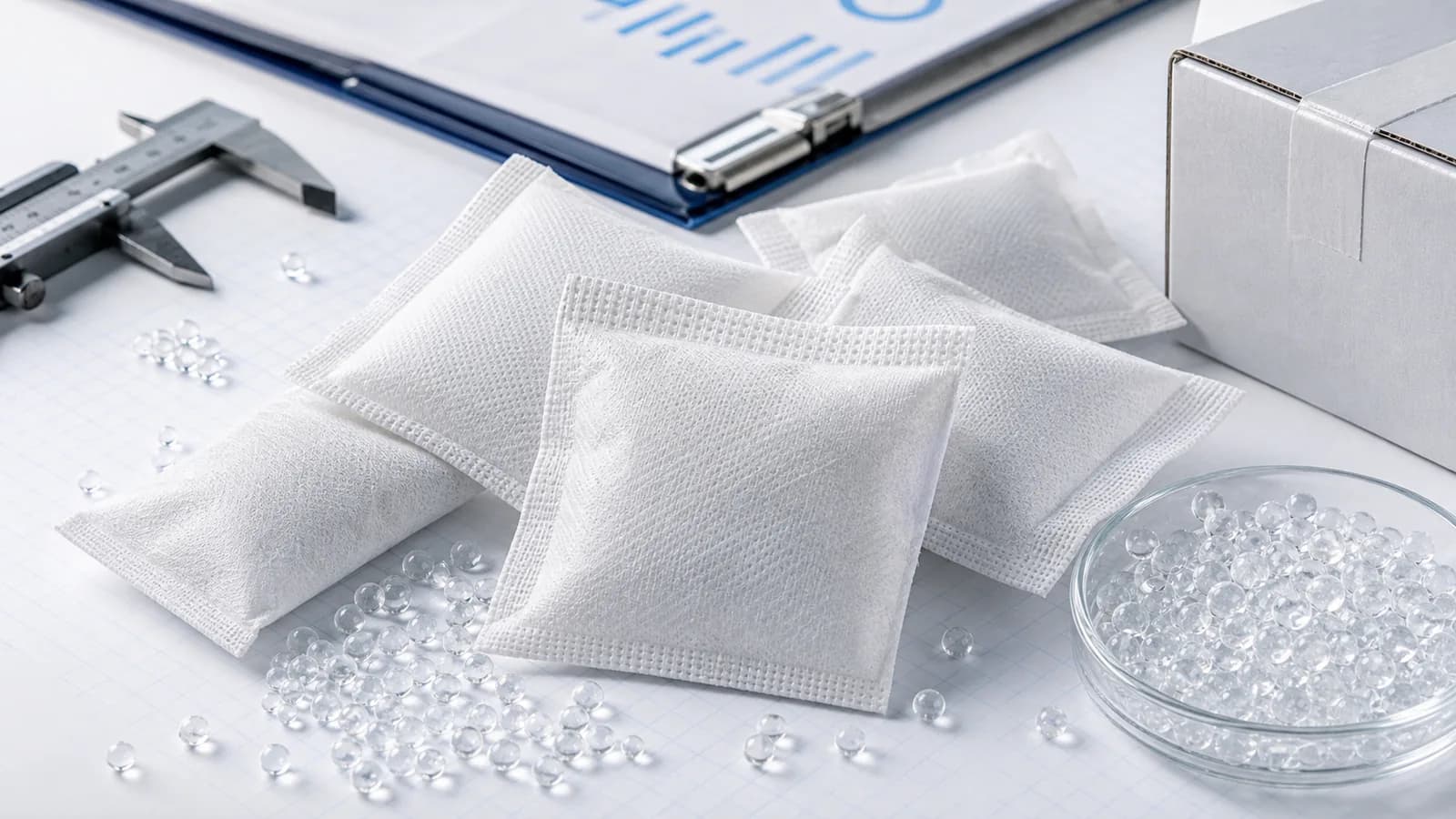
Regeneration pays off for bulk beads in reusable industrial systems (dry cabinets, desiccant dryers, closed-loop moisture control) where the same charge cycles repeatedly. It rarely makes sense for finished export sachets: the paper or non-woven sachet outer is single-use, oven heat can scorch or weaken it, and the labor of de-bagging, baking, and re-bagging usually exceeds the cost of fresh sachets. The honest rule: regenerate loose bulk beads; treat finished sachets and strips as single-use. Buyers running dry cabinets or reusable dryers should buy bulk beads specifically; buyers protecting one-way export shipments should buy fresh sachets and not attempt to reuse them.
- Worth it: bulk beads in dry cabinets, desiccant dryers, closed-loop systems.
- Not worth it: finished export sachets (single-use outer, scorch risk, labor cost).
- Rule of thumb: regenerate bulk beads; treat sachets/strips as single-use.
- Reusable systems → buy bulk beads; one-way export → buy fresh sachets.
Safety and capacity over repeated cycles
Silica gel is non-toxic and non-flammable, but regeneration still has safety basics: use oven mitts (beads hold heat), keep the gel away from open flame, and vent the moisture in a ventilated space. Over many cycles, capacity gradually declines as some pore structure is lost and fines accumulate - expect very good recovery for the first several cycles and a slow fade after that. For QC-critical applications, periodically verify capacity (weigh dry, expose to known humidity, reweigh) rather than assuming infinite reuse. When recovered capacity drops noticeably below fresh, retire the charge. DryGelWorld supplies bulk beads suited to reusable systems and can advise on a regeneration regime for your equipment.
- Non-toxic/non-flammable, but use mitts, avoid open flame, vent the moisture.
- Capacity slowly declines over many cycles (pore loss + fines).
- Strong recovery early; slow fade later - verify capacity for QC-critical use.
- Retire the charge when recovered capacity drops well below fresh.
- Bulk beads are the right format for reusable, regenerated systems.
References
- Silica (silicon dioxide, SiO2) — compound summary, CID 24261 , National Institutes of Health (PubChem)
- Water vapor desorption from silica gel in a combined drying and double-condenser compression refrigeration system (Heliyon, 2022) , PubMed Central, U.S. National Library of Medicine
- Drying and Preserving Plant Materials for Decorative Uses (CIR495/EP004) , UF/IFAS Extension, University of Florida
- Cobalt chloride (CoCl2) — compound summary, CID 3032536 , National Institutes of Health (PubChem)
- Silica — ToxFAQs , Agency for Toxic Substances and Disease Registry (CDC)