
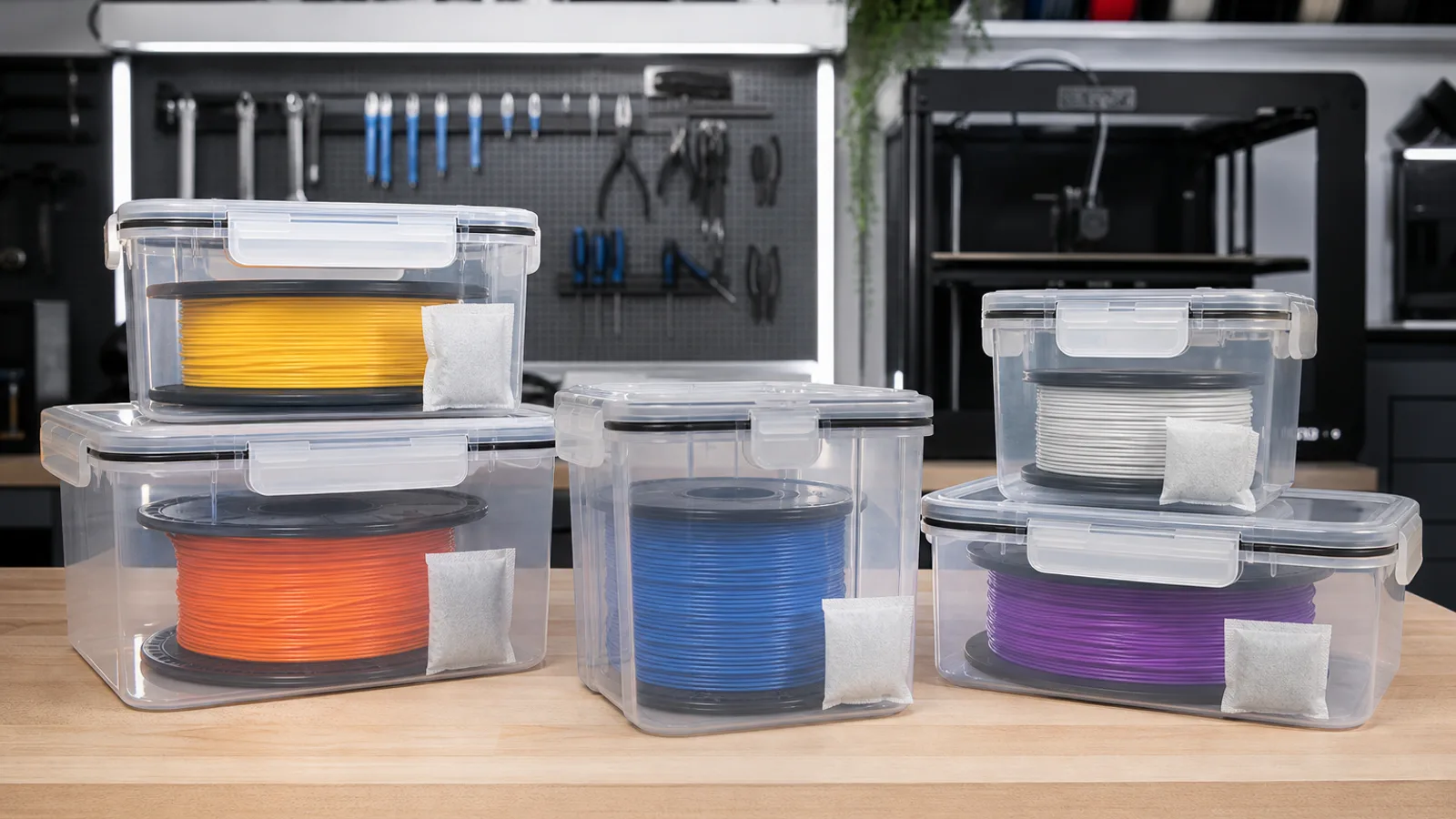
What moisture does to filament, and how early it starts
Most printing polymers are hygroscopic: they pull water out of the air and hold it between the polymer chains. When that filament reaches the hot end, the trapped water flashes to steam inside the melt. The visible symptoms are popping and hissing during extrusion, stringing between travel moves, a rough or foamed surface, and poor layer adhesion that shows up as parts snapping along layer lines. The important part is that mechanical strength degrades well before the surface looks bad, so a print that appears acceptable can already be significantly weaker than it should be.
- PLA is relatively tolerant but not immune, and degrades over weeks in humid storage.
- PETG, nylon, TPU and PVA absorb water quickly - nylon can be measurably wet within a day of open exposure.
- The damage is reversible by drying the filament, up to a point. Hydrolysis at high temperature is not.
How much silica gel a spool actually needs
The usual mistake is a single small sachet dropped into a large bag. Silica gel adsorbs up to about 40 percent of its own weight in water, but the figure that matters is not the total capacity - it is whether there is enough gel to pull the enclosed air down to a low humidity and hold it there against the slow leakage every container has. For a standard one-kilogram spool in a sealed bag or box, a useful working quantity is 50 to 100 grams of gel, not the two-gram sachet that shipped with the filament. Multiple spools in one box need proportionally more, and a box opened daily needs more again.
- 50 to 100 g per spool in a sealed container is a sensible starting point.
- The container matters as much as the gel. A zip bag that leaks defeats any quantity.
- Filament that is already wet must be dried first - desiccant maintains dryness, it does not rescue a soaked spool quickly.
Use indicating gel, and buy a hygrometer
Plain white silica gel gives no signal at all. It looks identical saturated and dry, so the common failure mode is a storage box that has been doing nothing for months. Orange indicating gel changes colour as it loads and is cobalt-free. Blue indicating gel also changes colour but contains cobalt chloride, which is restricted in the EU under REACH, and it should never be described as cobalt-free. Better still, put a cheap digital hygrometer in the box: it tells you the actual humidity rather than the state of the desiccant, which is the number you actually care about.
- Target below about 20 percent relative humidity inside the container for hygroscopic filaments.
- Orange indicating gel: cobalt-free, changes colour when saturated.
- Blue indicating gel: contains cobalt chloride. Not cobalt-free, and restricted in the EU.
Regenerating the gel instead of replacing it
Silica gel is reusable indefinitely in practical terms. Once saturated, heat drives the water back off and the beads return to full capacity. Spread them in a shallow single layer rather than a pile, because a heap dries only on the surface and you will put damp gel back in the box. Do not regenerate gel in a sealed sachet in a domestic oven if the sachet material is not rated for it - loose beads in a tray are the safe approach.
- 150 degrees Celsius, or 300 Fahrenheit, is the working regeneration temperature.
- Cool the beads in a sealed container, not on the counter, or they simply reload with room air.
- Indicating gel returning to its dry colour is the signal that the cycle is complete.