
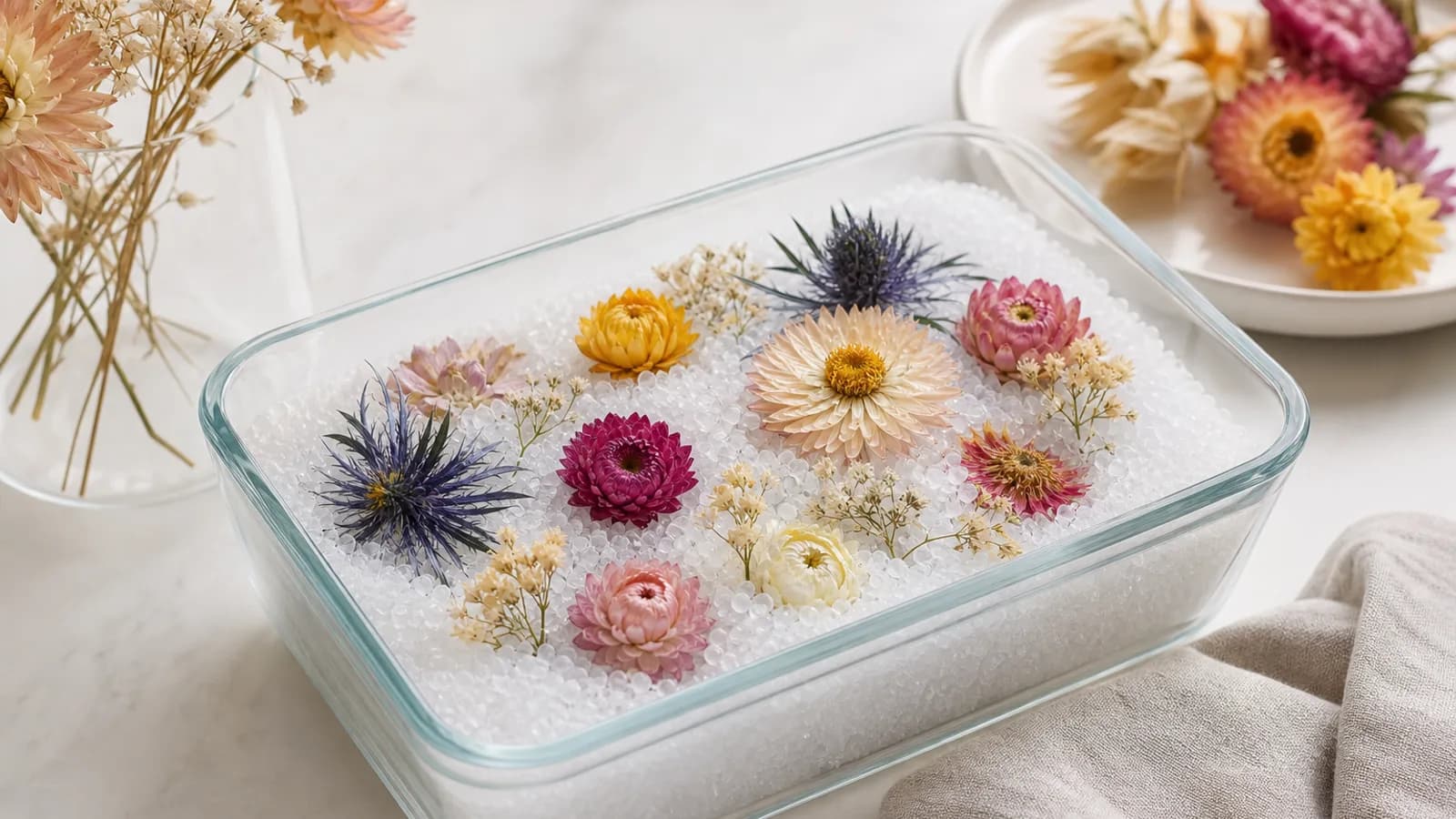
Why silica gel beats air drying, and what it is actually doing
Hanging a flower upside down to air dry removes water slowly from the outside in, and gravity flattens the petals while it happens. The result is brittle, browned, and half the original size. Silica gel works differently: the flower is buried so every petal is supported, and the beads draw water vapour out of the surrounding air rather than off the petal surface directly. The petal loses moisture into that dry pocket while its shape is held. Colour survives because the drying is fast enough that pigments do not have time to oxidise. Silica gel adsorbs up to roughly 40 percent of its own weight in water, which is why a relatively small quantity can dry a flower that is mostly water.
- The gel never touches the water as liquid - it lowers the humidity of the air immediately around the petal.
- Support on all sides is the point. Remove it and you are just air drying in a box.
- Speed preserves colour; a flower that takes two weeks to dry will brown regardless of method.
Bead size is the variable that decides the result
Most guides say 'silica gel' and stop there, which is why results vary so much. Coarse industrial beads of 2 to 5 mm are the wrong tool: they cannot flow between petals, so they leave gaps where the petal is unsupported and they emboss dimples into soft tissue. Fine granular silica gel, under about 1 mm, pours like dry sand and finds its way into the throat of a bloom without deforming it. If the only gel available is coarse, it can still work for robust, flat-faced flowers, but delicate multi-petal flowers need the fine grade. This is a genuine material difference, not a preference.
- Under 1 mm: correct for roses, peonies, ranunculus, anything with layered petals.
- 2 to 5 mm beads: acceptable only for flat, sturdy flowers such as daisies or pansies.
- Orange indicating gel shows saturation by colour change and is cobalt-free. Blue indicating gel contains cobalt chloride and is not.
The method
Use an airtight container, because gel that is busy adsorbing room humidity is not drying your flower. Pour a base layer about two centimetres deep, sit the bloom on it face up if it is a cup shape or face down if it is flat, then trickle gel around and between the petals rather than dumping it on top. The trickling matters: poured in bulk it pushes petals out of position and they set that way. Keep going until the flower is completely covered with a centimetre or two above it, seal the container, and leave it somewhere at room temperature.
- Cut the stem short before burial. Long stems dry unevenly and snap at the join.
- Never seal a container that is only half full of gel - the empty air space holds moisture.
- Do not open it to check every day. Each opening lets room humidity in and resets progress.
How long, by flower type
Drying time is a function of how much water the flower holds and how thick its tissue is, not of the gel. These are working ranges rather than guarantees, and a humid room extends all of them. The flower is done when the petals feel papery and make a faint rustle rather than bending softly. If it still feels cool to the touch it is still wet inside, whatever the surface says.
- Thin single-layer flowers such as pansies and violets: two to three days.
- Roses, carnations, and other layered blooms: four to seven days.
- Thick, fleshy flowers such as peonies, lilies, and dahlias: seven to ten days, sometimes longer.
- Foliage and ferns: one to two days, and they scorch easily if left too long.
Reusing the gel, and the one temperature that matters
Silica gel is not consumed. Once it is saturated it can be regenerated by driving the adsorbed water back off with heat, and the same batch will serve for years. The temperature is the thing people get wrong: too low and the water does not leave, too high and the pore structure begins to collapse and the gel loses capacity permanently. Spread it in a single shallow layer rather than a heap, because a deep pile dries only at the surface.
- 150 degrees Celsius, or 300 Fahrenheit, is the working figure. See the full regeneration guide for times by quantity.
- Indicating gel tells you when it is done by returning to its dry colour.
- Let it cool in a sealed container. Cooling in open air simply reloads it with room humidity.