
The chemistry difference, in plain language
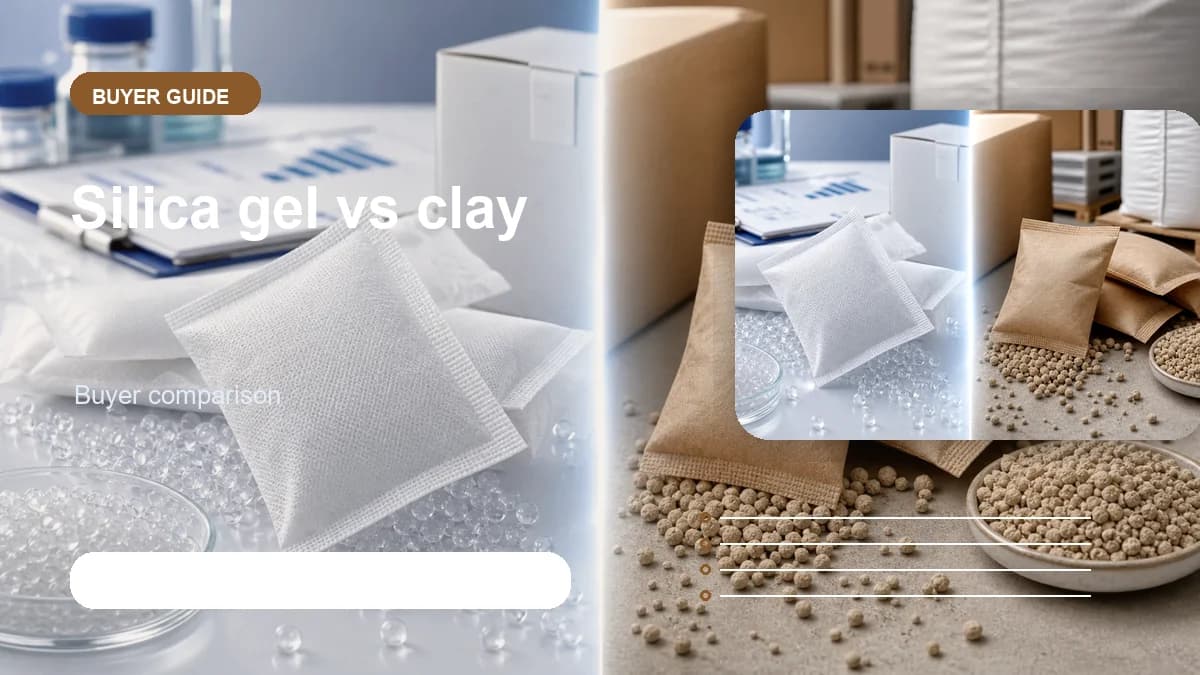
Silica gel and clay desiccants both absorb humidity, but they do it through different chemistry. Silica gel is amorphous silicon dioxide (SiO₂) - a synthetic, highly porous bead. Its huge internal surface area is what makes it grab water vapor through physical adsorption. Activated clay (typically bentonite or montmorillonite) is a natural mineral that has been heat-treated to expose its layered structure. Both work, but they behave differently across humidity ranges, temperature swings, and packaging environments. Understanding the chemistry is the first step in buying the right one for your shipment.
- Silica gel is synthetic, manufactured to consistent porosity and bead size - every sachet performs the same.
- Clay is mined and activated; performance varies more between batches and suppliers.
- Silica gel is chemically inert against most cargo materials; clay is also inert but can leave fine dust if the sachet is damaged.
- Neither is toxic at human-contact level, but neither is meant to be eaten - both should be packed with DO NOT EAT printed.
Adsorption capacity: the real numbers
This is the single most important number to compare. DryGelWorld silica gel adsorbs up to one-third (about 33%) of its own weight in water vapor. Typical activated clay adsorbs around 24-28% of its own weight under the same conditions. That makes silica gel roughly 35% more efficient on a per-gram basis - meaning a 5g silica gel sachet does the work of about a 7g clay sachet. For high-volume export programs that translates into less weight in your container, smaller sachets in your cartons, and cheaper freight per protected unit. Where clay can win is at very low humidity (below 20% RH), where it picks up moisture more aggressively in the early hours; silica gel maintains a steadier curve across the whole humidity range.
- Silica gel: up to 33% of own weight in water vapor adsorbed.
- Activated clay: typically 24-28% of own weight.
- Per-gram: silica gel is ~35% more efficient overall.
- Below 20% RH: clay's adsorption rate is initially faster.
- Above 40% RH: silica gel pulls clearly ahead and holds more vapor.
- For container shipments crossing tropical-to-temperate routes, silica gel's higher upper-end capacity matters more than clay's low-RH advantage.
Cost vs performance - the trade-off most buyers miss
Clay desiccant is cheaper per kilogram than silica gel. That's the headline. But the real cost comparison is per-unit-of-protection, not per-kilogram. Because silica gel adsorbs ~35% more per gram, a buyer who switches to clay 'to save cost' often ends up using more grams per carton to get equivalent protection - and the saving narrows quickly. For cost-sensitive industrial cargo (durable goods, parts, machinery) where the moisture risk is mainly mild oxidation, clay is a reasonable choice. For precision cargo, leather, electronics, pharma-style packaging, or any situation where damage costs more than the desiccant, silica gel almost always pencils out cheaper once you account for the actual protection delivered.
- Per kilogram: clay is cheaper.
- Per-unit-of-moisture-adsorbed: silica gel is competitive or cheaper.
- For low-risk industrial cargo: clay can win on raw cost.
- For high-value cargo: silica gel almost always wins on total cost of risk.
- Many programs use BOTH: clay for cost-tier carton-level protection, silica gel for precision-tier and container-level protection.
Format compatibility: which packs into what
Both materials are available as sachets, bags, and bulk fill - but the format range is not symmetric. Silica gel comes in cleaner small-format sachets (0.5g, 1g, 2g, 3g, 5g, 10g) which fit inside individual product packs and pharma-style bottles; that small-sachet range is genuinely silica-gel territory. Clay is more commonly supplied in larger formats (5g and above) because the bead structure of clay makes very small sachets harder to manufacture cleanly. At the container level, both are available as 1kg-5kg cargo strips, and either material works for hanging-strip placement on a container ceiling. For private-label sachet programs - printed sachets with carton labeling - silica gel is the cleaner choice because the breathable paper sachet stays neater and the printing prints crisper on a low-dust filling.
- Silica gel sachets: 0.5g, 1g, 2g, 3g, 5g, 10g, 25g, 50g, 100g, 250g, 500g.
- Silica gel container strips: 1kg, 2kg, 3kg, 5kg.
- Clay sachets: typically 5g and above, less common at the unit-pack level.
- Clay container strips: yes, comparable kg formats.
- Private-label printing on sachets: cleaner on silica gel paper sachets.
- Bulk loose for re-packers: both available, kg pricing applies.
Documentation and compliance: where buyers get burned
Documentation is where the silica-gel-vs-clay decision turns from a price question into a regulatory one. Silica gel has a well-established document trail in international export; reputable manufacturers can usually supply ISO 9001:2015 quality references, batch COAs, SDS sheets, and DMF-free product statements. Clay desiccant has the same document categories on paper, but document quality varies more by supplier. For buyers exporting to regulated markets, silica gel typically has the cleaner paperwork story. DryGelWorld supports ISO 9001:2015, SDS, COA, and DMF-free statements on request. Formal FDA, REACH, Halal, and food-grade certifications are not credentials currently held by DryGelWorld, so buyers should confirm those requirements before commercial terms.
- ISO 9001:2015: held for the silica gel manufacturing line.
- SDS, COA: available for both silica gel and clay on request.
- DMF-free statement: product-level claim for the silica gel.
- FDA, REACH, Halal, food-grade certification: buyer-specific compliance review - confirm before commercial terms, do not assume coverage.
- For pharma packaging programs: silica gel's cleaner document story matters more than the per-kg price.
Reusability and regeneration
Both materials can be regenerated by driving off the absorbed moisture with heat. Silica gel regenerates at 150°C (max 250°C); activated clay regenerates at lower temperatures, typically 100-120°C. Sounds like clay is the easier-to-reuse option - but in practice, clay's lower regen temperature is offset by its lower upper-bound capacity, so the energy-per-unit-of-future-protection is similar. For most B2B buyers, regeneration is not the main consideration: container-level cargo strips are sized to be saturated by end-of-voyage and treated as single-use consumables, regardless of material. Regeneration is more useful in laboratory and small-scale industrial contexts.
- Silica gel regen: 150°C (max 250°C).
- Clay regen: typically 100-120°C.
- Per-unit-of-protection energy cost: roughly comparable.
- Container-grade strips: usually single-voyage consumables either way.
- Lab and small industrial use: regeneration is genuinely cost-saving for both materials.
When to pick each - a decision matrix
After all the chemistry and pricing, the practical decision usually comes down to four questions: what cargo, what value, what route, and what document requirements. Use this as a quick-reference matrix when sizing a moisture program. Most established export programs end up using both materials at different layers - clay at the cost-tier carton level for industrial cargo, silica gel at the precision-tier carton level and at the container ceiling for high-value and high-risk routes.
- Pick silica gel when: cargo is precision/leather/electronics/pharma; route is tropical-to-temperate; documents are scrutinized; private-label printing matters; small sachets are needed.
- Pick clay when: cargo is durable industrial goods; route is short and climate-stable; cost-per-kg is the dominant constraint; sachet format is 5g or above.
- Use BOTH when: program has mixed cargo types and you want a tiered moisture control portfolio across the same shipment.
- Default to silica gel when: in doubt, or when the cost of cargo damage exceeds 10x the cost of the desiccant.
Common mistakes buyers make
The most common mistake is buying on per-kilogram price without doing the per-unit-of-protection math - which is how a cost-saving switch from silica gel to clay can quietly increase total moisture-related claim cost. The second-most-common is assuming clay is automatically food-grade or pharma-compliant because it's a 'natural' material - neither material is automatically certified for either market without supplier-specific documentation. The third is mixing up terminology: 'silica' is sometimes used loosely to mean any desiccant, but technically only synthetic silicon dioxide qualifies. When in doubt, ask the supplier for a material datasheet that names the specific material (silicon dioxide vs activated bentonite vs activated montmorillonite) and confirms the document set.
- Mistake: buying on per-kg price instead of per-unit-of-protection.
- Mistake: assuming 'natural' clay is automatically food-grade.
- Mistake: confusing silica gel with molecular sieve or activated alumina.
- Mistake: not requesting batch COA when buying at export scale.
- Mistake: ordering small sachets (under 5g) in clay format - likely won't pack cleanly.
References
- Silica (silicon dioxide, SiO2) — compound summary, CID 24261 , National Institutes of Health (PubChem)
- Bentonite — compound summary, CID 71586775 , National Institutes of Health (PubChem)
- DIN 55473:2021-07 — Auxiliary means of packaging - Desiccant in bag - Technical delivery conditions , DIN Media (German Institute for Standardization)
- MIL-D-3464 — Desiccants, activated, bagged, packaging use (ASSIST Quick Search) , U.S. Defense Logistics Agency
- 2.3: BET Surface Area Analysis of Nanoparticles , Chemistry LibreTexts