
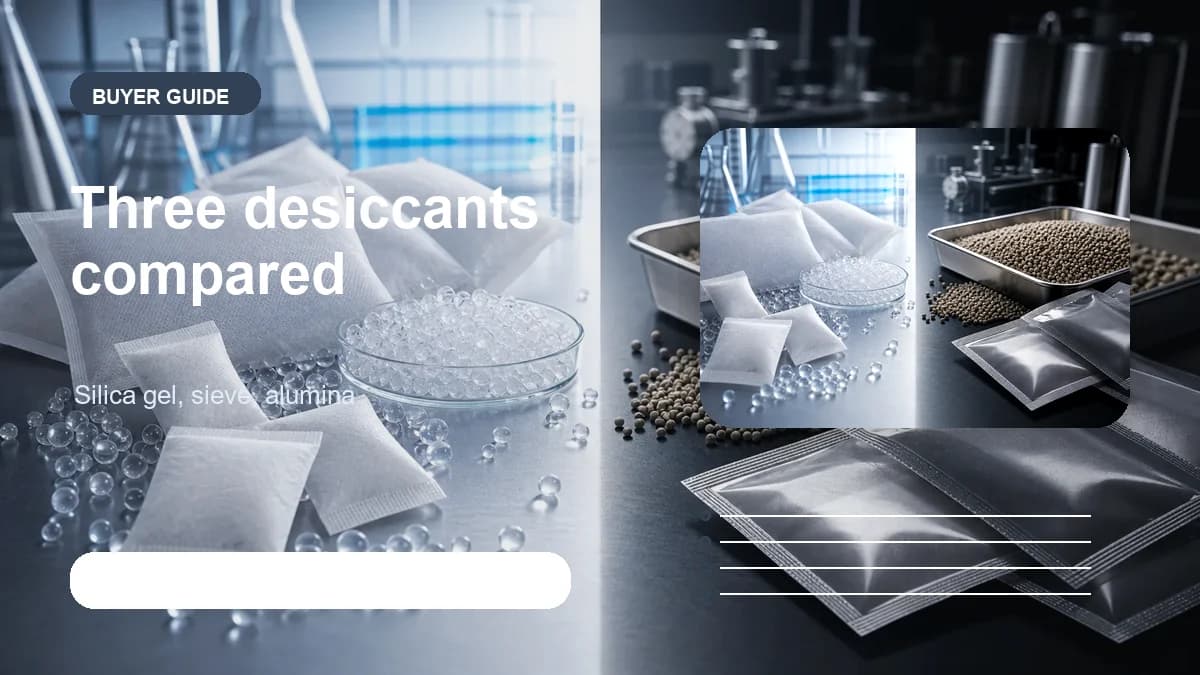
The three desiccants in plain language
Three industrial desiccants dominate B2B moisture control. Silica gel is the everyday workhorse - synthetic amorphous silicon dioxide, broad humidity range, balanced cost. Molecular sieve is the precision tool - synthetic crystalline zeolite with extremely uniform pore sizes (3A, 4A, 5A, 13X), built for very low humidity and selective adsorption. Activated alumina is the gas-drying specialist - synthetic aluminum oxide, optimized for compressed air dehydration, fluoride removal from water, and refinery gas processing. Each has a sweet spot. Most B2B export packaging buyers default to silica gel because it covers the widest range of practical situations; molecular sieve and activated alumina are specialist tools that earn their cost in narrow applications.
- Silica gel: amorphous SiO₂; broad RH range; cost-balanced; the default for export packaging.
- Molecular sieve: crystalline zeolite; uniform pore sizes; best at very low RH; premium cost.
- Activated alumina: Al₂O₃; gas drying and fluoride removal; premium cost; specialist applications.
- Silica gel covers ~80% of B2B packaging applications. The others are specialist tools.
Adsorption mechanism: why pore structure matters
Silica gel has a random, amorphous internal pore structure with a wide pore-size distribution. That gives it a huge total surface area (roughly 600-800 m² per gram) and broad-spectrum capture of water vapor across humidity levels. Molecular sieve, by contrast, has crystalline pores of precisely engineered diameter - 3 angstroms (3A), 4 angstroms (4A), 5 angstroms (5A), or 10 angstroms (13X). Molecules larger than the pore size simply cannot enter. That makes molecular sieve a kinetic sieve, not just a sponge - it can selectively capture water while leaving larger molecules untouched, which is critical in pharmaceutical and chemical processes. Activated alumina sits between them: medium-uniform pores, high surface area, and a chemistry that pulls fluoride and water particularly well from gas streams.
- Silica gel: ~600-800 m²/g surface area; random pore distribution; broad capture.
- Molecular sieve 3A: pore size 3 angstroms - captures water, excludes most other molecules. Used in pharma and refrigerant drying.
- Molecular sieve 4A: 4 angstrom pores - captures water plus some small organics.
- Molecular sieve 13X: 10 angstrom pores - captures water plus larger contaminants like CO₂.
- Activated alumina: ~200-400 m²/g; specialist for compressed air, fluoride, and gas drying.
Adsorption capacity: the real numbers
On paper, silica gel wins capacity. It adsorbs up to one-third (about 33%) of its own weight in water vapor. Molecular sieve adsorbs around 20-22% of its weight; activated alumina around 18-20%. So per gram, silica gel holds the most water - but here's the catch. Capacity is not the only measure of performance. Molecular sieve adsorbs water at much lower humidity levels (it can drive a sealed environment down to <1% RH), while silica gel runs out of steam below ~20% RH. Activated alumina similarly works at very low RH for gas drying. So the right number depends on what RH range you're operating in. For a sealed shipping container starting at 60-80% RH and cycling between 30-90%, silica gel's high upper-end capacity is the dominant factor. For a laboratory glovebox that needs <5% RH at all times, molecular sieve is the right tool even at lower per-gram capacity.
- Silica gel: ~33% of own weight (best raw capacity).
- Molecular sieve: ~20-22% of own weight (lower capacity but works at <1% RH).
- Activated alumina: ~18-20% of own weight (specialist gas drying).
- Above 40% RH: silica gel wins clearly.
- Below 20% RH: molecular sieve and activated alumina pull ahead.
- Container shipments and warehouse storage: silica gel is the right tool.
- Laboratory dry-room and gas-drying applications: molecular sieve / activated alumina.
Cost tiers: silica gel is roughly half the others
Cost ranking is consistent across markets: silica gel is cheapest per kilogram, molecular sieve and activated alumina are roughly 1.5-2.5× the price. Within molecular sieve grades, 13X (the largest pore) is more expensive than 3A or 4A. Activated alumina sits in similar territory to molecular sieve. For an export packaging buyer protecting a 40-foot container of leather goods on a 30-day Karachi-to-Hamburg voyage, silica gel cargo strips at the container ceiling (~5 kg total) are the right tool both technically and economically. Trying to do the same job with molecular sieve would cost roughly double, deliver similar protection above 20% RH, and waste capacity at the low-RH end where the cargo never operates.
- Silica gel: cheapest per kg of the three.
- Molecular sieve 3A/4A: ~1.5-2× silica gel price.
- Molecular sieve 13X: ~2-2.5× silica gel price.
- Activated alumina: ~1.5-2× silica gel price.
- Per-unit-of-protection in packaging: silica gel wins clearly.
- Per-unit-of-protection in low-RH industrial applications: molecular sieve can win despite higher cost.
Regeneration temperatures
Each desiccant has a different regeneration profile. Silica gel regenerates at 150°C (max 250°C) - moderate heat, easy in any commercial oven. Molecular sieve needs 200-300°C, sometimes higher. Activated alumina is the toughest to regenerate, often requiring 350-450°C. For B2B buyers running container-grade or carton-grade single-voyage desiccant, regeneration is rarely an economic factor - strips and sachets are treated as consumables. Where regeneration matters is laboratory drying, gas-purification systems with regenerable beds, and large industrial dryers where the bed is designed to cycle hundreds or thousands of times. For those applications, the lower regen temperature of silica gel is a real operational advantage.
- Silica gel: 150°C (max 250°C) - easiest to regenerate.
- Molecular sieve: 200-300°C - moderate energy cost.
- Activated alumina: 350-450°C - highest energy cost.
- Container/carton-grade single-voyage desiccant: regeneration economically irrelevant.
- Industrial gas-drying beds and lab desiccators: regeneration matters; silica gel often wins.
Use case decision matrix
Rather than ranking them as 'better' and 'worse', think of these three desiccants as different tools. Silica gel is the multi-purpose tool - it covers most B2B export packaging, container moisture control, retail pack desiccation, leather and electronics shipping, and warehouse stabilization. Molecular sieve is the precision tool - laboratory dry-rooms, pharmaceutical processing where moisture must be driven below 5% RH, refrigerant drying, glove-box atmospheres, and any system where pore-size selectivity matters. Activated alumina is the gas-handling tool - compressed-air drying systems, refinery gas processing, fluoride removal from drinking water, and ozone generation. For most readers of this page - B2B export buyers - the answer is silica gel. Period.
- Pick silica gel when: cargo packaging, container shipping, warehouse storage, retail pack desiccation, leather and electronics protection. (Default for ~80% of buyers.)
- Pick molecular sieve when: laboratory dry-room, pharmaceutical low-RH processing, refrigerant or gas drying, glove-box atmosphere, pore-size-selective adsorption.
- Pick activated alumina when: compressed-air drying, refinery gas processing, fluoride removal, ozone generation, specialty gas treatment.
Common mistakes when picking between them
The most common mistake is buying molecular sieve for general packaging because someone said it's 'better.' For shipping container moisture control, molecular sieve has lower capacity than silica gel in the operating RH range and costs roughly twice as much - strictly worse for that use case. The second-most-common mistake is trying to use silica gel where molecular sieve is needed; if your application requires sustained <5% RH, silica gel will saturate and stop working long before the operation ends. The third is confusing the three categories: 'silica' is sometimes used loosely to mean any desiccant, but technically only synthetic amorphous silicon dioxide qualifies. When in doubt, ask the supplier for a material datasheet that names the specific material chemistry.
- Mistake: buying molecular sieve 'because it sounds better' for general cargo packaging.
- Mistake: forcing silica gel into low-RH applications where molecular sieve is the right tool.
- Mistake: confusing silica gel with molecular sieve in RFQ language.
- Mistake: not checking pore size when ordering molecular sieve (3A vs 4A vs 13X matters).
- Mistake: ordering activated alumina for packaging applications where it has no advantage over silica gel.
When combinations make sense
Some advanced B2B applications combine multiple desiccants in a single program. For instance, a pharmaceutical packaging line might use molecular sieve at the primary product level (bottle inserts requiring sustained <10% RH) and silica gel at the secondary carton level (controlling carton humidity at 30-40% RH). A natural gas processing system might use a silica gel pre-bed to remove the bulk of moisture and a molecular sieve polishing bed to drive residual moisture below 1% RH. These layered programs cost more upfront but deliver substantially better performance for high-stakes applications. For typical export packaging, layering is unnecessary - silica gel alone covers the practical range.
- Pharma packaging: molecular sieve in primary container + silica gel at carton level.
- Industrial gas processing: silica gel pre-bed + molecular sieve polishing bed.
- Lab drying systems: silica gel for general use + molecular sieve for ultra-low RH zones.
- Standard export packaging: silica gel alone is sufficient.
References
- Silica (silicon dioxide, SiO2) — compound summary, CID 24261 , National Institutes of Health (PubChem)
- Zeolites — substance summary , National Institutes of Health (PubChem)
- Database of Zeolite Structures , International Zeolite Association, Structure Commission
- Alumina (aluminium oxide, Al2O3) — compound summary, CID 9989226 , National Institutes of Health (PubChem)
- 2.3: BET Surface Area Analysis of Nanoparticles , Chemistry LibreTexts