
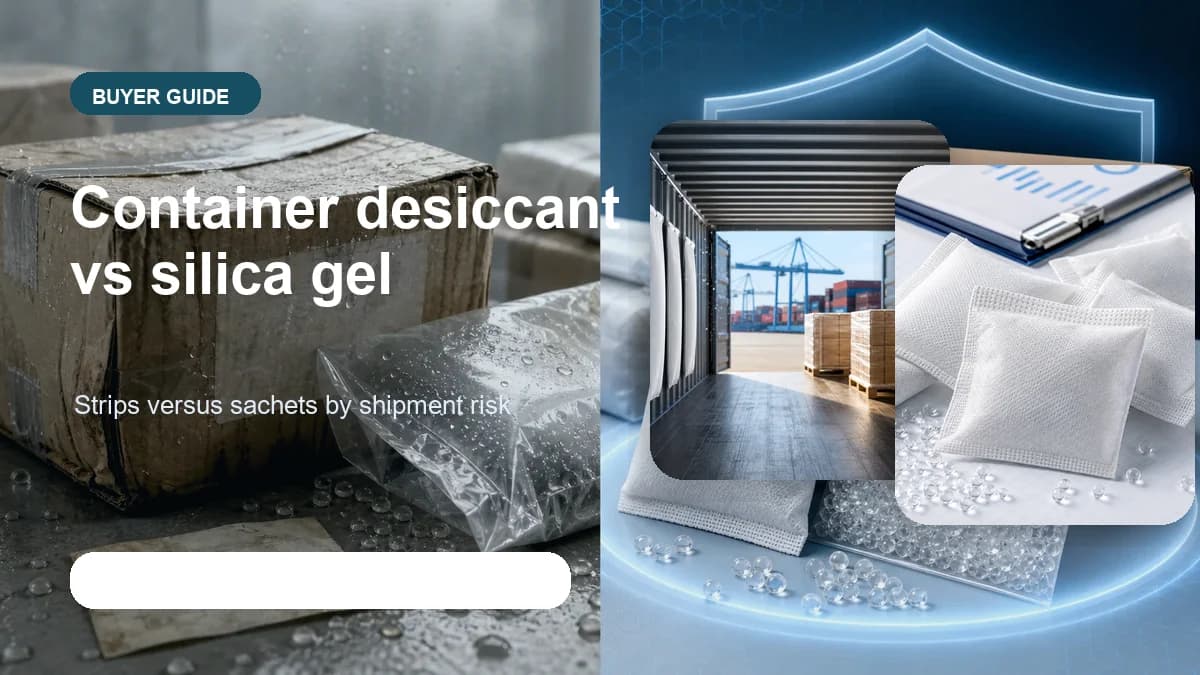
The naming confusion most buyers walk into
B2B buyers often ask 'should I use silica gel or container desiccant?' as if they're competing products. They're not. 'Container desiccant' describes a USE CASE - moisture control inside a shipping container. 'Silica gel' describes a MATERIAL - amorphous silicon dioxide. A container desiccant strip can be filled with silica gel OR with activated clay OR with calcium chloride; the product is the format, not the chemistry. Understanding this prevents the most common mis-buying decision in B2B desiccant procurement.
- Container desiccant = use case (moisture control inside a shipping container).
- Silica gel = material (amorphous silicon dioxide).
- The strip is the format; what's inside the strip is the material decision.
- Buyers who confuse the two often over-pay for inappropriate material choices.
Container-format desiccants - the actual product category
Container desiccants are large-format moisture absorbers designed to be hung at the container ceiling. Standard formats: 1kg, 2kg, 3kg, and 5kg multi-chamber strips. The strips have engineered air pockets so condensation moisture is absorbed efficiently from the container's internal air. They're treated as single-voyage consumables - at the end of the voyage, the strip is saturated and disposed (regeneration is technically possible but rarely economic at container-grade scale).
- Standard sizes: 1kg, 2kg, 3kg, 5kg multi-chamber cargo strips.
- Hung at container ceiling, distributed along the length.
- Designed for single-voyage use; saturation by end of voyage is the norm.
- Material inside the strip: silica gel OR activated clay OR calcium chloride.
Silica gel - the most common material inside container desiccants
When B2B buyers buy a container desiccant strip from DryGelWorld, what's actually inside is silica gel - amorphous silicon dioxide with porous bead structure. DryGelWorld supplies silica gel container strips because the material is more efficient per gram (~33% adsorption vs ~24-28% for clay) and has a cleaner document story for regulated buyers. Dry clay container strips are also available for cost-tier industrial cargo where the per-kg savings justify the lower adsorption capacity.
- DryGelWorld container strips default to silica gel material.
- ~33% of own weight in water vapor adsorbed.
- ~35% more efficient per gram than typical clay desiccant.
- Regenerable at 150°C if needed; rarely economic at container scale.
- Dry clay strips also available for cost-tier industrial cargo.
Sachet-format silica gel - the other side of the protection layer
Silica gel is also sold in sachet format - 0.5g, 1g, 2g, 3g, 5g, 10g, 25g, 50g, 100g, 250g, 500g - designed to fit inside product packs, master cartons, and unit packaging. Sachets protect the cargo at the box level; strips protect the container at the ceiling level. A complete program uses BOTH: sachets in each carton + strips at the container ceiling. They solve different problems and are NOT alternatives.
- Silica gel sachets: 0.5g-500g, for product packs and cartons.
- Silica gel strips: 1kg-5kg, for container ceiling.
- Sachets protect cargo INSIDE cartons; strips protect container AIR.
- Complete program uses both - they layer rather than compete.
When buyers ask 'silica gel or container desiccant' - the right answer
The right answer is: both, for different layers of the same protection program. If forced to pick only one (which is the wrong question), the choice depends on cargo and route. For unit-level moisture sensitivity (electronics in antistatic bags, pharma in bottles, leather goods inside cartons), sachets at the carton level matter more than container strips. For bulk cargo in a 40-foot container on a 30-day tropical-to-temperate route, container-level strips matter more because the dominant threat is ceiling-condensation. Most mature export programs use both at appropriate scale.
- Unit-level moisture sensitivity: carton-level sachets matter most.
- Bulk cargo on long-haul ocean: container-ceiling strips matter most.
- Most mature programs: both layers, sized to cargo and route.
- Forcing a single-product answer usually under-protects the cargo.
References
- Silica (silicon dioxide, SiO2) — compound summary, CID 24261 , National Institutes of Health (PubChem)
- Bentonite — compound summary, CID 71586775 , National Institutes of Health (PubChem)
- Calcium chloride — compound summary, CID 5284359 , National Institutes of Health (PubChem)
- IMO/ILO/UNECE Code of Practice for Packing of Cargo Transport Units (CTU Code) , International Maritime Organization
- Container Desiccant Calculator | kg per 20ft & 40ft , DryGelWorld