
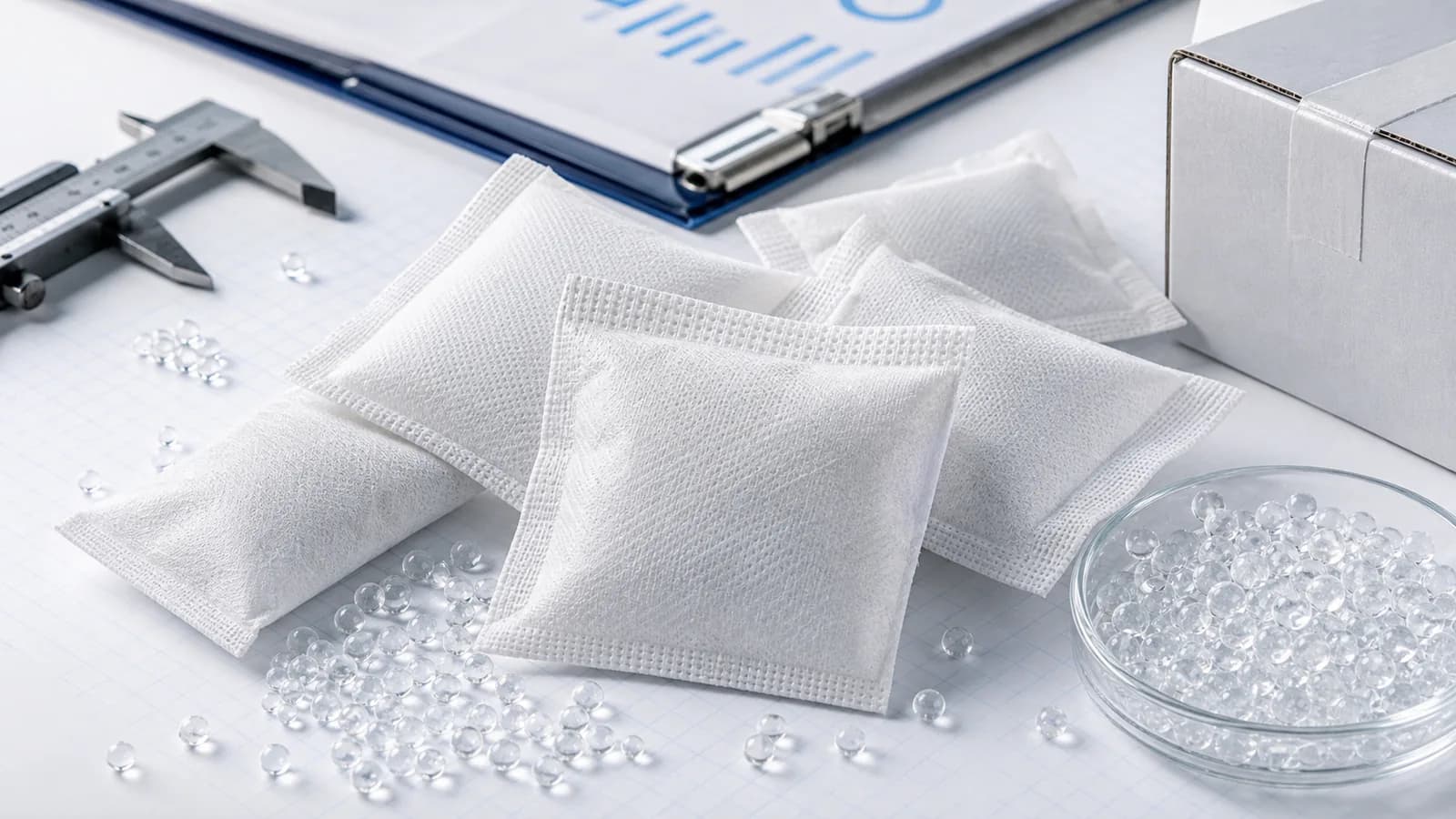
What a silica gel sachet manufacturer actually does
Silica gel sachet manufacturers, also called converters, take silica gel beads and fill them into breathable outers: paper, technical fibre, non-woven, or film-laminate. The value they add is in the sachet, not the chemistry: consistent fill weight, a dust-free outer that survives automated insertion, legible warning print, carton packing that keeps the sachets dry until the packing line opens them, and the documents an importer needs. Some converters make their own bead; most, including regional manufacturers, buy bead to a specification and convert it. Neither model is better; what matters is whether the converter controls fill weight, sachet integrity, and moisture content at the point of packing.
- Inputs: silica gel beads (white non-indicating as standard; cobalt-free orange indicating where a colour check is needed).
- Outputs: 0.5g to 500g sachets, printed private-label packets, container strips, and sometimes loose bead in 25kg bags for repackers.
- The converter's quality system covers fill accuracy, seal strength, dust, moisture content at packing, and lot traceability.
The seven things to compare between sachet manufacturers
Price per thousand is the last thing to compare, because it means nothing until the six items before it are the same. Compare these first.
- Fill weights offered: a full range (0.5g, 1g, 2g, 3g, 5g, 10g, 20g and up) shows a real line; a converter that only lists three sizes is often reselling.
- Outer materials: breathable paper for general packs; technical fibre or non-woven for low-dust electronics and precision parts; film-laminate where the sachet must not shed at all.
- Print and private label: warning text languages, logo, lot codes, and whether the converter prints in-house (shorter lead time) or subcontracts.
- MOQ structure: per size, per material, and per print run. Trial quantities before bulk are a sign the converter expects to keep the account.
- Packing: sealed inner liners or pouches inside the carton, so opened cartons do not spoil the whole batch on a humid packing floor.
- Documents: ISO 9001 certificate number and registrar, SDS, batch COA, DMF-free statement for leather programs; and an honest list of what is not held.
- Lead time and Incoterm: stock sizes in days, printed runs in one to two weeks, quoted on a named Incoterm at a named port.
Sachet size is a dosage decision, not a catalogue choice
A 1g sachet protects a sealed pack of roughly 0.001 to 0.01 cubic metres; a 2g sachet covers 0.01 to 0.02; a 5g packet a shoe box or similar carton; a 10g packet a master carton. Those are starting points at average export humidity with a reasonable barrier. Hygroscopic products, porous card-only packaging, and sea routes over three weeks push the size up or the count to two. A sachet manufacturer that asks about pack volume and route before quoting is doing its job; one that quotes 1g for everything is selling sachets, not protection.
- 1g: pill bottles, electronics accessory packs, small retail and shoe boxes.
- 2g: medium retail boxes, accessories, small leather goods, tool and parts packs.
- 5g: shoe boxes, garment cartons, boxed instruments and devices.
- 10g: master cartons, equipment cases, textile cartons; above that, 25g to 500g packs and container strips.
Where the sachet manufacturers are, and what that changes
Converters cluster near packaging demand. The USA (Multisorb, Desiccare, WiseSorbent's US arm) serves domestic pharma, electronics, and food packagers with short lead times and FDA-oriented documentation. Germany and Switzerland (Clariant's desiccant business) serve EU automotive and pharma with DIN 55473 units and REACH-aligned paperwork. China supplies the highest volume at the lowest unit price, typically through trading companies. India (Sorbchem and others) and Pakistan (DryGelWorld and a small number of other manufacturers) serve South Asian exporters of leather, textiles, and garments directly, and export finished sachets to the Gulf, Europe, and the UK on FOB and CIF terms. Location changes documentation defaults, lead time, and freight, not the silica gel.
- Buying for a regulated US or EU program: a domestic converter with the right registrations is usually the right call, even at a higher unit price.
- Buying for export cartons, footwear, textiles, or private label: a South Asian manufacturer with ISO 9001, SDS, COA, and DMF-free documents is often the most direct route.
- Buying raw bead by the tonne: go to a silica producer or its distributor, not a sachet converter.
Where DryGelWorld fits, honestly
DryGelWorld is a sachet manufacturer in Karachi, Pakistan, operating since 1983 and ISO 9001:2015 certified (certificate 9101225). It fills 0.5g to 500g sachets in paper, technical fibre, and non-woven outers, prints private-label packets, and makes container strips. It issues an SDS, batch COA, and DMF-free statement, and its dry clay ships in FSC-certified packaging. It does not hold FDA, food-contact, pharma GMP, Halal, or REACH registration, so direct-contact pharma and food programs should go to a converter that does. Where it fits is finished sachets for packaging, footwear, leather, textile, and electronics exporters, and mid-size private-label programs quoted in USD on FOB Karachi, CIF, or DAP terms.
- Dedicated size pages: 1g, 2g, 5g, and 10g silica gel sachets, each with dosage, materials, MOQ, and export notes.
- Indicative per-size USD references are published on the pricing page; firm prices are quoted per order.
- Buyers who need FDA DMF, food-contact, or REACH-registered material should read the top-10 supplier guide for the right alternatives.
References
- DIN 55473 desiccant units explained , DryGelWorld
- Paper vs Tyvek vs film desiccant sachet materials , DryGelWorld
- Top 10 silica gel suppliers in the world, and how to choose one in Pakistan , DryGelWorld
- Clariant Cargo and Device Protection , Clariant
- Multisorb Technologies , Multisorb (Filtration Group)
- Sorbchem India , Sorbchem India Pvt. Ltd.
- QMEC Group Intl - ISO 9001:2015 registrar , QMEC Group Intl