
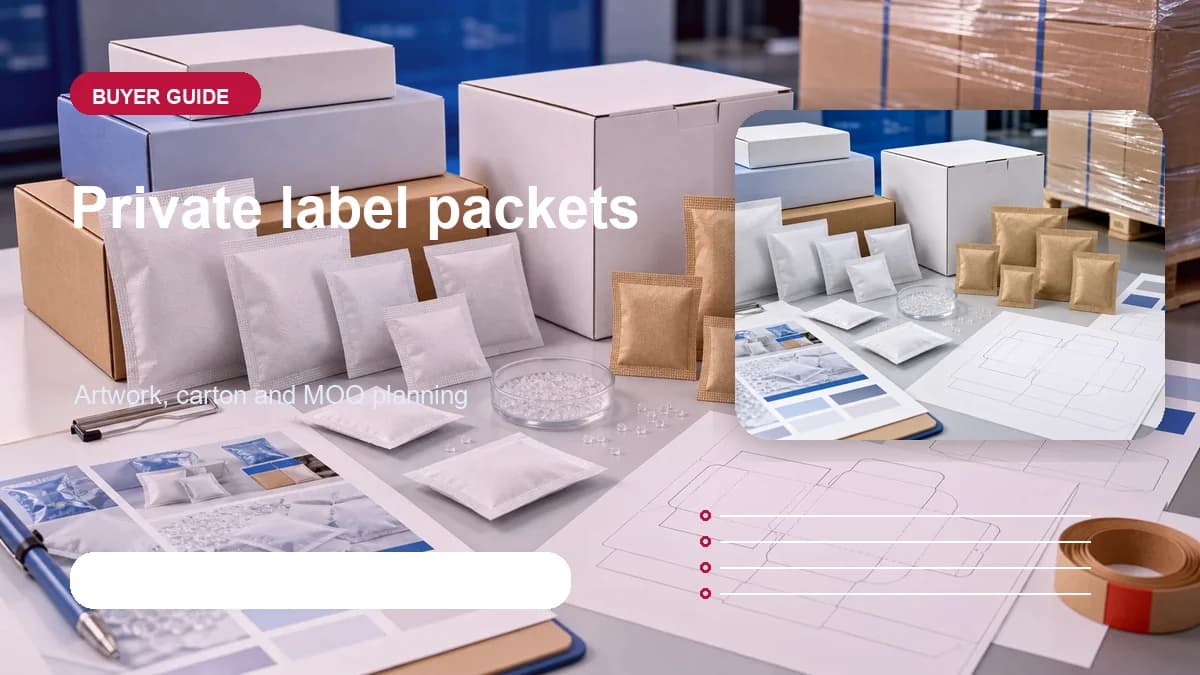
Private label isn't just printing a logo - it's process design
When a B2B buyer thinks 'private label silica gel,' the mental model is often 'standard packet with our logo on it.' That undersells what's actually happening. A private-label sachet is a packaging component that has to: (1) protect the product across its lifecycle, (2) carry legally-required safety warnings in the destination market's language, (3) fit the buyer's packaging line - automatic insertion, manual handling, or carton inclusion, (4) survive transit and shelf without losing legibility, (5) pass the buyer's QC document review, and (6) be reproducible across orders months apart. Treating private-label as a process design problem rather than an artwork problem is what separates programs that scale from programs that hit issues at order three.
- Private-label sachets are packaging components, not branded merchandise.
- Six functional requirements compete: protection, safety warnings, line compatibility, durability, QC, repeatability.
- Process-design framing prevents most order-three issues (artwork drift, packet inconsistency, document gaps).
- The buying team that gets private-label right at order one saves 2-3 cycles of rework on order three.
Sachet selection: size, material, and printing surface
Three decisions drive most of the private-label outcome. First, gram size: 0.5g-1g sachets have very limited print surface; 3g-10g sachets give enough surface for legible warning text and modest branding; 25g+ bags can carry full multi-line branding. Second, material: breathable paper sachets are the default for clean low-dust packaging; non-woven fiber for higher abrasion resistance; Tyvek for cleanroom-grade pharma (not yet in DryGelWorld catalog). Third, printing method: pre-printed packets are cost-effective at scale but require longer lead time; print-on-demand reduces lead time but raises per-unit cost. Most B2B programs settle on a 5g or 10g paper sachet with pre-printed warning text + buyer's brand identifier - good balance of print legibility, cost, and lead time.
- 0.5g-1g: limited print surface - typically only warning text fits.
- 3g-10g: enough surface for warning text + buyer's brand identifier.
- 25g+: full multi-line branding viable.
- Material: breathable paper (default), woven/non-woven fiber, Tyvek (expansion roadmap).
- Pre-printed at scale = cost-effective; print-on-demand = faster lead time, higher unit cost.
- Sweet spot for B2B: 5g-10g paper sachet, pre-printed.
Warning text rules: what's required, what's optional
Every silica gel sachet in B2B commerce should carry standard safety text - typically SILICA GEL, DESICCANT, DO NOT EAT, and THROW AWAY. These are non-negotiable. Beyond that, market-specific requirements vary: EU markets may require multilingual warning text; US consumer-facing packaging may require specific CPSIA language; GCC markets may require Arabic translation. Pharma packaging programs may require additional batch identifier or DMF-free statement on the packet. Lock the warning text language at RFQ stage - printing changes after artwork approval is expensive and slow.
- Universal standard: SILICA GEL · DESICCANT · DO NOT EAT · THROW AWAY.
- EU markets: consider multilingual text (EN + destination language).
- GCC markets: Arabic translation often expected on consumer-facing packs.
- Pharma packaging: batch identifier, DMF-free statement, or buyer-specific code.
- Print contrast: dark text on light packet material reads best; check legibility on a sample before bulk approval.
- Artwork changes after approval cost more than locking the text correctly upfront.
MOQ and lead time economics
Private-label MOQ depends on three things: packet size and material (small packets are cheaper per unit but require higher run quantity to make economic sense), custom print setup (plate and tooling cost amortizes across the order quantity), and the buyer's repeat-volume signal (monthly recurring programs unlock better MOQ and lead time than one-off orders). A standard rule of thumb: private label gets economically viable above 5,000 cartons per design for a 5g-10g paper sachet. Below that, plain packets with a separate carton label often deliver similar buyer-facing branding at a fraction of the cost. Buyers with strong forecast volume should share it explicitly at RFQ - it changes the supplier's MOQ math significantly.
- MOQ drivers: packet size, material, print complexity, repeat-volume signal.
- Standard private-label viability: 5,000+ cartons per design for a 5g-10g paper sachet.
- Below 5,000 cartons: plain packets + custom carton label is often the better economic choice.
- Forecast volume changes MOQ math - share monthly/quarterly forecast explicitly at RFQ.
- Lead time: plain packets ~2-3 weeks; custom print ~4-6 weeks from artwork approval.
Carton labeling - the part most buyers under-invest in
The carton label is the warehouse-facing identity of the order. It tells receiving, QC, and inventory teams what SKU, what lot, what gram size, and what customer is in the box. Without good carton labeling, even perfectly printed sachets get lost in distribution. A standard private-label carton label should include: customer brand or SKU code, packet gram size, packet count per carton, lot or batch number, production date, destination market, and any specific compliance markings (e.g. Halal logo if certified, EU CE if applicable). DryGelWorld supplies carton labels in standard format and can discuss custom formats at RFQ stage.
- Required fields: brand/SKU, gram size, count per carton, lot/batch, production date, destination.
- Optional: customer logo, compliance markings, distributor identifier, recycling codes.
- Standard carton label format available; custom formats discussed at RFQ.
- Carton labeling is often the difference between a program that runs smoothly and one that creates inventory chaos.
Document workflow for private-label programs
Private-label adds a documentation layer beyond standard supply. Buyers should request: artwork approval record (so future orders match approved spec), product specification sheet tied to the private-label SKU, SDS, COA per batch, ISO 9001:2015 reference, DMF-free statement (for EU-bound leather and consumer goods), and any market-specific document the destination requires. DryGelWorld supplies SDS, COA, ISO 9001:2015 reference, and DMF-free statement on request. The artwork approval record and product spec sheet should be maintained by both supplier and buyer as the canonical reference for future orders.
- Artwork approval record - locks visual identity across reorders.
- Product specification sheet - links the private-label SKU to the underlying product.
- SDS, COA, ISO 9001:2015 reference - standard documentation supplied on request.
- DMF-free statement - critical for EU-bound leather, footwear, consumer goods.
- Market-specific docs (FDA, REACH, Halal, FSSC, etc.) - confirmed per destination market and not held as blanket credentials, must be confirmed at RFQ.
Building a private-label program that scales across reorders
First-order private label is the easy part. The discipline matters at orders three through ten - when artwork drift, supplier confusion, and inconsistent QC start to compound. Patterns that work for scaling: lock the artwork in version-numbered files (artwork-v1.pdf, etc.) shared between buyer and supplier, keep a master product spec sheet that names sachet weight, material, print spec, and carton format, schedule a quarterly artwork-and-spec review even if no changes are planned, maintain photo records of approved samples to compare future shipments against, and pre-clear any artwork changes through both supplier QC and buyer marketing before triggering reprints. These are mechanical disciplines, not strategic ones - but they're what separates B2B private-label programs that run for years from programs that quietly break at order four.
- Version-control artwork files; share v-numbered PDFs explicitly.
- Master product spec sheet maintained jointly by supplier and buyer.
- Quarterly artwork-and-spec review even if no changes planned.
- Approved-sample photo record for shipment comparison.
- Pre-clear artwork changes through supplier QC and buyer marketing before reprint triggers.
- Mechanical disciplines, not strategic - but the difference between programs that scale and programs that quietly break.
OEM vs distributor private label - different procurement patterns
Two B2B private-label models share the same supplier infrastructure but follow different procurement patterns. OEM private label (where the buyer is the brand and the sachet goes into their consumer product) is print-intensive - packet artwork matters, branding compliance matters, line integration matters. Distributor private label (where the buyer resells the sachets under their own brand to downstream customers) is carton-intensive - outer carton branding, distributor logo, and supplier identification matter more than packet-level print. Match the procurement effort to which model you're running; over-investing in OEM-level print for a distributor program (or vice versa) wastes setup cost and lead time.
- OEM private label: packet artwork primary; carton labeling secondary.
- Distributor private label: carton labeling primary; packet print often plain or minimal.
- Hybrid (brand owner + distributor): both layers customized; highest setup cost but cleanest scaling.
- Match procurement effort to model - over-investing wastes setup cost and lead time.
References
- DIN 55473:2021-07 — Auxiliary means of packaging - Desiccant in bag - Technical delivery conditions , DIN Media (German Institute for Standardization)
- Silica — ToxFAQs , Agency for Toxic Substances and Disease Registry (CDC)
- Regulation (EC) No 1907/2006 (REACH) , EUR-Lex, Publications Office of the European Union
- Silica (silicon dioxide, SiO2) — compound summary, CID 24261 , National Institutes of Health (PubChem)