
The risk is fungus, and it does not come out
Condensation on a lens evaporates and is mostly harmless. Fungus is not. Fungal spores are already present on almost any equipment, and in warm, still, humid air they germinate and spread across internal glass surfaces as fine branching filaments. Once established, the growth etches the coating and, given long enough, the glass itself. Cleaning can remove the organism; it cannot restore an etched coating. The relevant threshold is around 60 percent relative humidity - below it growth effectively stops, above it the risk climbs with temperature and stillness.
- Warm, humid, unventilated storage is the worst case - a closed bag in a monsoon climate.
- Damage to coatings is permanent, and repair usually costs a significant fraction of the lens.
- Electronics in the same bag suffer separately, through corrosion of contacts and connectors.
The humidity band to actually hold
The instinct is to make storage as dry as possible, and that is wrong. Very low humidity, below about 30 percent, dries out the lubricants in focus and zoom helicoids and can shrink or crack rubber seals and grips over time. The target is a middle band: dry enough that fungus cannot establish, humid enough that the mechanical parts are not damaged. Somewhere between 35 and 50 percent relative humidity is the usual recommendation, and a cheap hygrometer in the bag is the only way to know where you are.
- Above roughly 60 percent: fungus risk.
- Below roughly 30 percent: lubricant and seal degradation over the long term.
- 35 to 50 percent is the practical target for stored equipment.
How much gel, and where to put it
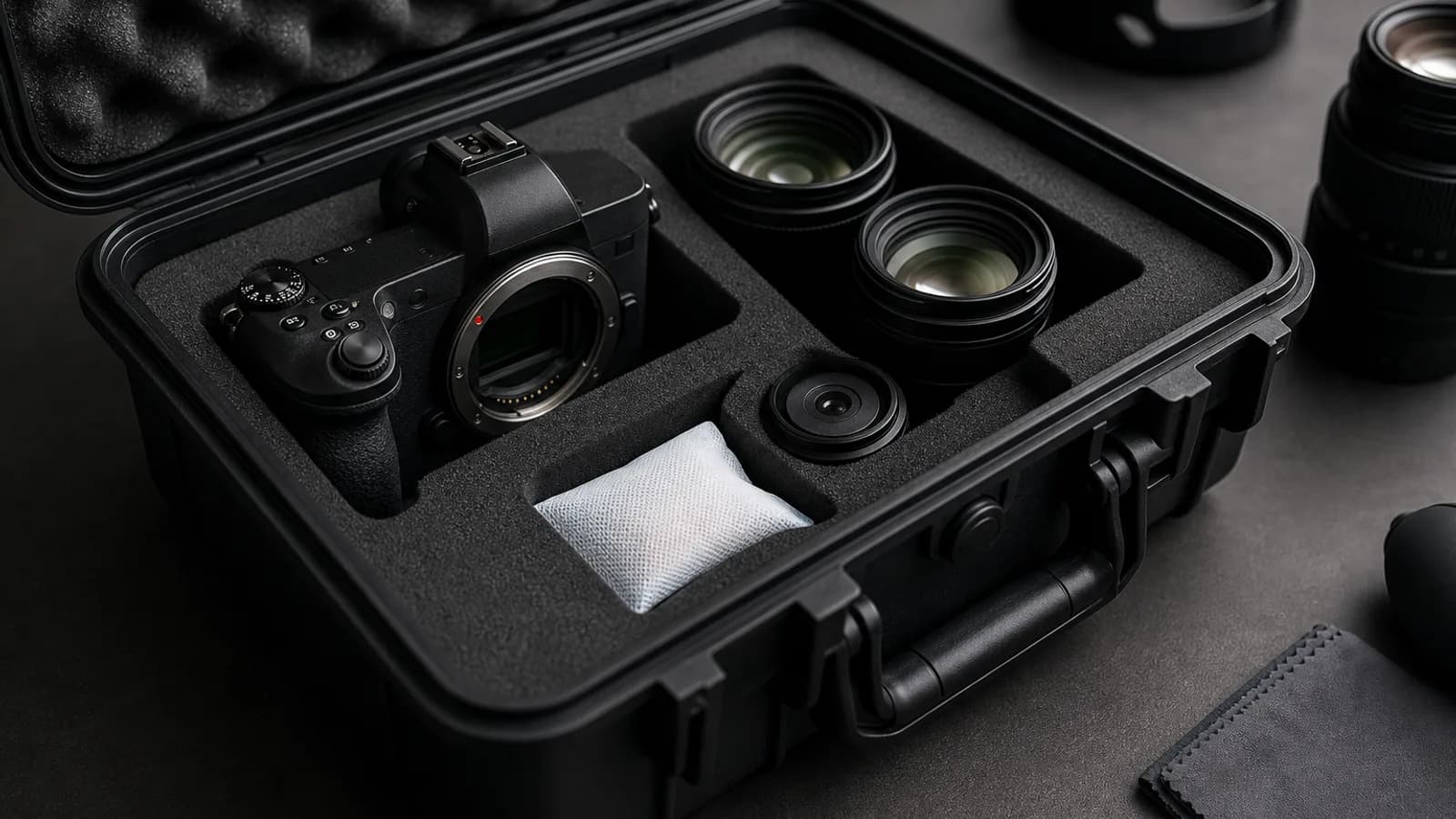
Quantity scales with the enclosed volume and how well it is sealed, not with the value of the equipment. A camera bag is a leaky container and will need refreshing often; a sealed dry box or cabinet holds its state far longer with the same amount of gel. Place sachets where air can circulate around them rather than compressed under equipment, and never let loose beads run free where they can enter a lens mount or a battery compartment.
- A typical camera bag: 50 to 100 g of gel, refreshed frequently because the bag leaks.
- A sealed dry box: the same quantity lasts much longer - the seal is doing the work.
- Use sachets rather than loose beads around equipment. Loose gel and lens mounts do not mix.
Condensation when moving between temperatures
Bringing cold equipment into warm humid air causes water to condense on and inside it, which is a separate problem from storage humidity and desiccant will not prevent it. The fix is thermal, not chemical: let the gear reach ambient temperature while still sealed inside its bag, so the condensation forms on the outside of the bag rather than on the glass. Only open it once it has warmed. Desiccant in the bag then handles the small amount of humidity that entered with it.
- Seal the bag before moving from cold to warm, not after.
- Allow time to equalise - a large lens takes longer than a body.
- Never use a hair dryer or heat source on a fogged lens.