
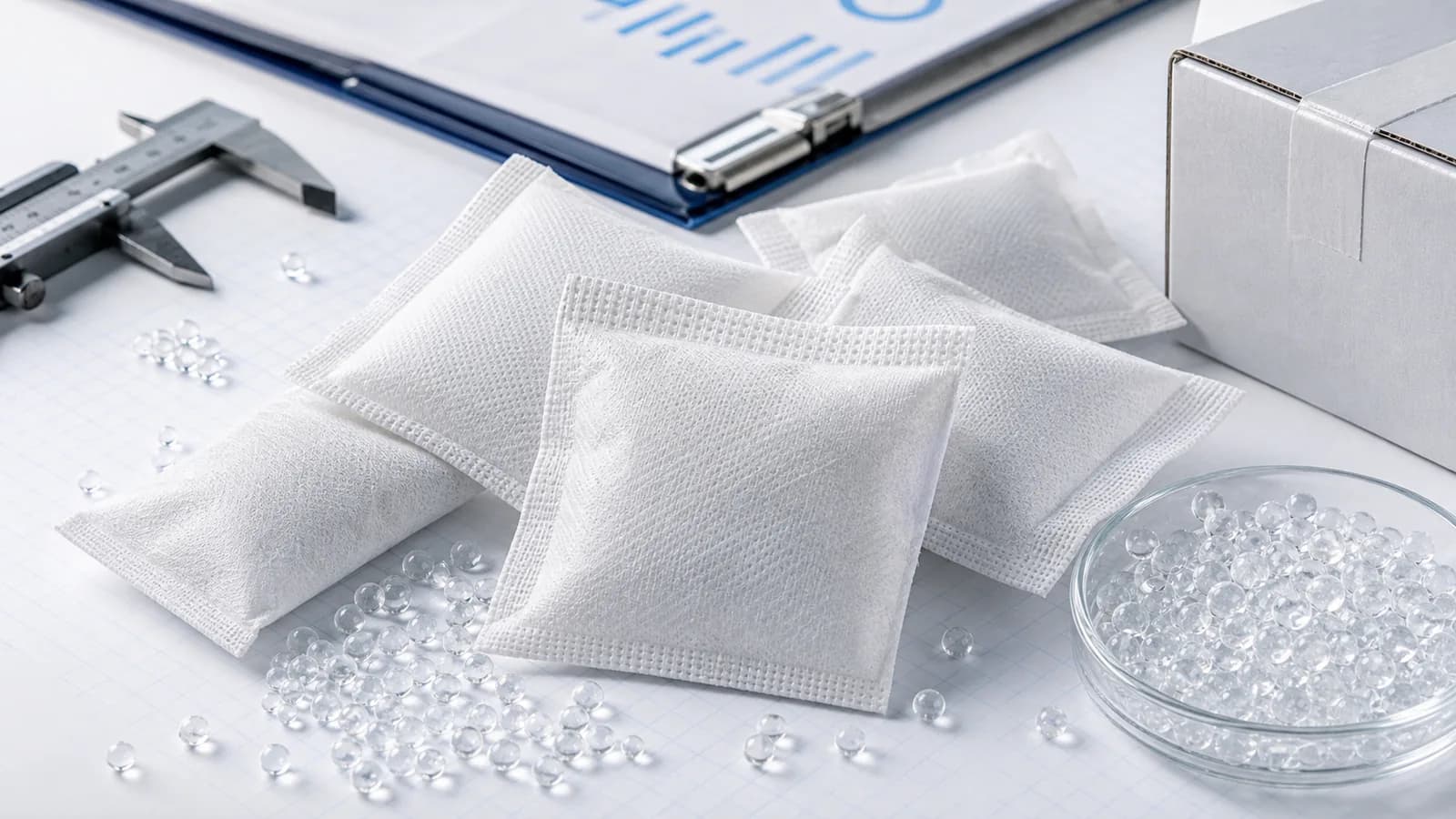
Colour tells you whether the gel indicates saturation
The colour of silica gel is not decoration - it tells you whether the gel is a plain (non-indicating) desiccant or an indicating one that visibly signals when it is saturated. White or translucent beads are standard non-indicating gel: they adsorb moisture but never change colour. Blue and orange beads are indicating gels treated with a moisture-sensitive indicator, so they shift colour as they fill with water vapour. All three are the same base material - amorphous silicon dioxide that adsorbs up to about one-third of its weight in water - only the indicator differs.
- White/clear: non-indicating - works, but never changes colour.
- Blue and orange: indicating - colour shifts as the gel saturates.
- Same base material (amorphous SiO2); only the indicator differs.
- All three adsorb up to ~33% of their weight in water vapour.
White / clear silica gel - the B2B workhorse
White or translucent non-indicating silica gel is the most widely used grade in B2B export packaging. It is the lowest cost per kilo, carries no indicator chemistry, and is the default for high-volume sachets inside cartons where you do not need a visual saturation check on every unit. Because it never changes colour, you verify performance by sizing math and pre-shipment sample testing rather than by looking at the beads. For most standard export programmes, white non-indicating gel is the correct and most economical choice.
- Lowest cost per kilo; no indicator chemistry.
- Default for high-volume carton-level sachets.
- Performance verified by sizing math and sample tests, not by colour.
- Correct choice for most standard export programmes.
Blue indicating silica gel - and why it is being phased out
Blue indicating gel is treated with cobalt(II) chloride: it is deep blue when dry and turns pink as it saturates. The visual signal is useful, but cobalt chloride is classified under EU CLP as a Category 1B carcinogen and is restricted under EU REACH. For that reason many buyers and markets are moving away from blue gel, especially for food-adjacent, pharma, or consumer-facing packaging. If you still see blue indicating gel specified, check whether the destination market permits it before committing to bulk.
- Cobalt chloride indicator: blue when dry, pink when saturated.
- Cobalt chloride is an EU Category 1B carcinogen, restricted under REACH.
- Being phased out for food, pharma, and consumer-facing use.
- Confirm destination-market acceptance before ordering blue gel.
Orange indicating silica gel - the safer signal
Orange indicating gel is the cobalt-free replacement for blue. It is orange when dry and shifts to dark green, brown, or colourless as it saturates, giving the same at-a-glance check without the cobalt-chloride concern. This makes it the preferred indicating grade for regulated and safety-sensitive shipments where a visual QC signal still matters - for example high-risk long-haul routes where the receiving buyer wants to confirm desiccant performance without lab testing. Specify cobalt-free orange explicitly in your RFQ so the right grade is supplied.
- Cobalt-free indicator: orange when dry, green/brown/colourless when saturated.
- Same visual QC signal as blue, without the cobalt-chloride concern.
- Preferred indicating grade for regulated and safety-sensitive cargo.
- Useful for long-haul QC verification without lab testing.
- Specify 'cobalt-free orange indicating' explicitly in the RFQ.
How to choose the colour for your shipment
The decision is mostly cost versus visibility. Use white non-indicating gel for the bulk of your sachets when correct sizing gives you confidence and you do not need a per-unit visual check - this is the most economical path. Add indicating gel where someone needs to read saturation by eye: a sample sachet per carton, container-ceiling placement, or high-value cargo on humid routes. When you do use indicating gel, default to cobalt-free orange unless a specific reason requires otherwise. Mixing - mostly white with a few indicating sachets as a check - is a common, cost-effective pattern.
- White non-indicating: bulk default, lowest cost.
- Indicating gel: where a human reads saturation by eye.
- Default indicating choice: cobalt-free orange.
- Common pattern: mostly white + a few indicating sachets as a check.
- Match colour choice to cargo value and route humidity.
Common colour myths
Two myths cause confusion. First: that white gel is 'weaker' than blue or orange. It is not - non-indicating white gel has the same adsorption capacity; it simply lacks the indicator, so it cannot show saturation. Second: that a colour change means the gel is 'used up' and useless. The change signals saturation, but most silica gel can be reactivated by oven-drying to restore capacity, and indicating gel returns to its dry colour once dried. Buy on grade, sizing, and indicator chemistry - not on the assumption that a brighter colour means a better desiccant.
- Myth: white gel is weaker - false; same adsorption capacity.
- Myth: colour change means it's useless - it means saturated, often reactivatable.
- Reactivated indicating gel returns to its dry colour.
- Choose by grade, sizing, and indicator - not by brightness.
References
- Candidate List of substances of very high concern (cobalt dichloride entry) , European Chemicals Agency (ECHA)