
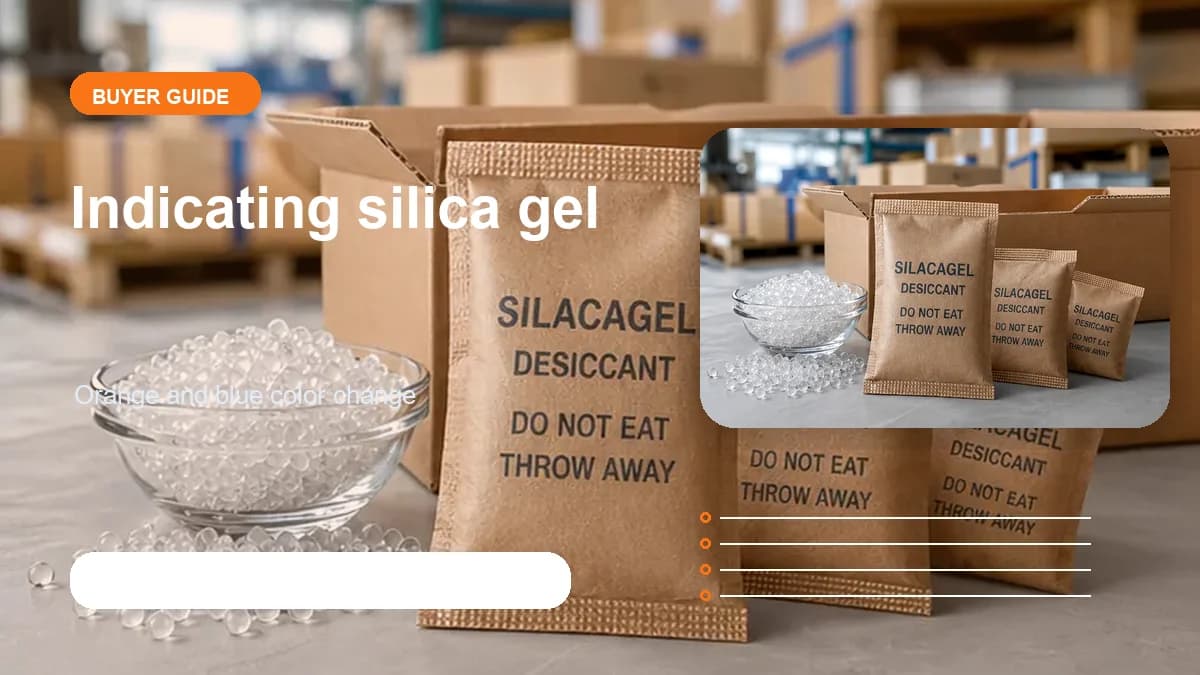
Indicating silica gel is a quality-control tool, not a different desiccant
Indicating silica gel is regular silica gel with a moisture-sensitive dye impregnated onto the beads. When dry, the beads display the 'dry' color. When the beads adsorb moisture and approach saturation, the dye changes color, giving a visual signal that the desiccant is approaching its working limit. The adsorption capacity is the same as non-indicating silica gel - the indicator dye is a quality-control feature, not a chemistry change. Buyers who use indicating silica gel get a visual saturation signal that lets warehouse staff verify desiccant condition without lab equipment or weight measurement.
- Indicating silica gel = standard silica gel + moisture-sensitive dye.
- Adsorption chemistry is unchanged; capacity is the same.
- Visual saturation signal replaces weight-based or lab-based QC.
- Warehouse staff can verify desiccant condition without equipment.
Orange indicating silica gel: methyl-violet-free, the modern standard
Orange indicating silica gel uses a non-toxic dye that shifts from orange (dry) to colorless or pale green (saturated). It's the modern standard because it replaces the older blue indicating silica gel formulation that contained cobalt chloride - a substance that has been classified as a carcinogen by EU REACH and other regulators since the early 2010s. Orange indicating silica gel is REACH-compliant and is the appropriate choice for buyers exporting to the EU, UK, and any market that follows REACH-equivalent regulations. The color change is sharp enough for reliable visual QC but the contrast is slightly less dramatic than the old blue-to-pink formulation, which is the only reason any buyer still asks about blue.
- Orange (dry) → colorless/pale green (saturated).
- Non-toxic, REACH-compliant.
- Modern standard for EU/UK and REACH-equivalent markets.
- Color change is reliable; contrast slightly less dramatic than legacy blue.
Blue indicating silica gel: legacy product, REACH-restricted
Blue indicating silica gel uses cobalt chloride as the indicator dye, shifting from blue (dry) to pink (saturated). The color change contrast is excellent and the dye is highly visible at a glance. The problem: cobalt chloride is classified as a category 1B carcinogen under EU REACH (and equivalent classifications in UK, Australia, and Canada). Blue indicating silica gel is restricted or banned for many end uses in those markets, particularly any application involving direct contact with consumer goods, pharma, or food. Buyers in markets where REACH-equivalent regulations apply should not specify blue indicating silica gel. Buyers in markets where cobalt chloride is still permitted (some US industrial applications, some Middle East and Asian markets) can continue to use blue, but should be aware that regulatory tightening continues globally and buying habits should migrate to orange.
- Blue (dry) → pink (saturated). Strong visual contrast.
- Uses cobalt chloride dye.
- REACH-classified as category 1B carcinogen.
- Restricted/banned for many uses in EU, UK, Australia, Canada.
- Migrate to orange even where blue is still permitted.
How to actually read the color change
The most common B2B mistake with indicating silica gel is replacing it too early - at the first hint of color shift rather than at full saturation. Practical guideline: replace the desiccant when 70-80% of the visible beads have shifted to the saturated color, not at first signs. Orange indicating gel goes through a transitional pale-green phase before becoming fully colorless; this intermediate phase still has 20-30% working capacity. Buyers who replace at first transition burn through more desiccant than they need to. Conversely, waiting until 95-100% of beads have shifted means you've already lost adsorption headroom and the protected product may have absorbed some moisture before you noticed. The 70-80% threshold balances cost against protection.
- Don't replace at first hint of color change - wait until 70-80% has shifted.
- Orange has a transitional pale-green phase with 20-30% remaining capacity.
- Replacing at 95-100% shift means you've already lost protection headroom.
- 70-80% is the practical replacement threshold.
When indicating silica gel is worth the cost premium
Indicating silica gel costs 30-60% more than equivalent non-indicating silica gel because of the dye treatment. The premium is worth it for visible warehouse stock requiring periodic QC checks; for reusable packaging programs where the same desiccant cycles through reactivation (you need to know when to reactivate); for any direct-contact application where weight-based QC is impractical; and for distributor or customer-facing programs where the buyer wants to demonstrate visible quality control to their own end customer. The premium is not worth it for single-use export shipments where the desiccant ships once with the cargo and is disposed of at destination - non-indicating silica gel sized correctly for the shipment does the same job at lower cost.
- 30-60% cost premium over non-indicating silica gel.
- Worth it: visible warehouse stock, reusable programs, customer-facing QC.
- Not worth it: single-use export shipments sized correctly upfront.
- Decision = QC visibility requirement, not desiccant performance.
Buying indicating silica gel from DryGelWorld
DryGelWorld supplies orange indicating silica gel in 2-5mm bead format for buyers in REACH-compliant markets and reusable / closed-loop industrial applications. Standard formats: bulk paper bags (25kg, 50kg), drums (200kg), and jumbo bags (1000kg). Sachet formats with indicating gel are available on request for specialty packaging programs. Blue indicating silica gel is also stocked for the limited remaining markets where it's still permitted, but DryGelWorld actively recommends orange for any new program. Quote stage: confirm market, intended use (single-use export vs reusable program vs warehouse QC), and required volume - orange vs blue selection follows from those answers.
- DryGelWorld supplies orange indicating gel 2-5mm beads.
- Bulk formats: 25kg/50kg bags, 200kg drums, 1000kg jumbo bags.
- Sachet indicating formats on request for specialty programs.
- Blue stocked for limited remaining markets; orange recommended for new programs.
- Confirm market, intended use, and volume at quote stage.
References
- Candidate List of substances of very high concern (cobalt dichloride entry) , European Chemicals Agency (ECHA)