
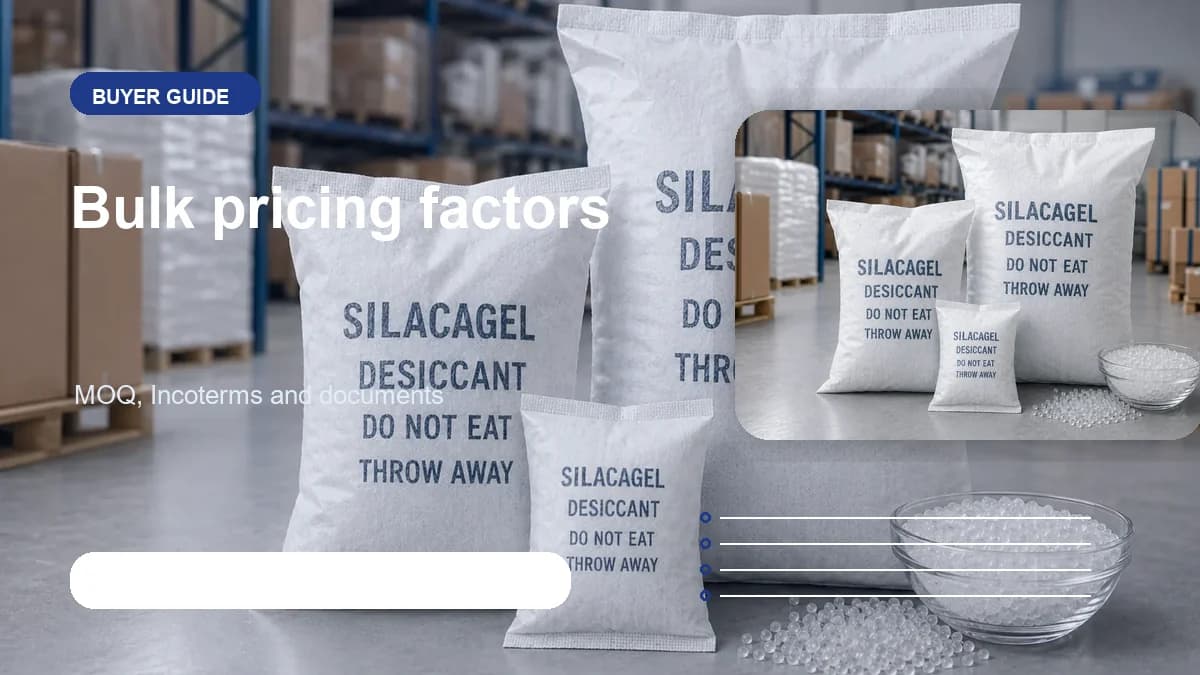
Silica gel is a commodity material - but the price isn't
Raw silica gel is a commodity chemical; the per-kilogram material cost varies by less than 15% across reputable global manufacturers at the same bead grade and pore-size specification. The reason quoted prices for 'silica gel' can vary by 200-300% between suppliers isn't usually the silica gel itself - it's everything wrapped around it. Format (sachet vs strip vs bulk), packaging (paper bag vs drum vs jumbo bag), certification scope (ISO 9001 only vs food-grade vs pharma DMF), private-label print, MOQ commitment, payment terms, and shipping Incoterm all materially affect the delivered price. B2B buyers benchmarking quotes should standardize all those factors before comparing per-kg numbers across suppliers, otherwise they're comparing fundamentally different products.
- Raw silica gel cost varies less than 15% across reputable manufacturers.
- Quoted prices vary 200-300% because of the layers wrapped around the material.
- Format, packaging, cert scope, MOQ, terms, Incoterm all affect price.
- Standardize all factors before comparing per-kg numbers.
Format cost ladder: bulk beads to printed sachets
Format drives the largest single delta in B2B silica gel pricing. The approximate cost ladder, lowest to highest per kg of silica gel content: bulk beads in jumbo bags (cheapest, no per-unit packaging); bulk beads in paper bags; bulk beads in drums; bulk beads in plain non-woven sachets (low cost per kg but format adds 30-50%); printed paper sachets (private-label printing adds another 15-25%); printed non-woven or Tyvek sachets (another 20-40%); finished container strips (engineered format, premium pricing); and reusable indicating silica gel (dye treatment adds 30-60%). The format you specify matters as much for cost as the volume you order.
- Cheapest: bulk beads in jumbo bags (no per-unit packaging).
- Bulk paper bags / drums: small premium over jumbo.
- Plain non-woven sachets: +30-50% over bulk.
- Printed paper sachets: +15-25% over plain sachets.
- Printed non-woven/Tyvek sachets: +20-40% additional.
- Container strips: engineered format, premium.
- Indicating gel: +30-60% over equivalent non-indicating.
MOQ economics - why your monthly volume matters
Silica gel manufacturing favors larger MOQ commitments. A buyer committing to a recurring monthly tonnage typically secures 10-25% better per-kg pricing than a buyer placing single ad-hoc orders, because the supplier amortizes setup, QC, and documentation cost across larger volumes. The discount curve flattens past ~5 metric tons per shipment; the biggest savings happen between 'one-off small order' (full retail-ish pricing) and 'recurring 1-5 ton monthly program' (typical export buyer pricing). Buyers placing one-off orders should be ready for a noticeably higher per-kg number than buyers committing to recurring volume - this isn't a supplier markup, it's the math of fixed costs amortized over variable volumes.
- Recurring monthly tonnage: 10-25% better per-kg pricing than ad-hoc.
- Discount curve flattens past ~5 metric tons per shipment.
- Biggest delta: one-off order vs recurring 1-5 ton monthly program.
- Fixed setup/QC/docs costs amortize across volume.
- Ad-hoc small orders carry higher per-kg cost - not markup, math.
Certification scope is a real cost layer
Certification documentation has a real cost that flows into per-shipment pricing. Baseline ISO 9001:2015 + per-shipment COA + SDS adds minimal cost - most reputable manufacturers include this in standard pricing. Adding REACH-specific documentation, food-contact certification (FDA, EU 1935/2004, GCC GSO), pharma-grade documentation (DMF or pharmacopoeia compliance), or any region-specific regulatory submission package adds documented per-shipment work that flows through to price. Buyers requiring extensive certification scope should expect a 15-30% premium over baseline ISO-only pricing. Buyers who can stay in the ISO-only baseline (which covers most secondary packaging applications) should specify that explicitly to avoid paying for certification scope they don't need.
- Baseline ISO 9001 + COA + SDS: minimal extra cost, usually included.
- REACH-specific docs: small premium.
- Food-contact certifications (FDA, EU, GCC): material premium (15-30%).
- Pharma DMF or pharmacopoeia compliance: similar premium.
- Buyers who don't need extensive cert scope should say so to avoid overpaying.
Incoterm and shipment route - the often-missed cost factor
Incoterm choice directly affects the per-kg landed cost. EXW (Ex Works) is the cheapest factory-gate quote but the buyer absorbs all subsequent logistics, customs, and risk. FOB (Free On Board) shifts loading and origin-port handling to the supplier - small premium but cleaner for first-time importers. CIF (Cost, Insurance, Freight) adds the supplier's ocean freight and insurance - convenient for buyers but the supplier's freight markup is typically 10-20% over what a buyer with their own forwarder pays. DAP (Delivered At Place) and DDP (Delivered Duty Paid) are the highest-touch options. Route also matters: short-haul to UAE or Singapore costs much less in freight than long-haul to US east coast or Northern Europe. Smart buyers benchmark quotes EXW or FOB and add their own freight separately, especially for recurring high-volume programs where forwarder relationships save 10-15%.
- EXW: cheapest factory quote, buyer absorbs all logistics.
- FOB: clean for first-time importers, small premium.
- CIF: convenient but supplier freight markup is 10-20%.
- DAP/DDP: highest-touch, highest cost.
- Route: short-haul (UAE, Singapore) cheap; long-haul (US east coast, EU) expensive.
- Smart buyers: quote EXW/FOB, add own freight, build forwarder relationships.
Currency, payment terms, and the quiet pricing levers
Three quieter factors that move per-kg cost in B2B silica gel procurement: currency - USD-denominated contracts are the global standard but EUR, GBP, and AED quotes are common; FX fluctuation between quote and shipment can add 2-5% in either direction over a 30-90 day cycle, and buyers should clarify which currency the locked price is in. Payment terms - TT in advance gets the best price; LC at sight is standard; 30-60 day open terms add a small premium reflecting the supplier's credit risk. Volume commitment - a 12-month tonnage agreement gets better pricing than 3-month rolling orders, which gets better pricing than per-order purchasing. These factors usually account for the last 5-10% delta in quoted prices between two otherwise-identical suppliers.
- Currency: USD standard; EUR/GBP/AED also common.
- FX fluctuation: 2-5% drift over 30-90 day cycles; clarify quote currency.
- Payment terms: TT advance < LC at sight < open terms.
- Volume commitment: 12-month > 3-month rolling > per-order.
- These factors = last 5-10% delta between otherwise-identical quotes.
References
- Incoterms® 2020 , International Chamber of Commerce
- World Container Index , Drewry Supply Chain Advisors
- Harmonized Tariff Schedule (heading 2811) , United States International Trade Commission
- HS Nomenclature 2022 Edition , World Customs Organization
- Regulation (EC) No 1907/2006 (REACH) , EUR-Lex, Publications Office of the European Union