
Define 'bulk' before comparing supplier prices
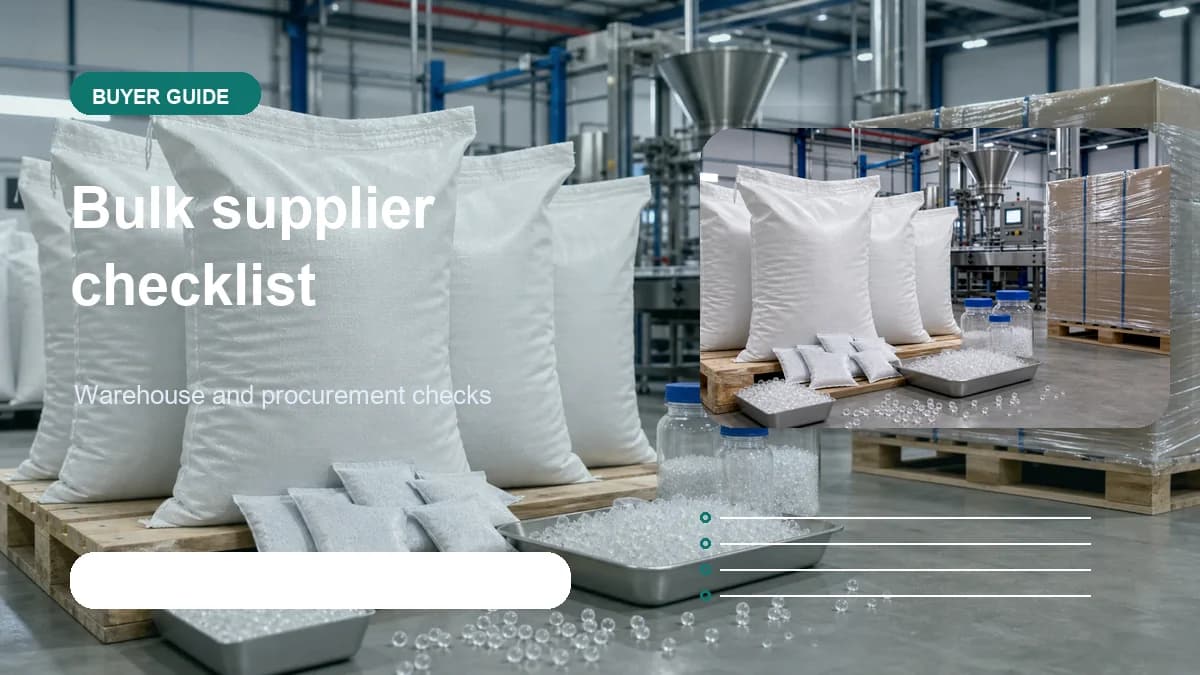
The single most common mistake in B2B silica gel buying is requesting 'bulk' quotes without defining what bulk means. 'Bulk' can mean loose 25kg silica gel beads (for re-packers), finished 25g-500g desiccant bags (for warehouse and carton use), pre-packed sachets in master cartons (for distribution), 1kg-5kg cargo strips (for container shipping), or recurring monthly tonnage agreements. Each of these gets a completely different price quote, lead time, and supplier conversation. Define the commercial unit before asking for prices - otherwise you're comparing apples to oranges across suppliers.
- Loose 25kg beads: for re-packers, industrial uses, distributor stock.
- Finished 25g-500g bags: for warehouse moisture control, master carton inserts.
- Pre-packed sachets: for unit-pack and master-carton distribution programs.
- 1kg-5kg cargo strips: for container-level shipping moisture control.
- Monthly tonnage agreements: recurring distributor programs.
Format selection by buyer type
The right bulk format depends on who you are and what your customers need. Industrial re-packers want loose 25kg silica gel - they fill their own sachets, brand them, and resell. Warehouse and storage operators want finished 250g-500g bags they can drop into stored goods without re-packaging. Distributors selling to packagers want pre-packed sachets in master cartons that can ship directly through their distribution network. Export shippers want 1kg-5kg cargo strips at the container level. Match format to your business model, not to whichever has the lowest per-kg price.
- Re-packers: loose 25kg beads or 25kg bags. Lowest per-kg cost but highest in-house work.
- Warehouse operators: 250g-500g finished bags. Drop-in ready, no repackaging.
- Distributors to packagers: pre-packed sachets in master cartons. Ready to ship downstream.
- Export shippers: 1kg-5kg cargo strips for container ceilings; pair with carton sachets.
- Mixed business model: source 2-3 formats from the same supplier for simpler procurement.
Bead and packaging quality - what to check before approving a supplier
The cheapest bulk offer can become expensive fast if the bead quality, bag strength, dust level, or carton packing creates downstream complaints. Wholesale buyers should sample before committing to volume. Things to check: bead size consistency (uniform 1-3mm range for industrial-grade vs irregular for low-grade), dust level (low-dust beads matter for clean packaging applications), bag strength (will it survive transit and rough handling without splitting?), seal quality (no weak seams on finished sachets), carton packing density (cartons should ship tightly packed, not loose). Reputable suppliers will send sample packs and packaging photos before bulk orders.
- Bead size consistency: 1-3mm uniform range for industrial-grade silica gel.
- Dust level: low-dust beads matter for clean packaging applications.
- Bag strength: must survive transit and rough handling.
- Seal quality: weak seams on finished sachets cause complaints.
- Carton packing: tight packs, not loose; affects shipping economics.
- Sample packs + packaging photos before bulk commitment.
MOQ economics - what 'minimum order' actually means
MOQ is one of the most confusing parts of bulk silica gel buying. Suppliers often quote two MOQs: the production MOQ (the minimum the factory will run as one batch) and the commercial MOQ (the minimum order they'll accept). These differ because suppliers may combine your order with other customers' to hit production batch size. Practical implications: lower-volume buyers should ask whether the supplier can combine your order with others to access lower commercial MOQ. Higher-volume buyers (whole pallets, whole containers) get factory-direct treatment with better unit pricing. Share your forecast volume explicitly - suppliers price differently for one-time vs recurring buyers.
- Production MOQ vs commercial MOQ - different numbers, suppliers will explain.
- Lower-volume buyers: ask about order combination across customers.
- Higher-volume buyers: full pallet or container orders get factory-direct unit pricing.
- Recurring buyers (monthly/quarterly): better MOQ + lead time than one-time orders.
- Always share forecast volume - it changes the supplier's pricing math.
Documents - what to request in the first RFQ
Wholesale buyers should include the full document checklist in the first RFQ message. Standard pack: SDS for the desiccant material, COA tied to the production batch, ISO 9001:2015 quality reference from the manufacturer, DMF-free statement (critical for EU-bound leather/footwear/consumer goods), product specification sheet, and any market-specific compliance documentation required by your destination market. DryGelWorld supplies SDS, COA, ISO 9001:2015 reference, and DMF-free statement on request. Market-specific certifications (FDA, REACH, Halal, FSSC, SASO) are not credentials currently held by DryGelWorld - confirm at RFQ stage so the supplier and your compliance team align before commercial terms.
- SDS - material safety, handling, storage.
- COA - batch-level quality confirmation.
- ISO 9001:2015 reference - manufacturer quality system credential.
- DMF-free statement - non-negotiable for EU-bound leather/consumer goods.
- Product specification sheet - links wholesale SKU to documented spec.
- Market-specific certs: FDA, REACH, Halal, FSSC - confirm what is held at RFQ.
Incoterms and dispatch terms - building the quote correctly
Wholesale procurement quotes vary dramatically based on Incoterms. EXW (Ex Works): cheapest unit price but you pick up from the supplier's gate and own all freight, customs, and risk. FOB (Free on Board): supplier loads at origin port, your freight from there. CIF (Cost, Insurance, Freight): supplier pays sea freight and insurance to destination port, you take from arrival. DAP (Delivered at Place): supplier delivers to your named destination, you handle import duty. For bulk silica gel from Karachi: FOB Karachi is the most common quote basis. CIF works for buyers who don't have their own freight forwarding. DAP works for buyers with limited customs experience but adds cost. Pick Incoterms based on your operational capabilities, not on which has the lowest invoice number.
- EXW: cheapest invoice, most operational complexity.
- FOB Karachi: most common Pakistani-origin quote basis.
- CIF [destination port]: supplier pays sea freight and insurance.
- DAP [named destination]: supplier delivers door-to-door less duty.
- Match Incoterms to your operational capability, not to lowest invoice number.
Building a repeat supply program - the scaling discipline
First-order wholesale silica gel is easy. Order three through ten is where most B2B programs hit issues: supplier inconsistency, format drift, document gaps, lead-time slippage. Patterns that scale: lock the product spec in writing (gram size, material, carton format, document set) and reference it on every reorder; share rolling 3-6 month forecast with the supplier so they can plan production; agree fixed Incoterms and pricing brackets; schedule quarterly supplier review even if no changes are needed; maintain approved-sample records to compare new shipments against. These mechanical disciplines separate B2B programs that run for years from programs that quietly degrade by order three.
- Lock product spec in writing - reference on every reorder.
- Share rolling 3-6 month forecast for production planning.
- Agree fixed Incoterms and price brackets across volume tiers.
- Quarterly supplier review even if no changes planned.
- Maintain approved-sample records for shipment comparison.
- Mechanical disciplines beat heroic per-shipment effort.
References
- Incoterms® 2020 , International Chamber of Commerce
- Harmonized Tariff Schedule (heading 2811) , United States International Trade Commission
- HS Nomenclature 2022 Edition , World Customs Organization
- DIN 55473:2021-07 — Auxiliary means of packaging - Desiccant in bag - Technical delivery conditions , DIN Media (German Institute for Standardization)
- Silica (silicon dioxide, SiO2) — compound summary, CID 24261 , National Institutes of Health (PubChem)