
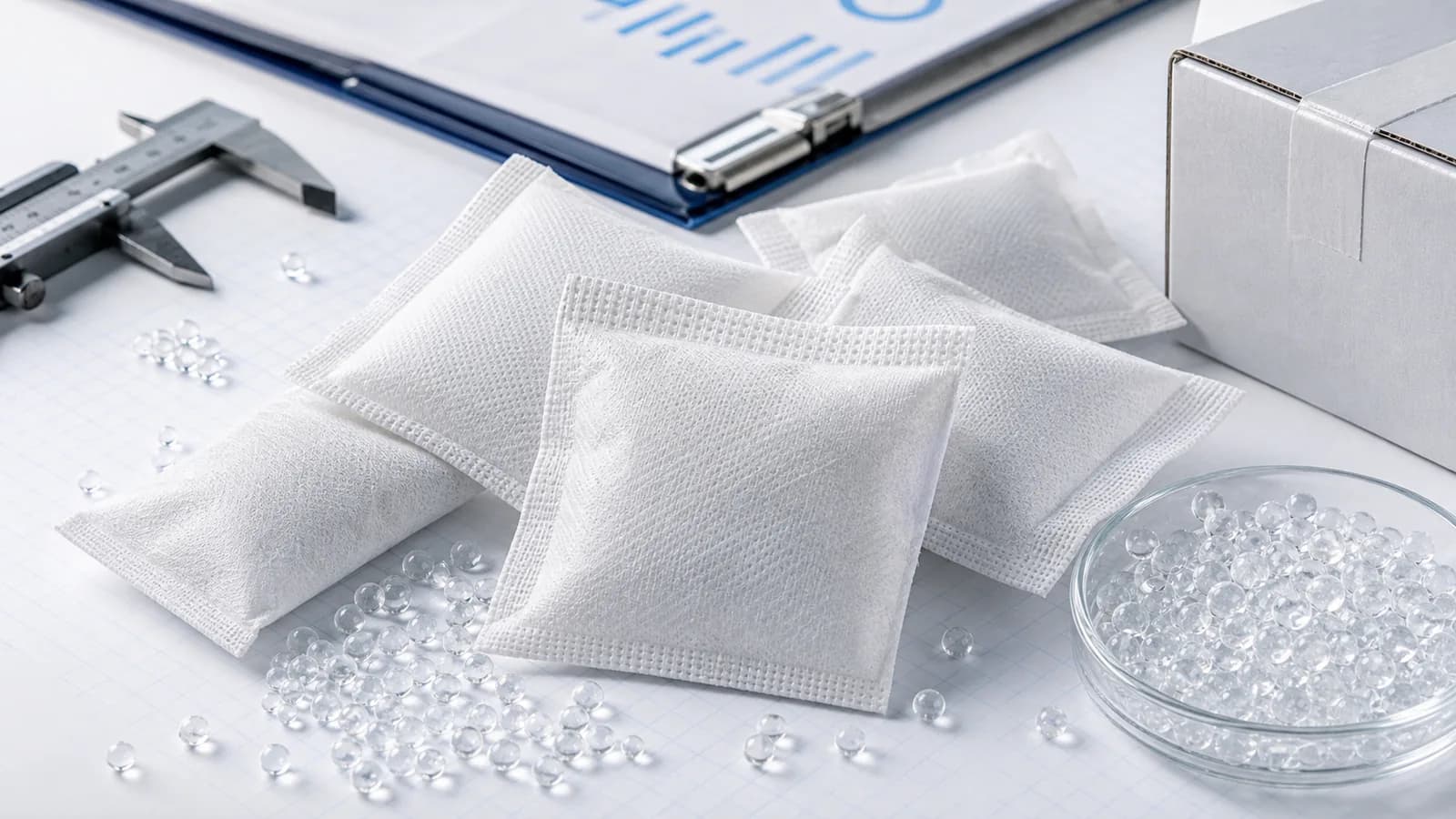
From sand to desiccant: the starting materials
Silica gel begins as sodium silicate - 'water glass' - which is itself made by fusing high-purity silica sand with sodium carbonate at high temperature and dissolving the result in water. Sodium silicate is the cheap, abundant, water-soluble source of the silicon dioxide (SiO₂) that will become the finished bead. The desiccant property is not in the chemistry of SiO₂ itself - quartz sand is also SiO₂ and adsorbs almost nothing. The magic is in the structure the manufacturing process builds: a rigid, internally porous network with an enormous surface area. That structure, not the formula, is what lets silica gel hold up to a third of its weight in water vapor.
- Raw input: sodium silicate (water glass), made from silica sand + sodium carbonate.
- Finished product is amorphous silicon dioxide (SiO₂).
- The adsorption power comes from pore structure, not the SiO₂ formula.
- Solid quartz is also SiO₂ but adsorbs almost nothing - structure is everything.
Step 1 - Gel formation: acid meets silicate
The process starts by reacting sodium silicate with a strong acid (typically sulphuric acid). This neutralization produces a silica hydrosol that rapidly polymerizes: microscopic SiO₂ particles link into a continuous three-dimensional network, trapping water in its pores and setting into a solid 'hydrogel'. The concentration, temperature, and pH at this stage are decisive - they set how big the eventual pores will be and how much internal surface area the gel will have. A manufacturer controlling these variables tightly produces consistent, predictable beads; one that does not produces gel whose adsorption performance drifts batch to batch. This is the single most important step for final quality.
- Sodium silicate + sulphuric acid → silica hydrosol → solid hydrogel.
- SiO₂ particles polymerize into a 3D porous network.
- pH, concentration, and temperature here set pore size and surface area.
- Tight process control = consistent beads; loose control = batch-to-batch drift.
Step 2 - Aging, washing, and removing salt
The fresh hydrogel is aged to let the pore structure mature, then washed extensively. Washing serves two purposes: it removes the sodium sulphate by-product of the acid reaction, and it removes residual salts that would otherwise sit in the pores and reduce capacity. Inadequate washing is a common quality shortcut - leftover salts lower adsorption performance and can cause the gel to deliquesce (turn sticky) in very humid conditions. Buyers comparing suppliers on price should remember that thorough washing costs time and water; a suspiciously cheap gel sometimes reflects a shortened wash. The wash water and aging time directly affect purity and capacity.
- Hydrogel is aged so the pore network matures.
- Extensive washing removes sodium sulphate by-product and residual salts.
- Under-washing lowers capacity and can make gel sticky in high humidity.
- Thorough washing is a real cost - very cheap gel may reflect a shortcut here.
Step 3 - Drying and activation
The washed gel is dried to drive off the pore water and 'activate' the desiccant - opening up the internal surface so it is ready to adsorb moisture again. Drying temperature controls the bead type: lower-temperature processing tends toward fine-pore Type A grades (high capacity at low-to-mid humidity, ideal for packaging desiccants), while different conditions yield wider-pore Type B grades. Over-drying or scorching damages the structure and reduces capacity, so activation is a controlled bake, not just heat. After activation the gel is screened and graded into bead-size fractions, because particle size affects how fast the gel works and how it flows into sachets and strips.
- Drying removes pore water and activates the gel for re-adsorption.
- Drying conditions determine bead type (e.g. fine-pore Type A vs wider-pore Type B).
- Over-drying/scorching damages pore structure and cuts capacity.
- Activated gel is screened and graded into bead-size fractions.
Indicating gel and final conversion
Standard non-indicating silica gel is clear/white at this point. Indicating gel is made by impregnating the beads with a moisture-sensitive dye: modern orange indicating gel uses a non-cobalt dye (REACH-compliant), while legacy blue gel uses cobalt chloride, which is restricted in the EU, UK, Australia, and Canada. The graded beads are then converted into finished formats - filled into breathable paper sachets, woven or non-woven bead bags, or multi-chamber cargo strips - and sealed in moisture-barrier outer packaging so they reach the buyer fully active. The shelf life of a sealed sachet (24-36 months in its outer pouch) depends on that final barrier packaging being intact.
- Non-indicating gel is clear/white; indicating gel is dye-impregnated.
- Orange indicating dye: non-cobalt, REACH-compliant.
- Blue indicating dye: cobalt chloride, restricted in EU/UK/AU/CA.
- Beads are filled into sachets, bags, or strips and sealed in moisture-barrier packaging.
- Sealed-sachet shelf life (24-36 months) depends on intact barrier packaging.
What to ask a silica gel manufacturer about quality
Because performance is built in during manufacturing, the right supplier questions are about process control, not just price. Ask what bead type and pore grade you are buying and whether it suits your humidity range. Ask how they verify adsorption capacity (RH-controlled gravimetric testing) and whether a Certificate of Analysis is available per lot. Ask about washing and residual-salt control, since that affects capacity and stickiness. Confirm quality-management certification - DryGelWorld manufactures under ISO 9001:2015 - and request the SDS and DMF-free statement if your end-market needs them. A manufacturer that can answer these clearly is controlling the steps above; one that only quotes a per-kg price may not be.
- Ask bead type / pore grade and its humidity-range fit.
- Ask how adsorption capacity is verified and whether a per-lot COA is available.
- Ask about washing / residual-salt control (affects capacity and stickiness).
- Confirm quality management - DryGelWorld manufactures under ISO 9001:2015.
- Request SDS and DMF-free statement if your end-market requires them.
References
- US1297724A — Silica gel and process of making same (W. A. Patrick, 1919) , Google Patents (U.S. Patent and Trademark Office)
- Sodium silicate — compound summary, CID 23266 , National Institutes of Health (PubChem)
- Sulfuric acid — compound summary, CID 1118 , National Institutes of Health (PubChem)
- Silica (silicon dioxide, SiO2) — compound summary, CID 24261 , National Institutes of Health (PubChem)
- 2.3: BET Surface Area Analysis of Nanoparticles , Chemistry LibreTexts
- Cobalt chloride (CoCl2) — compound summary, CID 3032536 , National Institutes of Health (PubChem)