
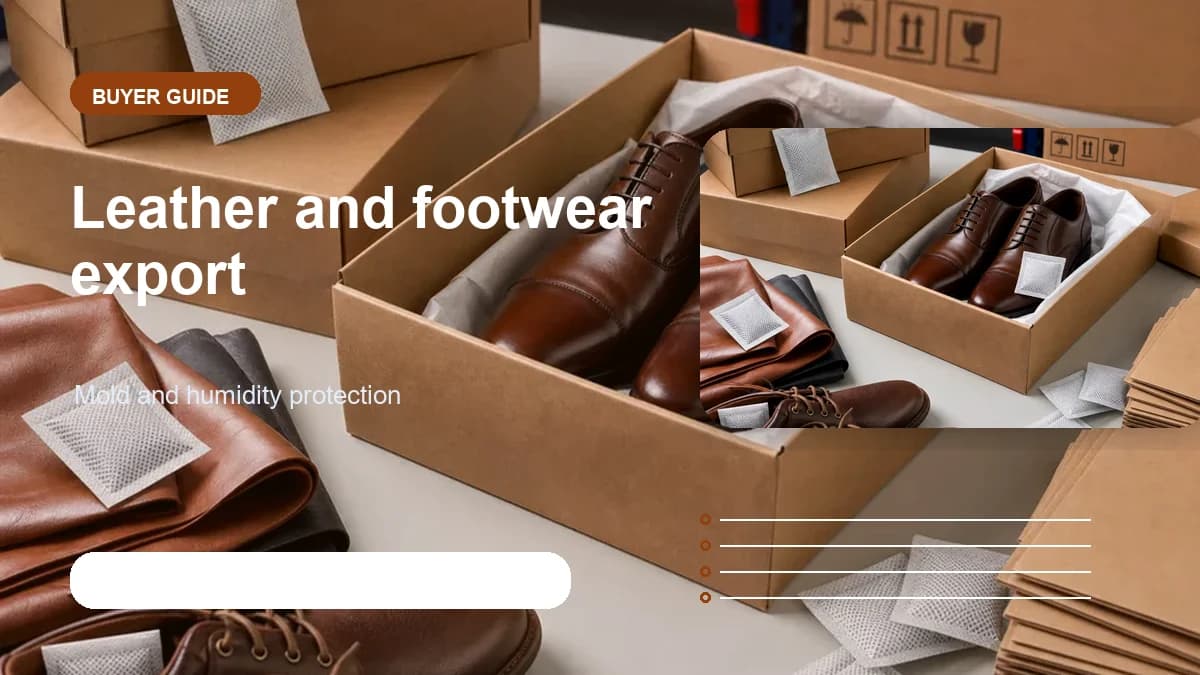
Leather and footwear lose value fast under moisture exposure
Leather and footwear are uniquely moisture-sensitive cargo categories. Unlike electronics where moisture damage shows up as corrosion years later, leather damage from a single humid voyage shows up immediately as visible mold, white salt bloom on the surface, blue-green spotting, dimensional warping, and adhesive failure on shoe construction. The financial impact is direct: a single moldy carton of footwear isn't 'salvageable with cleaning' - it's destination-rejected, returned at the shipper's cost, and often hits the brand's QC reputation with the importing buyer. The cost per failed carton is typically multiples of the retail SKU value once return logistics, replacement shipping, and buyer relationship damage are accounted for.
- Leather moisture damage shows immediately on the cargo.
- Mold, white salt bloom, blue-green spotting, dimensional warping.
- Adhesive failure on shoe construction.
- One moldy carton = full reject + return + reputation cost.
- Per-failure cost = multiples of SKU retail value.
Why leather is moisture-sensitive (it's not the leather, it's what's in it)
Leather hides retain trace tanning agents, fats, and moisture from the tanning process. When ambient humidity rises in a sealed shipping container - which it does steadily across a 25-35 day ocean voyage as condensation cycles drive moisture deeper into the cargo - those organic residues become a mold-growth substrate. Different tanning methods produce different mold susceptibility: chrome-tanned leather is more moisture-tolerant than vegetable-tanned, but even chrome-tanned leather is significantly more vulnerable than synthetic materials. Footwear adds adhesive vulnerability: water-based adhesives common in non-luxury footwear lose bond strength as moisture penetrates the construction, leading to sole separation or upper-edge unbonding by destination.
- Leather retains trace tanning agents, fats, moisture from tanning.
- Sealed container condensation cycling drives moisture deeper.
- Residues become mold-growth substrate.
- Chrome-tanned more tolerant than vegetable-tanned, but both vulnerable.
- Water-based adhesives lose bond strength under moisture exposure.
Sizing silica gel for leather export - the practical math
Base sizing for leather and footwear cartons is more aggressive than for electronics or general industrial cargo. Per standard product carton (0.05-0.1 m³ internal volume): 10-25g silica gel per carton at base sizing, increased to 15-50g for tropical or trans-equatorial routes. Per master carton (0.1-0.5 m³): 50-100g silica gel, increased to 100-250g for long-haul humid routes. Container level: bulk silica gel strips of 1kg-2kg, 8-12 strips per 40ft container on long-haul tropical routes. Distribute desiccant evenly through the cargo rather than concentrating it in one place - moisture doesn't equilibrate fast enough across a sealed 40ft container during a 25-day voyage for a single corner-located desiccant pile to protect cargo at the opposite end.
- Product carton (0.05-0.1 m³): 10-25g base, 15-50g humid routes.
- Master carton (0.1-0.5 m³): 50-100g base, 100-250g humid routes.
- Container: 8-12 × 1-2kg strips per 40ft on long-haul tropical.
- Distribute evenly across the cargo - don't concentrate in one place.
- Moisture doesn't equilibrate fast enough across a sealed container.
Packaging discipline matters as much as silica gel weight
Silica gel only does its job if the packaging gives it time to work. Three packaging disciplines specific to leather export: kiln-dry the leather goods themselves for 24-48 hours before final packing - surface humidity from the factory environment is the first thing the desiccant has to absorb, and reducing it pre-pack lets the desiccant protect against the voyage instead. Don't pack leather in plastic bags that prevent desiccant exposure - the desiccant needs vapor access to the cargo space, so loose tissue or breathable cotton bags work better than sealed plastic. Use kiln-dried wooden pallets or polymer-skid pallets, not green-wood or wet pallets - pallet moisture is one of the biggest avoidable sources of container humidity. Combine the desiccant program with these packaging disciplines for reliable arrival quality.
- Kiln-dry leather for 24-48 hours before final packing.
- Don't pack leather in sealed plastic bags (blocks desiccant access).
- Use tissue or breathable cotton bags inside cartons.
- Kiln-dried wood or polymer-skid pallets; never green-wood.
- Packaging discipline + desiccant program = reliable arrival.
Route-specific risk: which routes need the most attention
Some leather export routes are dramatically higher-risk than others. Highest risk: Pakistan, India, or Bangladesh origin → US East Coast or Northern Europe (long-haul, tropical-to-temperate transition with extreme condensation cycling). High risk: Karachi or Mumbai → UAE → trans-shipment to US (longer total transit time, multiple temperature transitions). Medium risk: PK/IN/BD → UK / Mediterranean Europe (slightly shorter, less aggressive transition). Lower risk: short intra-Asia routes (PK → Middle East, short transit time, low condensation cycling). Buyers running high-risk routes should size at the upper end of base sizing, use indicating silica gel for shipment QC verification, and consider container-ceiling cargo strips in addition to per-carton sachets.
- Highest risk: PK/IN/BD → US East Coast / Northern Europe (long-haul transition).
- High risk: PK/IN/BD → UAE trans-shipment to US.
- Medium risk: PK/IN/BD → UK / Med Europe.
- Lower risk: short intra-Asia routes.
- High-risk routes: upper-end sizing + indicating gel + container strips.
DryGelWorld supply for leather and footwear export buyers
DryGelWorld supplies leather and footwear exporters in Pakistan, India, Bangladesh, and adjacent origin markets with: 10g-100g paper and non-woven silica gel sachets sized for per-carton placement, 1kg-2kg container desiccant strips for container-ceiling deployment, bulk silica gel beads (Type A) for buyers who package their own sachets, and indicating silica gel for buyers who want visual QC verification at destination. Standard documentation: ISO 9001:2015 + COA + SDS per shipment. Lead times are 3-10 days from confirmation depending on print and format. Quote stage: provide cargo type (chrome-tanned vs vegetable-tanned vs synthetic), destination market, route, monthly volume, and any specific buyer-side documentation requirements.
- 10g-100g paper and non-woven sachets sized for per-carton placement.
- 1kg-2kg container strips for ceiling deployment.
- Bulk Type A beads for in-house sachet packing.
- Indicating gel for destination QC verification.
- Standard docs: ISO 9001 + COA + SDS per shipment.
- Quote stage: provide cargo type, destination, route, volume, doc reqs.