
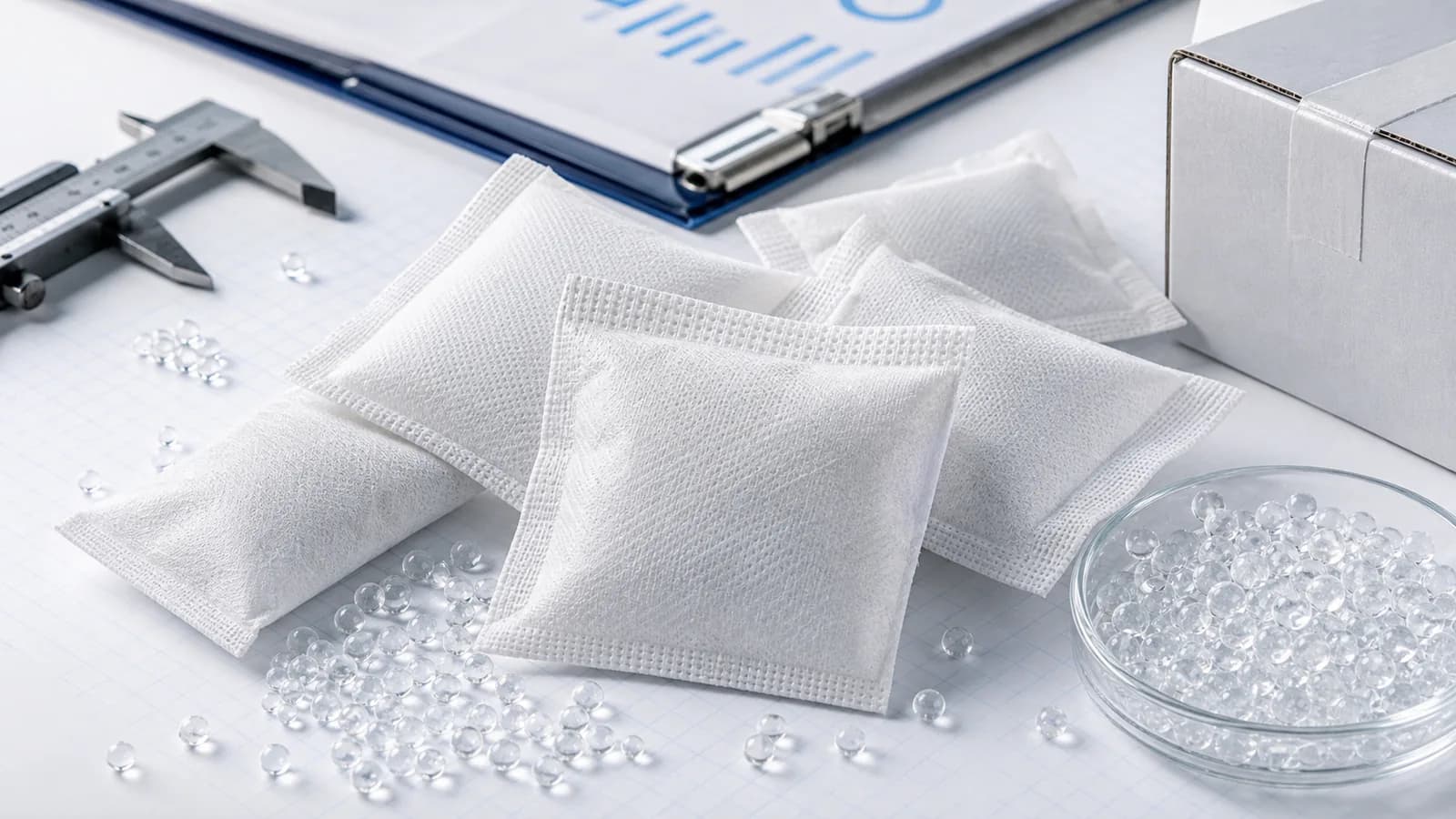
Unused silica gel does not expire chemically
Silica gel is amorphous silicon dioxide - a stable, inert material that does not break down, oxidise, or 'go off' the way a chemical reagent might. In that sense unused silica gel has effectively unlimited shelf life. What actually limits it is not chemistry but exposure: silica gel adsorbs moisture from the air around it, so stock left exposed slowly fills with ambient humidity and loses adsorption capacity before it is ever packed. Shelf life is therefore really a question of how well the stock is sealed, not how old it is.
- Silica gel is inert SiO2 - it does not chemically expire.
- The real limit is moisture exposure, not age.
- Exposed stock silently loses capacity to ambient humidity.
- Shelf life = seal integrity, not a date.
Sealed packaging is what protects capacity
Bulk silica gel is shipped in moisture-barrier packaging - typically foil or heavy polyethylene bags - precisely so it keeps its capacity in storage. While that packaging is intact and airtight, the stock inside stays close to full adsorption capacity for years. Manufacturers often quote a shelf life of around two to three years in original sealed packaging, but that figure assumes the seal is unbroken; a punctured or poorly sealed bag can lose meaningful capacity in weeks in a humid warehouse. Inspect incoming stock for intact seals and store unopened bags as received.
- Bulk gel ships in foil / heavy PE moisture-barrier bags.
- Intact sealed stock holds capacity for years.
- Typical quoted shelf life: ~2-3 years in original sealed packaging.
- A broken seal can lose capacity in weeks in humid conditions.
- Inspect incoming seals; store unopened bags as received.
Once a bag is opened, the clock starts
The moment a bulk bag or sachet carton is opened, the stock begins exchanging moisture with the surrounding air. In a dry, air-conditioned room this is slow; in a hot, humid port-city warehouse it is fast. Best practice is to open only what you will use in the current packing run, and to reseal partially used bags immediately - squeeze out air and clip or heat-seal them. Decanting working quantities into a small airtight container at the packing station keeps the main stock sealed while still giving the line easy access.
- Opening a bag starts moisture exchange with room air.
- Humid warehouses saturate opened stock much faster.
- Open only what the current run needs.
- Reseal partially used bags immediately (squeeze out air).
- Decant working quantities; keep main stock sealed.
How to store silica gel stock in a warehouse
For warehoused desiccant stock, the storage rules are the same ones you apply to the cargo it protects. Keep bags in a cool, dry area off the floor on pallets, away from direct sun and from sources of humidity such as open doors, wash areas, or condensation-prone walls. Avoid temperature cycling, which drives condensation. If your facility is in a high-humidity climate, a dedicated sealed store or even a few large desiccant bags inside the storage area help protect opened stock. Treat silica gel inventory as moisture-sensitive, because it is.
- Cool, dry area; pallets off the floor.
- Away from sun, open doors, wash areas, and damp walls.
- Avoid temperature cycling (it drives condensation).
- High-humidity sites: use a dedicated sealed store.
- Treat desiccant inventory as moisture-sensitive cargo.
Stock rotation and checking capacity
Run silica gel inventory on first-in-first-out rotation so older sealed stock is used before newer stock, and label received dates on bulk bags. To check whether stored stock is still good, indicating gel is the easiest tell - if orange beads have shifted toward green, that batch has picked up moisture. For non-indicating white stock, a simple weight check against fresh gel, or a quick humidity test in a sealed container, confirms capacity. If a batch has partly saturated in storage, it is not wasted - it can usually be reactivated rather than discarded.
- Use FIFO rotation; label received dates on bulk bags.
- Indicating gel: colour shift reveals moisture pickup.
- Non-indicating: weight check or quick humidity test.
- Partly saturated storage stock is reactivatable, not waste.
Reactivating stock that picked up moisture
Silica gel that has adsorbed moisture in storage can be regenerated by driving the water back off with heat. The general approach is to dry the beads in an oven at a moderate temperature for a few hours until capacity is restored; indicating gel returns to its dry colour as it regenerates. Always follow the supplier's grade-specific temperature guidance, since over-heating can damage some indicating chemistries, and avoid regenerating food-contact or pharma stock in shared equipment. For large volumes, factor reactivation time into your packing schedule or simply order fresh sealed stock closer to when you need it.
- Oven-dry beads at a moderate temperature to regenerate.
- Indicating gel returns to its dry colour when reactivated.
- Follow grade-specific temperature guidance from the supplier.
- Don't regenerate food/pharma stock in shared equipment.
- For big volumes, plan reactivation time or order fresh stock just-in-time.
References
- Silica (silicon dioxide, SiO2) — compound summary, CID 24261 , National Institutes of Health (PubChem)
- DIN 55473:2021-07 — Auxiliary means of packaging - Desiccant in bag - Technical delivery conditions , DIN Media (German Institute for Standardization)
- NWS Glossary — Relative humidity , NOAA National Weather Service
- Drying and Preserving Plant Materials for Decorative Uses (CIR495/EP004) , UF/IFAS Extension, University of Florida