
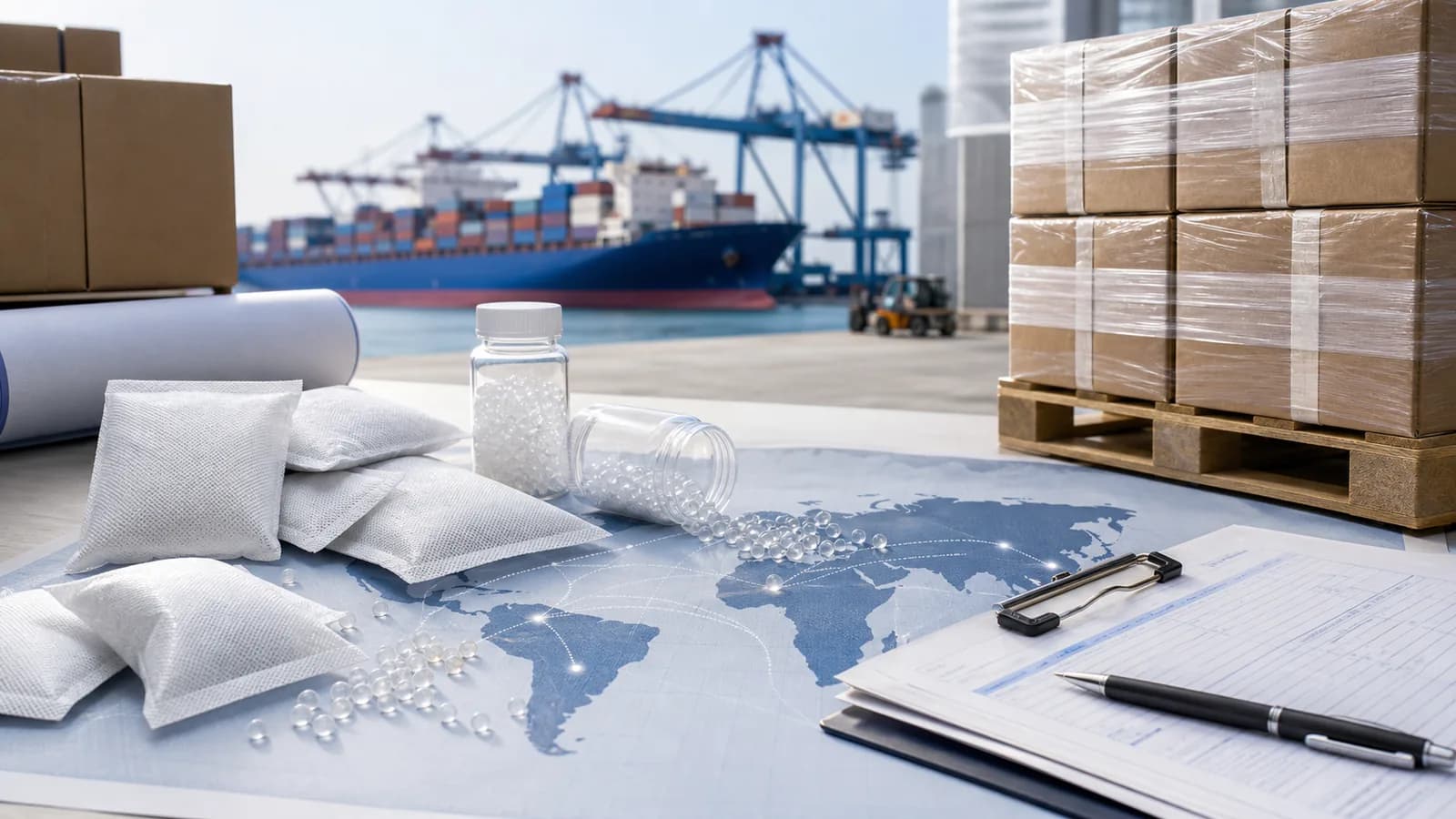
Why bagged food commodities are high-risk cargo
Rice, wheat, pulses, spices, and dried produce are hygroscopic - they hold and exchange moisture with the air around them. Packed in jute or PP bags and stacked in a steel container across humid sea routes, they face condensation ('container rain') as temperatures cycle between day and night and between climate zones. Trapped moisture drives mould growth and, in grains and nuts, the conditions that allow aflatoxin-producing moulds to develop - a leading cause of rejected and downgraded food shipments. Desiccant protection is not a luxury for these cargoes; it is rejection-risk insurance.
- Grains, pulses, spices, dried produce are hygroscopic.
- Temperature cycling in containers causes condensation ('container rain').
- Trapped moisture drives mould and aflatoxin-favouring conditions.
- Mould/aflatoxin is a top cause of rejected food shipments.
- Desiccant = rejection-risk insurance for food commodities.
Container desiccants do the heavy lifting
For bagged food commodities the primary defence is container-level desiccant: high-capacity desiccant bags or poles (typically 1kg-2kg units) hung along the container walls or placed between the cargo and the doors. These manage the large volume of humid air inside the container that condenses onto the ceiling and walls and drips back onto the top bags. Silica gel and calcium-chloride blends are both used here; silica gel is inert, non-leaking, and predictable, which matters when the desiccant sits directly against food packaging. The goal is to keep container-air humidity below the dew point so condensation never forms.
- Primary defence: container desiccant bags/poles (1kg-2kg units).
- Hung on walls / placed near doors to control container air.
- Stops ceiling and wall condensation dripping onto top bags.
- Silica gel is inert and non-leaking against food packaging.
- Target: keep container humidity below the dew point.
How much desiccant per container
Sizing depends on cargo moisture content, route humidity, and voyage length, but working starting points help. A standard 20ft container of bagged dry commodity typically uses roughly 4-8 desiccant units of 1kg-2kg, and a 40ft container roughly 8-16, increased for long tropical-to-temperate routes and for cargo with higher residual moisture. Very moisture-active cargo (freshly milled grain, high-moisture spices) needs the upper end. Always validate on a first shipment by checking the desiccant condition and cargo on arrival, then tune the quantity for that route rather than carrying the same number blindly every time.
- 20ft bagged dry commodity: roughly 4-8 units of 1-2kg.
- 40ft: roughly 8-16 units; more on long tropical routes.
- High residual-moisture cargo → upper end of the range.
- Validate on the first shipment, then tune per route.
- Don't carry a fixed number blindly across different routes.
Food-contact rules: keep it in the air, not in the food
For loose food commodities the safe pattern is to control the air and packaging environment, not to mix desiccant into the food itself. Container desiccant bags hang in the container space; they are not buried in the grain. Where sachets are used inside retail or export packaging, use a food-appropriate grade and keep the sachet separated from direct loose-food contact by the packaging structure. Plain silica gel is inert, but food-grade documentation and any direct-contact decision is a compliance question to settle with your buyer and destination regulator before shipping - specify it in the RFQ.
- Control the air/packaging environment, not the food mass.
- Container desiccants hang in the space, not buried in grain.
- In-pack sachets: food-appropriate grade, separated by packaging.
- Direct-contact and food-grade status = a compliance decision.
- Settle grade and documentation with buyer/regulator in the RFQ.
Packaging and loading practices that multiply the effect
Desiccant works best alongside good loading discipline. Make sure commodities are within safe moisture content before bagging - desiccant manages transit humidity, it cannot dry out cargo that was loaded wet. Use breathable but barrier-appropriate bags, avoid loading after rain, and where the cargo value justifies it, line the container or use kraft/poly cover sheets under the ceiling to intercept drips. Place container desiccants high and near the doors where condensation concentrates. These practices cost little and significantly cut the moisture load the desiccant has to handle.
- Load cargo at safe moisture content - desiccant isn't a dryer.
- Avoid loading after rain; keep bags and floor dry.
- Consider container liners or cover sheets for high-value cargo.
- Place desiccants high and near the doors (condensation zone).
- Good loading reduces the moisture load on the desiccant.
Indicating gel and arrival verification
For high-risk food-commodity routes, a small amount of indicating silica gel gives the receiving buyer a visual check that moisture control held during transit - useful for QC sign-off and for resolving disputes without lab testing. Prefer cobalt-free orange indicating gel near food packaging. On arrival, inspect the container ceiling for condensation marks, check the desiccant saturation, and sample top-layer bags for any musty smell or clumping. Feeding that arrival data back into your sizing keeps each route dialled in and steadily lowers rejection risk over a season of shipments.
- Indicating gel gives buyers a visual transit-moisture check.
- Use cobalt-free orange indicating gel near food packaging.
- On arrival: inspect ceiling, desiccant saturation, top-layer bags.
- Feed arrival data back into sizing for each route.
- Iterating per route steadily lowers rejection risk.