
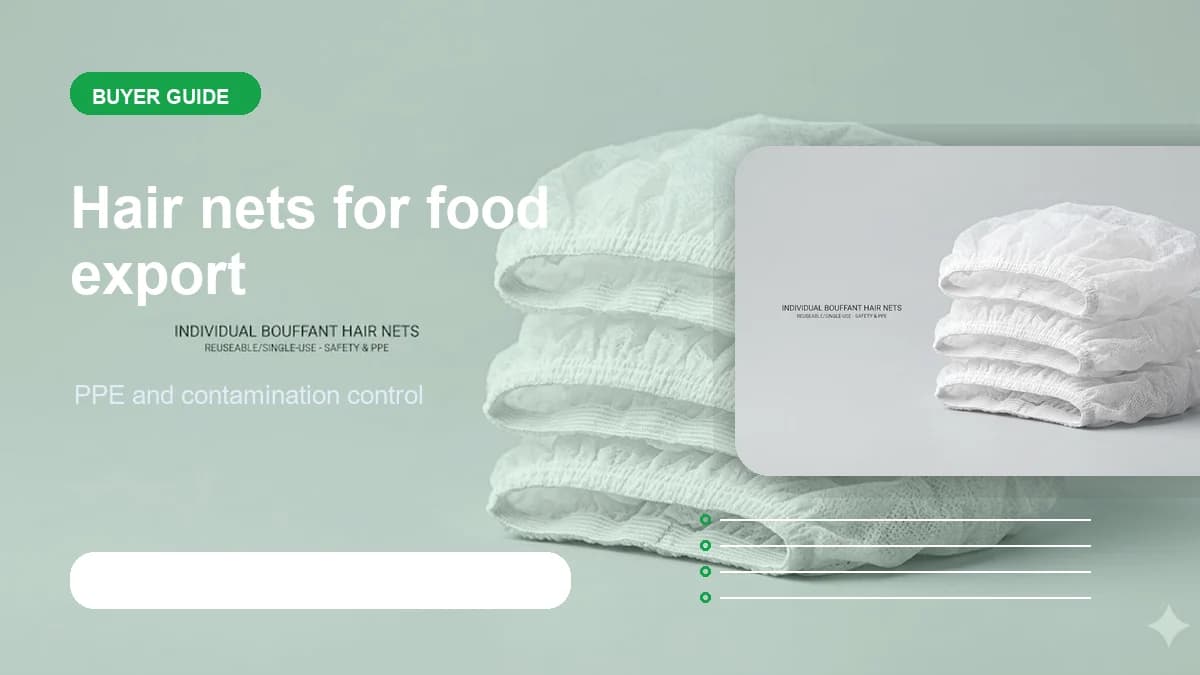
Why hair containment is part of the food export checklist
Hair nets and beard covers are not optional PPE in food processing - they are a regulator-driven control on physical contamination. Loose hair, eyebrow hair, and beard hair are among the most commonly cited contaminants in food-safety audits, and importing markets like the EU, UK, US, and the GCC explicitly require visible PPE compliance during processing and packaging. For exporters, the question is rarely 'do we use hair nets' - the question is which size, which color zone, what carton count, and which compliance evidence the destination market expects. Building hair-containment PPE into your export program protects against shipment rejection, audit findings, and the harder-to-quantify reputation cost of a contamination event.
- Loose hair is among the most-cited physical contaminants in food-safety audits.
- EU, UK, US, and GCC markets all expect visible PPE compliance during food handling.
- Hair containment is required during processing AND packaging, not just one stage.
- Beard covers are a separate control from hair nets - both are needed where facial hair is present.
- Audit findings on missing PPE can hold a shipment at port even if the cargo itself is clean.
Color zoning: green vs white in a production facility
Most food and manufacturing facilities use color zoning to visually separate production areas - for example, raw meat zones from packaging zones, or low-care zones from high-care zones. Hair nets are color-coded to match. Green is commonly used to mark a designated zone (raw, low-care, or a specific line), and white is the general-use default. The point is that a worker walking into the wrong zone in the wrong color cap is visibly out of place - supervisors and auditors can spot the breach instantly. DryGelWorld supplies bouffant hair nets in both green and white. When sizing an order, buyers should think about how many people work in each zone and order the carton mix accordingly, not just a flat split.
- Green: commonly used to mark a designated zone (raw materials, low-care, or a specific production line).
- White: general-use default for most production hygiene programs.
- Other industry colors (blue, red): used by some facilities for specific zone codes - confirm the buyer's color standard before ordering.
- Order mix should match headcount per zone, not a flat 50/50 split.
- Color zoning works best when paired with matching beard cover colors.
Hair nets and beard covers as a pair, not separate buys
Hair nets cover the head; beard covers contain facial hair. Many buyers under-order beard covers because they only think about hair-on-head when planning PPE - but any worker with facial hair needs both. As a rough planning rule, expect 30-50% of male workers to need beard covers, depending on the workforce demographic. Order the two products together so the per-shift distribution is balanced. Mixing brands or carton-count formats across hair nets and beard covers also creates inventory friction at distribution time, so consistency matters.
- Plan beard cover quantity at 30-50% of male workforce headcount as a starting estimate.
- Hair nets and beard covers should be sourced together to keep distribution simple.
- Match carton counts across both products (e.g., both at 100/carton or both at 1000/carton) to simplify inventory.
- Color-match where possible: green hair net with white beard cover, or vice versa, can also be used as a zone signal.
- Don't substitute hair nets for beard covers - the elastic fit is different and the containment outcome is different.
Sizing: 18, 20, 21, 22 inches and what they actually mean
Bouffant hair nets are described by their flat-laid diameter - 18, 20, 21, or 22 inches. The number is not the head circumference; it's the gathered flat measurement before elastic. As a working guide: 18 inch is for smaller heads and snug fit (pediatric, slim build, lab-tight requirement); 20 inch is the most common production-line size and fits most adult workers comfortably; 21 inch is a mid-range option that allows for hair volume; 22 inch is preferred where workers have longer or thicker hair, or where the facility wants extra coverage and slack. For volume buyers, 20 and 22 are usually the best two sizes to stock. Smaller orders can use a single 21 inch size as a one-size-fits-most.
- 18 inch: smaller heads, snug fit, lab and pediatric use.
- 20 inch: most common production-line size, fits most adult workers.
- 21 inch: mid-range universal option for smaller orders.
- 22 inch: longer or thicker hair, extra slack, broader fit.
- Volume buyers: stock 20 and 22 as the primary two sizes.
- Custom diameters can be discussed for specific brand or workforce requirements.
Documentation: what to expect, what NOT to expect
Industrial-safety hair nets and beard covers are typically supplied as PPE without formal food-grade certification by default - even though they are widely used in food production. Formal food-grade certification (FDA compliance, FSSC 22000, EU Regulation 1935/2004) is a separate certification track that depends on the manufacturer's facility audit, not just the product itself. A reputable supplier should be able to confirm: ISO 9001:2015 (or equivalent quality system), material datasheet identifying non-woven polypropylene, and any specific destination compliance discussions. What buyers should NOT expect from generic industrial-safety PPE: assumed FDA approval, assumed Halal certification, or assumed REACH registration. Confirm those discussions per buyer market before commercial terms - do not assume coverage.
- Expect: ISO 9001:2015 or equivalent quality reference.
- Expect: material datasheet identifying non-woven polypropylene or specified material.
- Expect: discussion of compliance per buyer market.
- Do NOT assume: FDA approval, FSSC 22000 alignment, EU 1935/2004 compliance, Halal certification, REACH registration - confirm explicitly per shipment.
- Pharma cleanroom programs (ISO 13485, EN ISO 14644 alignment): require explicit confirmation; do not assume from a general industrial PPE supply.
Common mistakes when buying PPE at export scale
Three mistakes show up repeatedly in B2B PPE procurement. First: ordering only one size. A flat 22-inch order under-fits a third of the workforce and over-fits another third. Order at least two sizes for any production-line program. Second: under-ordering beard covers. Buyers think about hair-on-head and forget that any worker with facial hair needs separate containment. Third: assuming color is interchangeable. Green and white serve different purposes in zone-coded facilities; ordering whichever is cheapest defeats the purpose of having color zoning at all. The fourth, less common but more expensive, is assuming food-grade compliance from generic industrial PPE - which can hold a shipment at port if a destination auditor asks for the certification paperwork.
- Mistake: ordering only one size of hair net.
- Mistake: under-ordering beard covers relative to workforce demographic.
- Mistake: ignoring color zoning when ordering.
- Mistake: assuming food-grade compliance without explicit certification confirmation.
- Mistake: mixing carton counts across hair nets and beard covers, which complicates distribution.
PPE alongside moisture control - a complete export program
For exporters who already buy silica gel desiccant for cargo moisture control, adding hair nets and beard covers to the same RFQ flow is a small lift with a real benefit. Sourcing PPE and moisture control products from the same supplier means one set of commercial terms, one set of documents, one shipment plan, and one Incoterm conversation - instead of three. DryGelWorld supports both desiccant programs (silica gel sachets, dry clay packs, container strips) and PPE supply (bouffant hair nets, beard covers) under one buyer relationship. For buyers building a complete food-export or manufacturing-export supply chain, the combined RFQ saves coordination overhead.
- Combined RFQ: silica gel + dry clay + hair nets + beard covers in one supply program.
- Single Incoterms negotiation across desiccant and PPE.
- One document set covers both product lines.
- Same dispatch schedule, same carton planning, same destination support.
- Tier the program: desiccant for cargo, PPE for the production line that loads the cargo.