
PPE procurement is process design, not a shopping list
B2B PPE buying is often handled as a commodity purchase - a procurement team gets a request, places an order, ships boxes. The shipments that actually reduce contamination, accident, and audit risk treat PPE as a process design problem instead. The questions that matter: which production zones need which PPE, what color zoning prevents cross-contamination, what disposable-vs-reusable economics make sense at your shift volume, what documentation the destination market actually requires, and which suppliers can repeat the same specification across recurring orders. Getting these right at the procurement stage is cheaper than fixing them after an audit finding.
- PPE is part of a contamination-control process, not a shopping line item.
- Zone design (where each PPE type is required, where it isn't) matters as much as product selection.
- Disposable-vs-reusable economics break differently above and below ~50-employee shifts.
- Documentation expectations vary by destination market - confirm before commercial terms.
- Supplier reliability for repeat supply matters more than first-shipment price.
The PPE categories most B2B factories actually need
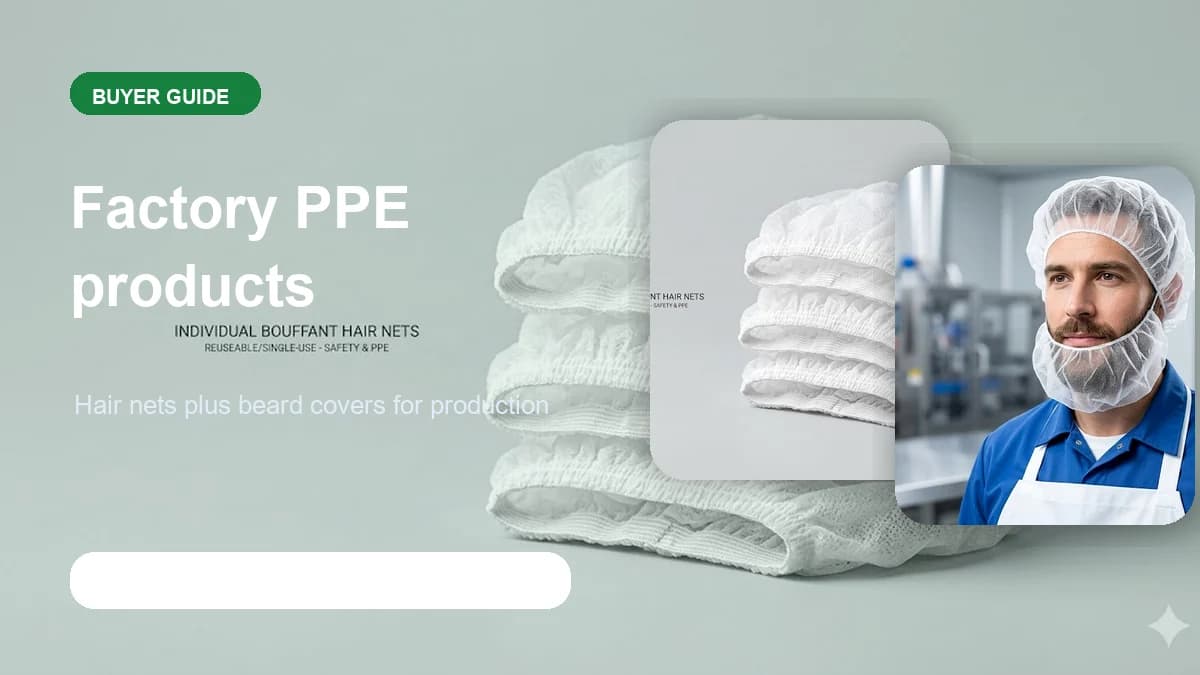
Industrial PPE programs typically cover four categories: hair containment (bouffant hair nets), facial-hair containment (beard covers), hand protection (gloves), and respiratory protection (masks). DryGelWorld currently supplies the first two - bouffant hair nets in 18/20/21/22 inch diameters across green and white, and disposable beard covers. The other two (gloves and masks) are not currently in the catalog. Buyers building complete PPE programs should plan supply across all four categories, even if sourcing from multiple suppliers - gaps in coverage create the contamination risk PPE is meant to prevent.
- Hair containment: bouffant nets in 18/20/21/22 inch diameter, green or white - DryGelWorld supplies these.
- Facial-hair containment: disposable beard covers - DryGelWorld supplies these.
- Hand protection: nitrile, latex, or vinyl gloves - sourced from PPE specialists; not currently in DryGelWorld catalog.
- Respiratory protection: masks (surgical, FFP1, FFP2, FFP3) - sourced from PPE specialists; not currently in DryGelWorld catalog.
- Apron / coverall / shoe cover: secondary controls; sourced from PPE specialists.
Color zoning: the cheapest contamination-control tool
Color zoning uses different PPE colors in different production zones to visually separate areas and prevent worker movement-driven cross-contamination. The classic food-processing application: green PPE in the raw-meat zone, white PPE in the finished-product zone - a worker who walks from raw to finished is immediately visible by their PPE color. Zone color codes are arbitrary by industry, but consistency within a facility matters. Establishing the zoning system at PPE procurement stage is much cheaper than retrofitting it after an audit finding. DryGelWorld stocks bouffant hair nets in green and white precisely to support this zoning use case.
- Food processing: typically green for raw zones (meat, vegetable prep), white for finished/packaging zones.
- Manufacturing: zoning is facility-specific; common pattern is white for general production, blue/red for higher-risk or QC zones.
- Pharma / healthcare: typically white throughout, with color used for visitor / contractor identification.
- Cleanroom: white default, with cleanroom-grade Tyvek replacing standard non-woven for higher-class environments.
- Color zoning is consistent within a facility - switching mid-shift defeats the purpose.
Sizing hair nets and beard covers across your workforce
Hair net diameter is sized to head size, and a multi-size production line ordering only one diameter creates an uncomfortable workforce - which leads to nets being worn improperly or not at all. Standard production lines benefit from carrying at least two diameters: 20 inch and 22 inch covers most adult head sizes; 18 inch fits smaller heads or workers who prefer a snug fit; 21 inch is a mid-range option. Beard covers are typically one-size with elastic edges so sizing is less critical, but quantity planning is - beard covers should be planned at roughly 30-50% of male workforce headcount, depending on facial-hair demographic. Under-ordering beard covers is one of the most common B2B PPE procurement mistakes.
- Hair net diameter: stock 20 inch and 22 inch as defaults; add 18 inch for smaller heads, 21 inch for mid-range.
- Beard cover quantity: ~30-50% of male workforce headcount per shift.
- Daily consumption: ~1-2 hair nets per worker per shift (depending on shift length and contamination risk).
- Carton planning: standard cartons hold 100 or 1000 pieces - order by monthly consumption forecast.
- Buffer stock: maintain ~2 weeks of supply on-site to absorb supply chain hiccups.
Document expectations vary by market
PPE documentation expectations vary substantially by destination market. ISO 9001:2015 is the most universally recognized baseline, and DryGelWorld holds this. Beyond that, EU markets often expect EN 14126 or similar PPE-specific compliance, US food markets expect FDA / FSSC 22000 alignment, GCC markets may expect SASO or ESMA alignment, and pharma cleanroom programs may expect ISO 13485. These market-specific credentials are not currently held for the DryGelWorld PPE line. Buyers requiring stamped market-specific compliance should confirm the documentation set at RFQ stage so the supplier and the buyer's compliance team can align before sample dispatch.
- ISO 9001:2015 - held; baseline quality system reference.
- EN 14126 (EU PPE compliance) - not currently held.
- FDA / FSSC 22000 (US food) - not currently held.
- SASO / ESMA (GCC) - not currently held.
- ISO 13485 (medical device / cleanroom) - not currently held.
- Confirm documentation set at RFQ stage - don't assume coverage of un-held credentials.
Disposable vs reusable: the economics break around 50 workers
Disposable PPE (single-use hair nets and beard covers) dominates B2B procurement because the per-unit cost is low and the labor cost of laundering reusable PPE adds up quickly. The economics start to flip around 50-100 employees per shift, where disposable consumption scales linearly but reusable laundering costs scale sub-linearly. Above ~100 employees, some facilities consider reusable PPE programs with industrial laundering contracts. Below that threshold, disposable almost always wins on total cost. DryGelWorld supplies disposable hair nets and beard covers - buyers above the threshold should evaluate reusable PPE specialists alongside the disposable program rather than instead of it.
- Under 50 employees per shift: disposable almost always wins on total cost.
- 50-100 employees: depends on shift count, contamination risk, and labor cost of laundering.
- Above 100 employees: reusable PPE worth evaluating with industrial laundering specialists.
- Most facilities use BOTH: disposable for high-turnover zones, reusable for stable workstation PPE.
- DryGelWorld's hair nets and beard covers are disposable / single-use; reusable PPE is not in the current catalog.
Supplier selection checklist
PPE procurement reliability matters more than first-shipment price for any program above a few hundred dollars per month. A good PPE supplier should: (1) ship consistent specification across orders - same material, same size, same color; (2) supply the documentation set the destination market requires; (3) handle private-label and carton printing if needed; (4) maintain stock to support unplanned demand spikes; (5) ship reliably on agreed Incoterms. Compare suppliers on these five dimensions, not on per-unit price alone. The cheapest PPE supplier is almost never the most reliable, and supply interruptions cause more economic damage than the price difference between cheapest and best supplier.
- Specification consistency - can the supplier repeat the exact same product across recurring orders?
- Documentation - can they supply the SDS, COA, ISO, and market-specific docs the destination requires?
- Private-label capability - can they print carton labels in the buyer's language and brand?
- Stock and lead time - can they support demand spikes and meet agreed delivery windows?
- Reliability on Incoterms - FOB / CIF / DAP, port handover, and dispatch communication.