
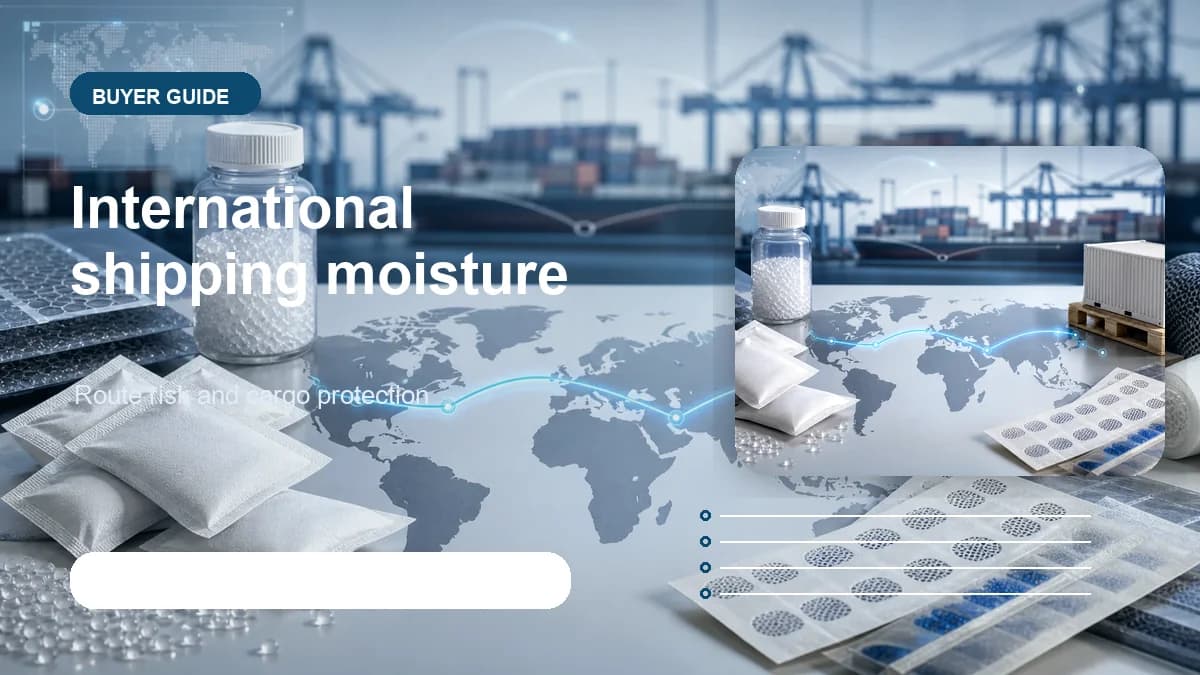
Moisture damage is the export risk most buyers under-budget
International export buyers spend significant time negotiating Incoterms, freight rates, and customs documentation - and dramatically less time on moisture protection, which is often the single biggest non-loss-non-damage cost driver in long-haul shipping. A 40-foot container of leather goods can absorb enough humidity during a 25-day tropical-to-temperate voyage that 5-20% of the cargo arrives unsalable. Insurance covers the cost, but the time, reputation, and customer-relationship damage doesn't recover quickly. Moisture protection is fixed insurance overhead, not a variable line item to negotiate down at quote time.
- Moisture damage is the most common non-physical cargo loss type in long-haul ocean freight.
- Insurance covers cost; doesn't cover delayed shipment, customer-relationship damage, or repeat-buyer loss.
- Per-shipment moisture protection cost runs 0.3-1% of cargo value; per-claim cost runs 5-20% of cargo value plus carrier fees.
- Prevention-to-damage ratio is roughly 1:20 to 1:40 - the cheapest insurance in international shipping.
Route risk profiles - knowing your worst case
Not all international shipping routes carry the same moisture risk. Tropical-to-temperate routes (Karachi → Hamburg, Mumbai → Rotterdam, Ho Chi Minh → NYC) are the worst case because they cycle the dew point dozens of times. Trans-Pacific routes (Karachi → Vancouver, Shanghai → LA) add Pacific storm exposure on top of climate-zone shifts. Cross-equator routes cycle twice through the ITCZ. Intra-region routes (Karachi → Jebel Ali, Karachi → Jeddah) are short and lower-risk but not zero-risk. Knowing your route's worst case lets you size desiccant correctly instead of using the same program for every lane.
- Tropical-to-temperate long-haul (Karachi → Hamburg, ~25 days): 25-40 condensation cycles, highest carton risk.
- Trans-Pacific (Karachi → Vancouver, ~30 days): Pacific storm cycling adds extra cargo stress.
- Cross-equator (Karachi → Sydney, ~22 days): ITCZ crossings cycle dew point twice.
- Intra-region (Karachi → Jebel Ali, ~7 days): lower risk but still meaningful for moisture-sensitive cargo.
- Trans-Atlantic (Karachi → US East Coast, ~30 days): Atlantic storm exposure layered onto climate-zone shifts.
Layered desiccant programs - three tiers that compound
Effective moisture protection for international shipping is a three-tier program, not a single-product purchase. Tier 1 is the unit pack: 0.5g-5g silica gel sachets inside each consumer-facing pack or antistatic bag. Tier 2 is the carton: 10g-50g sachets or bead bags inside each master carton, managing the carton-level air pocket. Tier 3 is the container: 1kg-5kg multi-chamber strips hung at the container ceiling, where condensation cycles peak. Each tier solves a different problem; layering them gives the cargo the protection it actually needs.
- Tier 1 (unit pack): 0.5g-5g silica gel inside each product pack or antistatic bag.
- Tier 2 (carton): 10g-50g silica gel or dry clay in each master carton.
- Tier 3 (container): 1kg-5kg cargo strips at container ceiling.
- Optional Tier 4 (pallet): 100g-250g supplementary bag at pallet base for high-value programs.
- VCI paper or emitter for cargo with exposed metal surfaces - complements, doesn't replace, desiccant.
Silica gel vs dry clay - when each wins
Both silica gel and dry clay desiccant work for international shipping. The choice depends on cargo profile and budget. Silica gel adsorbs ~33% of its weight in water vapor - roughly 35% more efficient per gram than typical clay desiccant (~24-28%). Silica gel is the right choice for precision cargo (electronics, leather, pharma) and high-value programs where damage cost is high. Dry clay is cost-effective for industrial durable goods on shorter routes where moisture risk is mild oxidation. Many established export programs use both - clay at cost-tier carton level, silica gel at precision-tier carton level and at the container ceiling.
- Silica gel: ~33% adsorption capacity, broad RH range, cleaner document story, higher per-kg cost.
- Dry clay: ~24-28% adsorption, lower per-kg cost, suitable for cost-tier industrial cargo.
- Long-haul tropical-to-temperate routes: silica gel almost always wins on per-unit-of-protection economics.
- Short intra-region routes for industrial durable goods: dry clay is the cost-effective choice.
- Mixed programs combining both materials are the most common pattern in mature export operations.
Pre-load workflow that prevents claims
Most moisture-damage claims that go to arbitration fail not because the desiccant was wrong, but because the loading workflow was undocumented. A claim-defensible workflow is mechanical: humidity-check incoming cargo at receiving, inspect pallets for damp wood, place sachets at unit and carton level by documented dosage, seal cartons, hang container-level strips, photograph the loading, seal the container, dispatch with a packing list naming the desiccant format and quantity. The workflow itself is cheap; the claim-defense it provides is priceless.
- Step 1: Humidity-check incoming cargo; reject above-threshold material (typically 12-14% moisture content for woven goods).
- Step 2: Inspect pallets (kiln-dried or plastic only); reject damp or split wood.
- Step 3: Place sachets at unit and carton level by documented dosage; record per-carton.
- Step 4: Seal carton with date and packer ID label.
- Step 5: Hang container-level cargo strips at ceiling line.
- Step 6: Photograph loading; record container seal number.
- Step 7: Dispatch with packing list naming desiccant format, total quantity, and placement.
Documentation that defends a moisture claim
When a moisture-damage claim hits the carrier or underwriter, the evidence pack determines whether the shipper recovers. Standard pack: an SDS confirming the desiccant is non-toxic, non-flammable, and DMF-free; a COA tying the desiccant batch to the shipment; an ISO 9001:2015 quality reference for the manufacturer; dated loading photos showing strip placement and seal number; and a packing list that names desiccant format and quantity per carton. DryGelWorld supplies the SDS, COA, ISO 9001:2015 reference, and DMF-free statement on request. The photo log and packing list are the shipper's responsibility but cheap to maintain.
- SDS - non-toxic, non-flammable, DMF-free confirmation.
- COA - batch quality tied to shipment date.
- ISO 9001:2015 reference - manufacturer credibility.
- Loading photo log - placement, quantity, seal, date.
- Packing list with desiccant detail - quantifies what went into the box.
- Voyage temp/humidity log from carrier (where available) - supports condition-of-cargo defense.
Cost reality - desiccant is the cheapest insurance you can buy
For a typical international export program, moisture protection costs run 0.3-1% of cargo value. For a USD 80,000 container of leather goods, that's USD 240-800. A single rejected shipment for moisture damage costs USD 4,000-16,000 plus carrier fees, plus the harder-to-quantify cost of customer-relationship damage and lost repeat business. The math is not subtle: moisture protection is the highest-ROI line item in most export programs, yet it's the one most often skipped or under-specced because the upside (no damage) is invisible until the downside hits.
- Per-shipment desiccant cost: 0.3-1% of cargo value.
- Per-claim moisture damage cost: 5-20% of cargo value plus carrier fees + reputational damage.
- Prevention-to-damage ratio: 1:20 to 1:40.
- Moisture protection is fixed insurance overhead, not a variable cost to negotiate down.
- Programs that under-spec desiccant 'to save money' lose more on a single rejected shipment than they would have spent on prevention across a full year.