
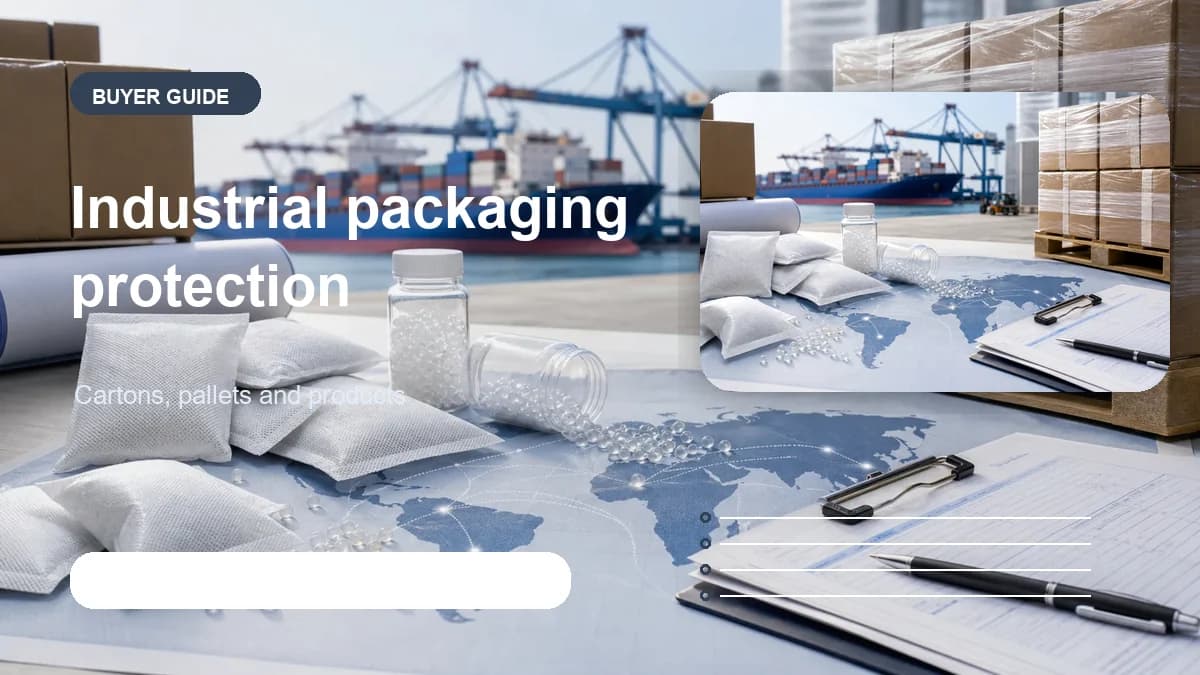
Industrial packaging protection is a system, not a product
When industrial exporters think 'packaging protection,' the conversation often defaults to one product - desiccant sachets, or stretch wrap, or VCI paper. The reality is that effective B2B industrial packaging is a layered system, where each layer addresses a different threat: moisture, corrosion, physical shock, contamination, theft, and regulatory compliance. Designing the system means deciding which threats apply to your cargo, what controls address each threat, and how the documentation ties the whole program together for QC, insurance, and audit purposes. Single-product thinking under-protects high-value cargo; system-thinking is what separates mature export programs from amateur ones.
- Six threat categories: moisture, corrosion, physical shock, contamination, theft, regulatory non-compliance.
- Each threat needs a dedicated control - single-product thinking under-protects.
- Documentation ties the system together for QC, insurance, and audit purposes.
- Mature export programs design the system once and reuse it; amateur programs improvise per shipment.
Moisture control - the largest non-physical threat
For most B2B industrial cargo, moisture damage is the single largest source of non-physical loss. The control program runs three tiers: silica gel sachets inside unit packs (0.5g-5g per pack), larger sachets or bags inside master cartons (10g-50g per carton), and 1kg-5kg multi-chamber strips at the container ceiling. Material choice (silica gel vs dry clay) depends on cargo value and route - silica gel for precision and high-value cargo, dry clay for cost-tier industrial durable goods. Total cost runs 0.3-1% of cargo value; prevention-to-damage ratio is 1:20 to 1:40.
- Three-tier desiccant program: unit pack + carton + container.
- Silica gel for high-value cargo (precision, leather, electronics, pharma).
- Dry clay for cost-tier industrial durable goods on shorter routes.
- Cost: 0.3-1% of cargo value; prevention-to-damage ratio 1:20 to 1:40.
- See /blog/best-desiccant-for-shipping-containers for full sizing math.
Corrosion control - what desiccant doesn't fix
Desiccant manages humidity but doesn't directly protect exposed metal surfaces from corrosive attack. For cargo with exposed metal - connectors, machine parts, automotive components, military hardware - pair desiccant with VCI (volatile corrosion inhibitor) paper or emitters. VCI works by releasing molecules that form a protective monolayer on metal surfaces, preventing oxidation even in trace humidity. VCI doesn't replace desiccant; it complements it. For high-value metal cargo on long-haul routes, the combination program is standard.
- Desiccant manages air humidity; VCI protects metal surfaces directly.
- VCI paper for wrapping individual parts; VCI emitters for cartons.
- Combine with desiccant - not a substitute for moisture control.
- Standard for: automotive parts, electronics with exposed connectors, machinery, military hardware.
- VCI is not in DryGelWorld's current catalog - sourced from specialist suppliers when needed.
Physical shock and bracing
Physical damage during transit comes from three sources: vibration (truck and rail), compression (carton stacking and pallet load), and impact (handling at ports). Controls: foam padding inside cartons for vibration-sensitive products, stretch-wrap and shrink-wrap for carton-to-pallet load consolidation, dunnage bags or wood bracing for container load stability, and proper pallet design for compression resistance. None of this is the desiccant supplier's domain - but it should be part of the integrated packaging program. Industrial buyers building complete protection programs should source physical-protection components from packaging specialists and coordinate with the desiccant supplier on dimensions and load placement.
- Vibration: foam padding, internal corners, suspension packaging for fragile cargo.
- Compression: pallet design, carton stacking limits, shrink-wrap for load stability.
- Impact: stretch-wrap, edge protectors, corner boards for handling resistance.
- Container stability: dunnage bags, wood bracing, void-fill material.
- Sourced from packaging specialists, not desiccant suppliers - coordinate dimensions at planning stage.
Contamination control - PPE and clean handling
For cargo in regulated industries (food, pharma, electronics, cosmetics), the packaging program includes contamination controls beyond the packaging itself. Worker PPE - hair nets, beard covers, gloves, masks - prevents hair and skin contamination during packing. Clean-room or clean-handling protocols prevent foreign-particle introduction during line operations. Material isolation (food zones vs non-food zones) prevents cross-contamination at the warehouse level. DryGelWorld supplies the PPE side of this program: bouffant hair nets (18"-22") and disposable beard covers in non-woven polypropylene.
- Worker PPE: hair nets + beard covers prevent hair/skin contamination during packing.
- Clean-handling protocols: gloves, hand-wash stations, line-area discipline.
- Material isolation: food vs non-food zones at the warehouse level.
- DryGelWorld supplies hair nets and beard covers - coordinate with desiccant supply in one program.
- Color zoning (green vs white PPE) for production-zone separation.
Theft, tampering, and seal integrity
For high-value industrial cargo on long-haul routes, tampering and theft control matters as much as moisture protection. Standard tools: tamper-evident container seals (numbered bolt seals or cable seals), GPS tracking devices on high-value containers, broken-cable or magnetic-disturbance alerts on premium freight, and warehouse-handover documentation with photo evidence. Like physical bracing, this isn't the desiccant supplier's domain - but the seal number should be recorded in the desiccant loading photo log so that a future tampering investigation can correlate the photo record with the seal-integrity record.
- Tamper-evident seals: numbered bolt seals or cable seals as the standard.
- GPS tracking: optional for premium-value containers.
- Photo evidence: load + seal at dispatch, integrity check at destination.
- Seal number recorded in desiccant loading log for correlation.
Documentation - the glue that holds the system together
Each protection layer has a documentation requirement. Desiccant: SDS, COA, ISO 9001:2015 reference. Corrosion control: VCI product specification and material safety information. Physical protection: pallet certification (ISPM-15 for international wood pallets), packaging specification per cargo unit. PPE: ISO 9001:2015 quality reference, market-specific compliance evidence (confirmed per market). Seal integrity: seal number record. Insurance: combined evidence pack including all of the above. When a damage claim happens, the underwriter looks for evidence that the shipper implemented appropriate controls - missing documentation is often the reason claims fail.
- Desiccant docs: SDS, COA, ISO 9001:2015 reference, DMF-free statement (where applicable).
- Pallet docs: ISPM-15 stamp for international wood pallets.
- PPE docs: ISO 9001:2015 reference; market-specific compliance per buyer requirement.
- Seal docs: numbered seal records, dispatch-to-destination correlation.
- Combined evidence pack: SDS + COA + pallet cert + loading photos + seal number + packing list.
Cost reality - protection is fixed overhead, not variable cost
Across the layered industrial packaging protection program, total cost typically runs 1-3% of cargo value for a full implementation. For a USD 80,000 industrial cargo shipment, that's roughly USD 800-2,400 in combined protection: desiccant + corrosion + physical bracing + PPE for the packing team. A single damaged or rejected shipment can cost 20-50% of cargo value. The math is consistent across the desiccant-only analysis: prevention-to-damage ratio of 1:10 to 1:30. The economic case for the full program is identical to the case for any individual layer - and skipping any single layer creates a weak point that the rest of the program can't compensate for.
- Total program cost: 1-3% of cargo value for full implementation.
- Damage cost: 20-50% of cargo value for major events.
- Prevention-to-damage ratio: 1:10 to 1:30.
- Skip any single layer → creates weak point others can't compensate for.
- Protection is fixed overhead, not variable cost to negotiate down.